
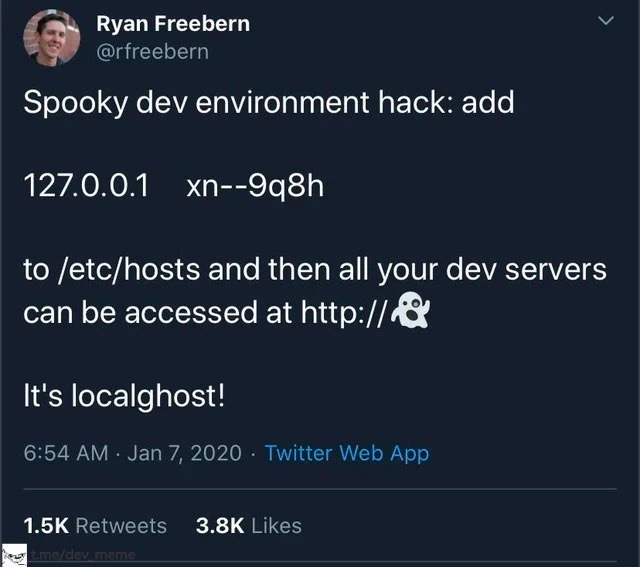
The 'Localghost' Punycode Trick
Description
A screenshot of a tweet from user Ryan Freebern (@rfreebern). The tweet, posted on January 7, 2020, presents a 'Spooky dev environment hack.' The text instructs the reader to add the line '127.0.0.1 xn--9q8h' to their /etc/hosts file, which will then allow them to access their dev servers at 'http://👻'. The punchline of the tweet is 'It's localghost!'. The image shows the tweet has received 1.5K retweets and 3.8K likes. The technical joke here relies on Punycode, an encoding that allows Unicode characters (like emojis) to be represented in the ASCII-only Domain Name System. The string 'xn--9q8h' is the Punycode representation of the ghost emoji (👻). By mapping this Punycode hostname to the 127.0.0.1 loopback address in the local hosts file, the user creates a clever alias for 'localhost', hence the pun 'localghost'. It's a sophisticated joke that appeals to senior developers who understand DNS, networking, and OS-level configurations


Comments
7Comment deleted
The best part about the localghost setup is that when something inevitably breaks, you can honestly tell your manager you're debugging a ghost in the machine
Just wait until infosec files a CVE because 👻.internal is technically a phishing domain - turns out even the loopback can haunt you in prod
The real horror is when you forget about this 'spooky' hosts entry six months later and spend three hours debugging why your monitoring alerts are showing '👻 is down' - and good luck explaining that one in the incident post-mortem when the CTO asks why production depends on a ghost emoji
Finally, a legitimate use case for Punycode that isn't phishing! Though explaining to your team why production is down because someone accidentally deployed the 👻 domain to prod might be the real horror story. At least when the intern asks 'where's the dev server?' you can now say 'it's in the machine' with full supernatural authority
Neat until your OAuth callback whitelist rejects xn--9q8h and you’re debugging CORS with a literal ghost in the host
Cute alias - until someone rsyncs /etc/hosts to staging and the ingress chokes on IDNA/SNI because the cert doesn’t cover 👻; that’s how 'works on my machine' becomes an incident
Pro tip: Map 💀 to staging next - nails that authentic 'prod is down' vibe without the pager