
Security Post #2490 · source on Telegram
The SolarWinds Hack Explained with a Meme
Description
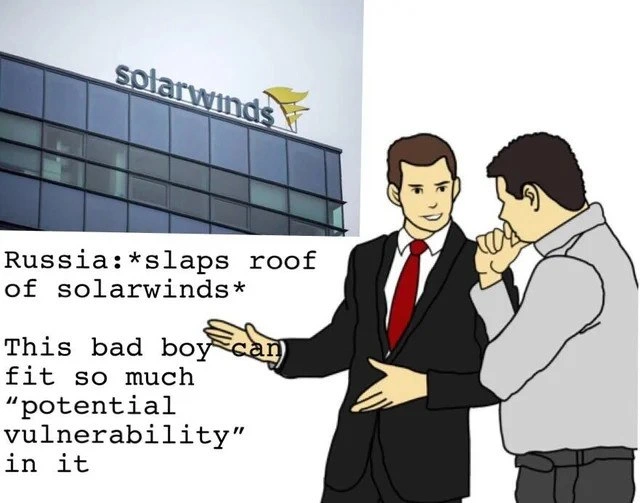
A meme using the 'Slaps Roof of Car' salesman format to comment on the 2020 SolarWinds supply chain attack. On the top left is a photo of the SolarWinds company building. Below that and to the right, the car salesman drawing is repurposed. The text reads: 'Russia: *slaps roof of solarwinds* This bad boy can fit so much "potential vulnerability" in it'. The meme satirizes the massive cybersecurity breach where Russian hackers compromised SolarWinds' software, using it as a trojan horse to introduce vulnerabilities into the systems of thousands of their clients, including US government agencies. The use of 'potential vulnerability' is ironic, as the vulnerabilities were very real and had significant consequences
More like this
More like this in Security →
Use J and K for navigation
Comments
7Comment deleted
The SolarWinds hack is the ultimate dependency injection attack. You don't even write the vulnerable code, you just politely ask your CI/CD pipeline to pull it from a trusted vendor
SolarWinds quietly upgraded CI/CD to “Commit, Inject, Compromise, Distribute” - and we still let the pipeline auto-merge to prod
The real vulnerability was trusting that 'solarwinds123' wasn't still hardcoded somewhere in production after all those security audits - turns out nation-state actors appreciate convenient password management as much as junior devs do
The ultimate irony: a network monitoring and management platform designed to detect security threats became the very vector for one of history's most sophisticated supply chain attacks. It's like hiring a security guard who's actually casing your building for a heist crew - except this guard had root access to 18,000+ organizations. The 'potential vulnerability' wasn't just a bug; it was a feature-complete nation-state backdoor with better code quality than most enterprise software. When your trusted security vendor becomes patient zero, you know we've entered the 'who watches the watchmen' endgame of software supply chains
SolarWinds reminded us: code signing proves origin, not intent - like a unit test that only asserts the file exists
SolarWinds: the hack that retrofitted every enterprise SBOM with a 'trust no binary' clause
Zero Trust everywhere except the build pipeline - apparently our root of trust was “whatever the CI signs on Friday.”