
The Glass House of Complaining About Legacy Work
Description
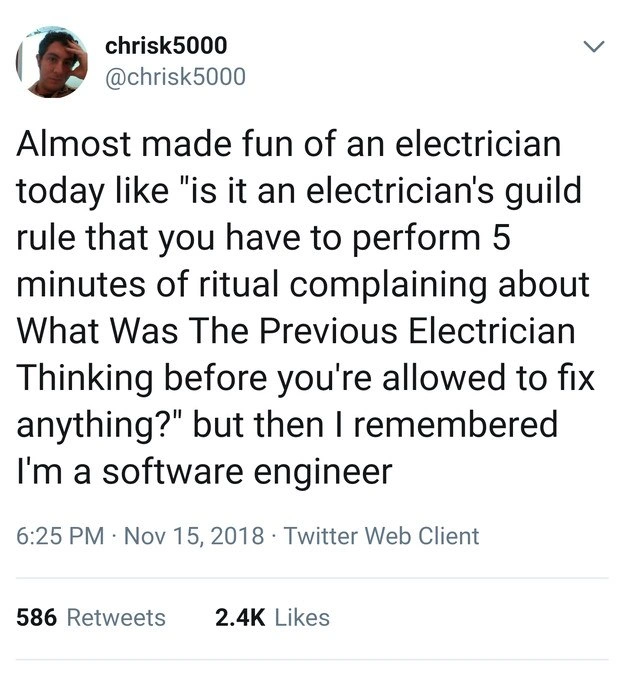
This image is a screenshot of a tweet from user Chris (@chrisk5000) posted on November 15, 2018. The tweet humorously recounts a moment of self-awareness: 'Almost made fun of an electrician today like "is it an electrician's guild rule that you have to perform 5 minutes of ritual complaining about What Was The Previous Electrician Thinking before you're allowed to fix anything?" but then I remembered I'm a software engineer'. The joke draws a direct and witty parallel between the common practice of skilled tradespeople criticizing a predecessor's work and the identical, deeply ingrained habit within software engineering culture. For senior developers, this is exceptionally relatable, as a significant portion of their work involves inheriting, debugging, and refactoring legacy codebases, which almost invariably begins with a period of lamenting the questionable decisions of the original authors. It's a moment of humorous introspection on the universal engineering experience of dealing with technical debt and confusing prior implementations


Comments
15Comment deleted
We call it the 'archaeological survey' phase: before you touch the legacy code, you must spend at least one sprint loudly cursing the name of the ancient architect who built the temple on a cursed burial ground
Step 1: run git blame, rant about the clown who cross-wired the service layer. Step 2: notice the commit author is “me, 2013.” Step 3: call it a legacy integration and move on - rewiring isn’t in the sprint
The real difference between electricians and software engineers? Electricians can actually trace the problem back to ground, while we're still trying to figure out why someone thought naming a variable 'data' in a 10,000 line class was acceptable documentation
Every codebase is legacy code written by an idiot - git blame just occasionally reveals the idiot had your SSH key
Every senior engineer knows the sacred ritual: spend the first 15 minutes of any bug fix session performing a dramatic reading of the git blame output, questioning the architectural decisions of your predecessors, and muttering 'who wrote this garbage' - only to discover via git blame that you wrote it yourself three years ago during a production incident at 2 AM
Every trade has a ritual; ours is git blame, spelunk a Confluence link to a 2013 Jira, then hotfix the one-liner while the tech-debt interest compounds
Electricians vent verbally; we summon git blame to exorcise the ghost of devs past before touching the sacred monolith
Our incident runbook begins with a five‑minute git blame séance - where the previous engineer we summon is always Past Me, optimized for shipping
Good Sysadmin always shits at his predecessors Comment deleted
Good Sysadmin always shits Comment deleted
thanks Comment deleted
Good Sysadmin always Comment deleted
Sysadmin is always good Comment deleted
Good Sysadmin Comment deleted
Sysadmin always shits Comment deleted