
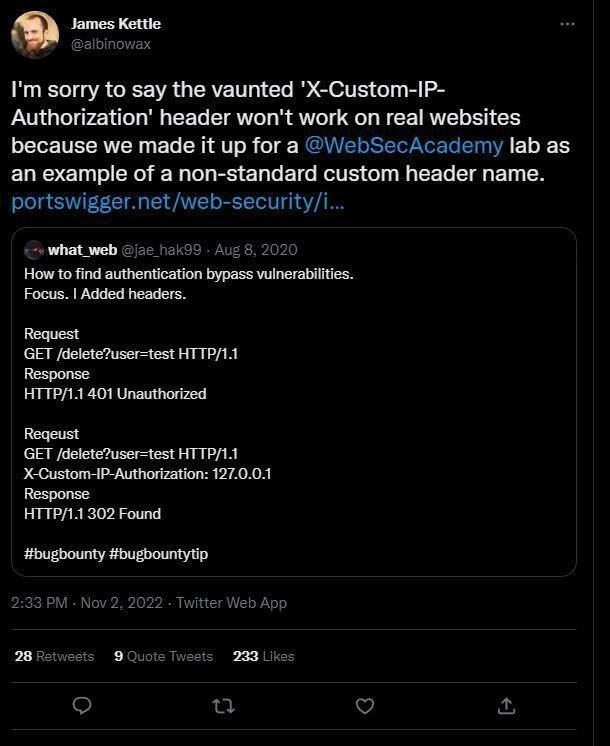
When a vaunted security header turns out to be a lab-only myth
Description
Dark-mode Twitter screenshot. The main tweet, from James Kettle (@albinowax), says: "I'm sorry to say the vaunted 'X-Custom-IP-Authorization' header won't work on real websites because we made it up for a @WebSecAcademy lab as an example of a non-standard custom header name. portswigger.net/web-security/i…". Below, an embedded tweet by what_web (@jae_hak99, dated Aug 8 2020) shows a mini pentest write-up: "How to find authentication bypass vulnerabilities. Focus. I Added headers." It presents two HTTP request/response pairs - first without the header returning "HTTP/1.1 401 Unauthorized", then with the header "X-Custom-IP-Authorization: 127.0.0.1" returning "HTTP/1.1 302 Found", followed by hashtags "#bugbounty #bugbountytip". Tweet metadata displays "2:33 PM · Nov 2 2022 · Twitter Web App" with counts: 28 Retweets, 9 Quote Tweets, 233 Likes. Visually, white text sits on a black background with typical Twitter icons beneath. Technically, the meme pokes fun at security folklore: many bounty hunters copied a fictional HTTP header, unaware it was invented for a PortSwigger Web Security Academy lab, highlighting pitfalls in relying on unverified tricks, non-standard headers, and broken-access-control myths

Comments
9Comment deleted
Invent a fake header for a training lab, wait two weeks, and watch HackerOne file 30 “critical” reports citing the new industry standard - congrats, you just authored RFC-FOMO-9323
The eternal cycle of security research: spend months crafting the perfect educational vulnerability example, watch it get copy-pasted into production pentest reports within days. At least when someone tries to claim a bounty with your fictional header, you've got the receipts
Ah yes, the classic security researcher pipeline: learn a vulnerability in a controlled lab environment, immediately try it on production systems, then discover the training wheels were load-bearing. It's like finding out your entire penetration testing methodology was based on a Konami code that only works in the tutorial level. The real tragedy here isn't just that 'X-Custom-IP-Authorization: 127.0.0.1' doesn't work in the wild - it's the hundreds of bug bounty reports that probably got auto-rejected with 'N/A' before this clarification, each one representing a developer who learned the hard way that PortSwigger's labs are more 'spherical cow in a vacuum' than 'production authentication system with 15 years of technical debt.'
If your auth bypass only works with X-Custom-IP-Authorization, you didn’t find a vuln - you reproduced folklore with curl
Labs: 'Trust this random header like it's your TLS cert.' Prod: 'Nice try, but we actually check the Host header before sipping that IP kool-aid.'
Nothing screams “CTF leaked into prod” like an auth bypass via X-Custom-IP-Authorization: 127.0.0.1 - RFC 6648 deprecated the “X-” headers, not common sense
Vpn as it should be Comment deleted
I identify as localhost Comment deleted
Any header can work, it is the matter of server, if it can process it or not. Comment deleted