
Google thinks Chromium forks are non-Chromium - browser monoculture irony
Description
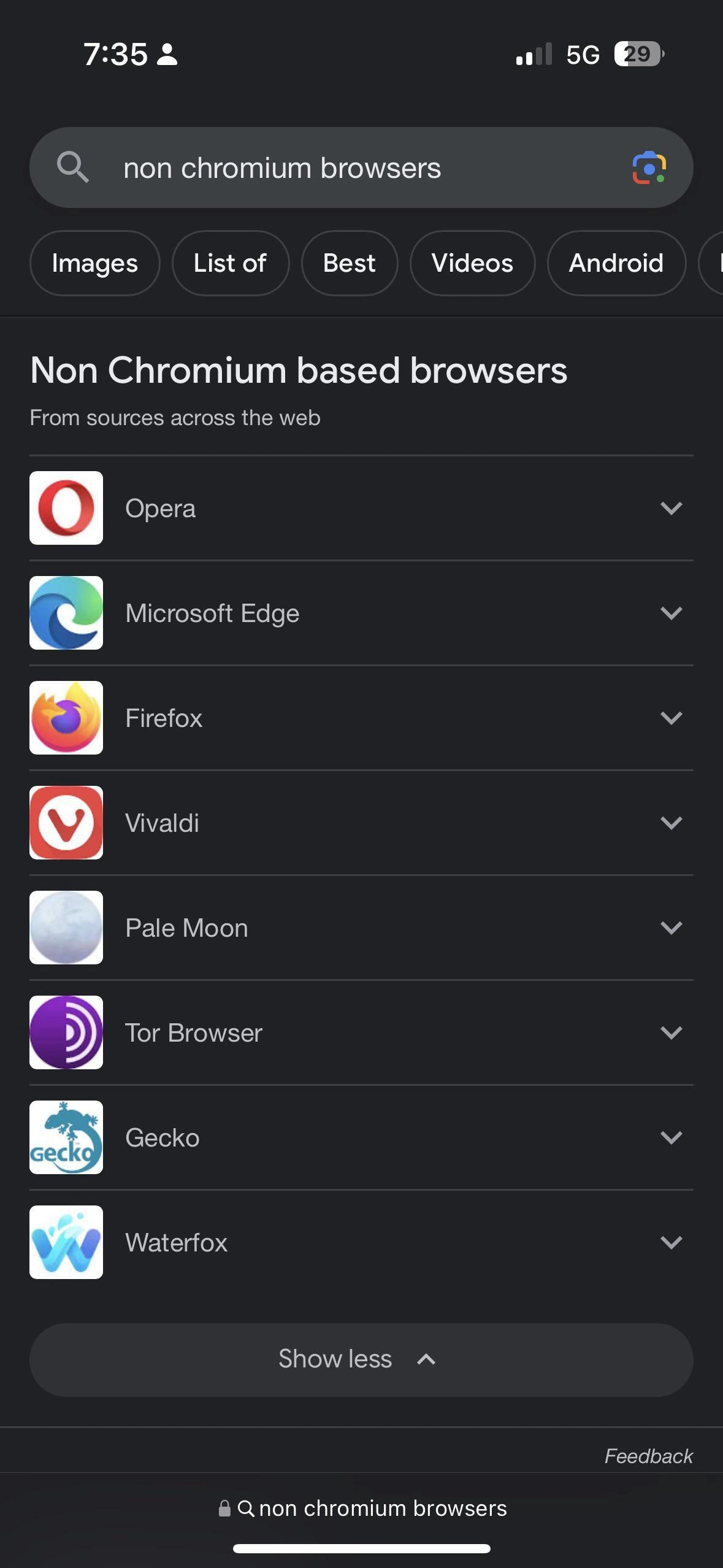
Mobile screenshot of a dark-mode Google search at 7:35 a.m.; the query in the omnibox reads “non chromium browsers.” Search pills like “Images,” “List of,” “Best,” and “Videos” sit below the bar. The top featured list card, titled “Non Chromium based browsers - From sources across the web,” enumerates eight rows, each with an icon, name and dropdown arrow: 1) Opera, 2) Microsoft Edge, 3) Firefox, 4) Vivaldi, 5) Pale Moon, 6) Tor Browser, 7) Gecko, 8) Waterfox. A “Show less” button ends the card, with a locked address bar repeating the search at the bottom. The technical gag is that Opera, Edge and Vivaldi are all Blink/Chromium under the hood, so Google’s own rich snippet ironically perpetuates the very engine monoculture senior web engineers complain about, highlighting how even search ML pipelines conflate ‘browser’ with ‘browser engine’ and why true diversity (Gecko, Servo, WebKit) keeps fallback CSS rules and spec compliance testers employed

Comments
22Comment deleted
When even Google’s knowledge graph can’t tell Blink apart from Gecko, you realise the real single-point-of-failure isn’t the browser engine - it’s the search engine driving your PM’s ‘just support Chrome’ requirement doc
This is what happens when your search algorithm is so deeply integrated with Chrome that it literally can't comprehend a world where browsers aren't just Chromium in different outfits - it's like asking a fish to recommend non-water environments and getting 'swimming pool, ocean, and bathtub.'
Searching for non-Chromium browsers in 2024 is like asking for restaurants that don't serve Coca-Cola products - technically they exist, but you're really just choosing between Firefox, Firefox-with-extra-steps, and that one place that still runs on Gecko because they refuse to let go of XUL extensions from 2008. The real irony? You're using Google to escape Google's browser engine dominance, which is like asking the Death Star for directions to the Rebel base
Apparently “non‑Chromium” now means “Chromium with a different favicon” - which explains why our cross‑browser QA plan is three logos and one engine
Nothing says browser diversity like a “non‑Chromium” list containing Edge, Opera, Vivaldi - and, sure, Gecko; a textbook knowledge graph with no foreign keys
Searching for non-Blink browsers on Blink-powered Chrome: Top results remind you diversity was so 2013
gpt moment Comment deleted
Majority in the top five is Chromium based, well done ... 🤔 Comment deleted
Firefox? Comment deleted
Pale Moon and Firefox are not Chromium-based. But they're only 2 out of the top 5. Comment deleted
everybody: spring the trap! Comment deleted
gecko isn't even a browser Comment deleted
amogus Comment deleted
no matter how Microsoft treats Chrome, Google still tolerates them. Wait, hold on... Comment deleted
💀💀💀😂 Comment deleted
TOR Browser is based on Firefox isn't it? Comment deleted
Yes Comment deleted
That’s the reason why this screenshot is funny 😄 Comment deleted
when google wants to conceal chromium footprint Comment deleted
Akshually 🤓 The list makes sense if you go before 2016 lol Edge and Opera weren't chromium based (using EdgeHTML and Presto engines accordingly) Comment deleted
Vivaldi and opera also chrome based though Comment deleted
That’s an entire point There’s more chromium based browser Comment deleted