
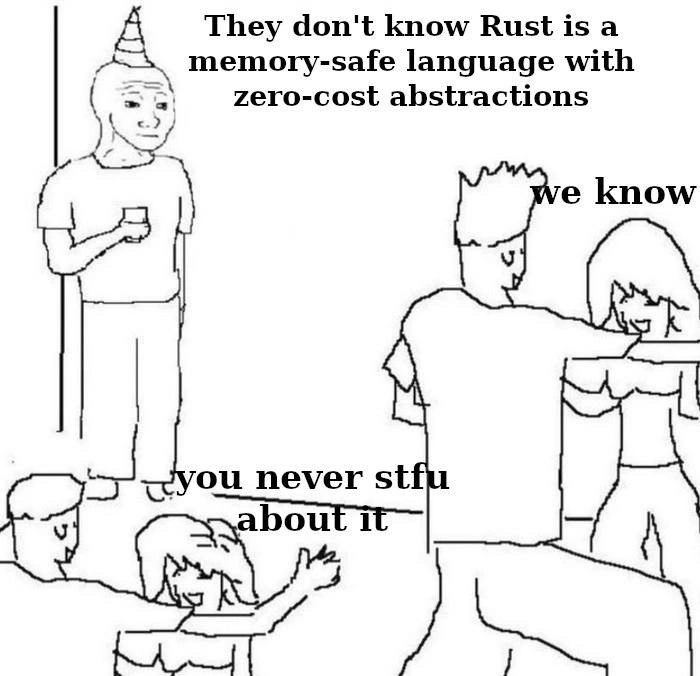
The Rust Evangelist at the Party
Description
This is an instance of the 'I Wish I Was at Home' or 'They Don't Know' meme format, adapted for a tech audience. The image depicts a crudely drawn black-and-white party scene. In the top-left corner, a sad Wojak character wearing a party hat stands alone, thinking, 'They don't know Rust is a memory-safe language with zero-cost abstractions.' In the foreground, other partygoers are dancing and interacting. One character says, 'we know,' while another adds, 'you never stfu about it.' The meme humorously skewers the stereotype of Rust language enthusiasts as overly zealous evangelists who constantly praise its technical merits (like memory safety and zero-cost abstractions) to the point of social annoyance. It's a self-aware joke about the passion of the Rust community and how it can be perceived by other developers
Comments
10Comment deleted
The average Rust developer has two conversational states: 1) Not talking about Rust. 2) Lying
Rust evangelists at parties are like the borrow checker - claiming zero-cost abstractions while monopolizing the conversation’s mutable reference
The real zero-cost abstraction is how Rust developers abstract away their ability to have a conversation without mentioning the borrow checker, lifetime annotations, or how they're rewriting everything in Rust - including this party's small talk subroutines
The Rust community has achieved what no other language could: making memory safety so annoying that developers would rather risk segfaults than hear about the borrow checker one more time at a conference mixer
Rust: zero-cost abstractions, non-zero social cost - the ownership of this conversation is 'static' and the borrow checker won’t let me drop it
Rust’s zero-cost abstractions are real; the runtime overhead is just the 20-minute borrow-checker lecture I compile at every party
Rust's zero-cost abstractions: free performance, infinite evangelism
Rust is a piece of shit near Haskell Comment deleted
hey you, explain yourself Comment deleted
If only Haskell was suitable for day to day tasks rather than being a dildo for kinky academics. Comment deleted