
Security Post #4019 · source on Telegram
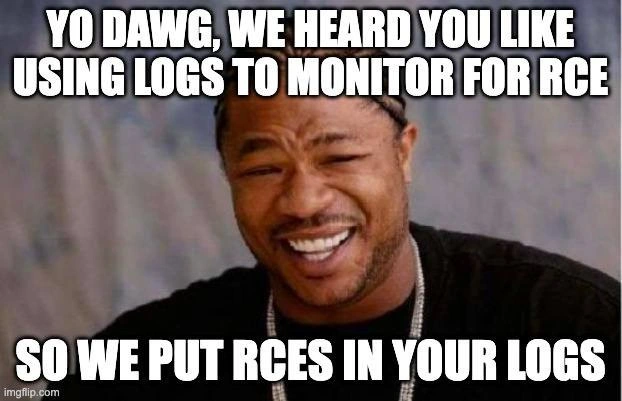
Yo Dawg meme jokes about RCE hiding inside the logs you monitor
Description
The meme uses the classic "Yo Dawg" two-line white impact font format over a photo of a rapper-styled man whose face is pixelated for anonymity. Top text reads: "YO DAWG, WE HEARD YOU LIKE USING LOGS TO MONITOR FOR RCE". Bottom text reads: "SO WE PUT RCEs IN YOUR LOGS". The joke riffs on the 2021 Log4Shell incident where a log entry itself could trigger remote-code-execution, highlighting the irony of relying on logs for security visibility while those same logs become the attack vector. Visually it is high-contrast white text with black stroke on a blurred studio backdrop, emphasizing developer humor around observability, security vulnerabilities, and DevOps monitoring practices
More like this
More like this in Security →


Use J and K for navigation
Comments
7Comment deleted
Log4Shell reminded us our observability pipeline isn’t read-only - it’s basically a write-exec volume with Grafana doing the crime scene sketches
The real irony isn't just that logs became attack vectors - it's that we spent years telling juniors to 'log everything' for debugging, only to discover we'd essentially installed a backdoor in every Java application since 2013. Now our incident response playbooks need incident response playbooks
Defense in depth, 2021 edition: the attacker's payload arrives pre-indexed, timestamped, and shipped to your SIEM at your own expense
The ultimate security architect's nightmare: spending months implementing comprehensive logging and monitoring for RCE detection, only to discover your logging framework itself is the RCE vector. It's like hiring a security guard who's actually a burglar, or more accurately, like the Log4Shell incident where simply logging a malicious string could pwn your entire infrastructure. Nothing says 'defense in depth' quite like your observability stack becoming patient zero
Observability is still code; if your pipeline resolves ${jndi:ldap://...}, you didn’t build a SIEM, you deployed an attacker to prod
Your SOC asks for log enrichment; your JVM calls JNDI - congrats, you’ve built eval() over TCP and called it observability
Centralized logging: because why hunt RCEs when your Splunk can just eval() them for you?