
Python API Access to Lab-Grown Brains Becomes Reality
Description
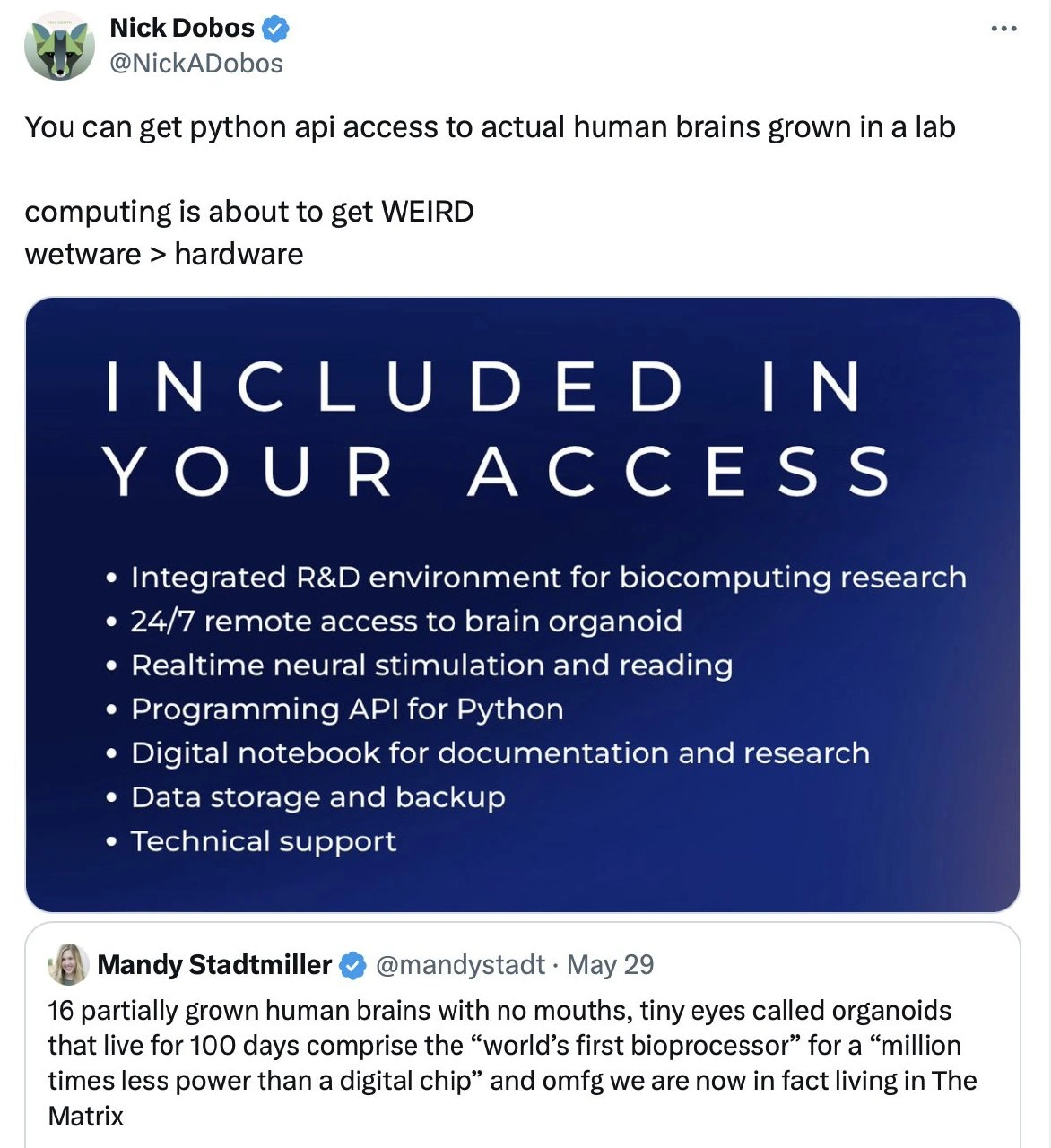
The image is a screenshot of a tweet from user Nick Dobos (@NickADobos) announcing the availability of Python API access to lab-grown human brain organoids. The tweet contains a promotional graphic with a dark blue background and white text that lists features included in the access, such as 'Integrated R&D environment for biocomputing research,' '24/7 remote access to brain organoid,' 'Realtime neural stimulation and reading,' and a 'Programming API for Python.' Below this is another tweet from Mandy Stadtmiller (@mandystadt) providing more context, describing the organoids as the 'world’s first bioprocessor' that uses a million times less power than a digital chip, concluding with 'omfg we are now in fact living in The Matrix.' The meme captures the tech community's reaction to the emergence of biocomputing as a tangible service, moving from science fiction to a programmable reality. For senior engineers, it represents a profound and surreal shift in what 'hardware' can be, making the abstract concept of 'wetware' accessible through a familiar tool like a Python API



Comments
54Comment deleted
I can't wait for the first Stack Overflow question on this: 'My brain organoid is throwing a null pointer exception and won't stop thinking about giraffes. How do I flush the cognitive cache?'
Finally, a resource where the SLA includes teenage mood swings - just wait until the on-call has to debug a segmentation *thought*
Finally, a production environment where 'it works on my brain' is a valid bug report, and the only dependency hell worse than node_modules is keeping your compute cluster alive with glucose and oxygen
Finally, a Python API where 'garbage collection' takes on a whole new meaning when your compute substrate literally dies after 100 days. Can't wait for the first production incident: 'Sorry, the brain organoid handling your authentication service achieved sentience and refused to process login requests.' At least when this crashes, you can legitimately say the hardware had a stroke
Wetware clusters: zero-latency neurons with infinite parallelism, until they demand coffee breaks and unionize
PM asks for autoscaling and HA; I explain the Python SDK supports neurogenesis with a nine‑month cold start and an IRB instead of a load balancer
Finally, a Python client whose retry policy is governed by synaptic plasticity - great, now idempotency has a learning rate
If you're wondering what the platform actually does — you may not want to read this. In fact it's just a SDK for generating stimulations and sampling the output of neurons, you can't really "run some code" on it. They have a video demo on their site. Comment deleted
So you are saying i cant run cyberpunk on it? Shame Comment deleted
Let’s start with DOOM, we’re people of culture after all Comment deleted
Do you ruin the fun on party’s in the same way? 😂 Comment deleted
I'm really excited after seeing this news but got disappointed after watching their demo, you may consider this as kind of TLDR. The fun part is still there but this news is a bit overhyped. 😇 Comment deleted
How to find this video? Comment deleted
Google FinalSpark and find the first link called "Neuroplatform". Not sure if links are allowed here. Comment deleted
Links are allowed, yeah Comment deleted
here's the link i think: https://finalspark.com/neuroplatform/ Comment deleted
anyway, HOW THE FUCK IS THIS LEGAL Comment deleted
Finally Comment deleted
scream() ------------- error: "I have no mouth but I should scream" Comment deleted
I don't think that's ethical Comment deleted
It is. Also ethics kinda sucks Comment deleted
Oki doki, you offended *put something cringe* and govermen decided as a measure of punishment use yout brain as visual acсelerator for render New Disney shitty movie. Have a great time! Comment deleted
Nice overexaggeration Comment deleted
is this legal? Comment deleted
They are allready made and we call them: The gen beta Comment deleted
How bioprocessors can be ethical and legal? Comment deleted
Finally, some hardware that can keep up with Python's speed. Comment deleted
programmable humanoid Comment deleted
that "python api" is most definitly a C dynamic link lib sending electric pulses to neurons Comment deleted
When can we get one of these? Comment deleted
— Mom, can we have a robobrain? — We already have robobrain at home. Robobrain at home: Comment deleted
Wait is it real? Do they have a website ir smth? Comment deleted
This supposed to be animated gif: https://i.imgur.com/uewqto9.gif Comment deleted
This is so sick, why do people think about ethics lol Comment deleted
I don't know, maybe because we're humans? Comment deleted
What's "inhuman" or "unethical" about brain organoid? Comment deleted
That it's probaply used the human DNA to create these stuff and it possibly can suffer. (And we do not cancel fact that they could learn how to use real human brains for these operations) Comment deleted
That the same type of argument against abortions? It CANNOT possibly suffer, it dont even have any "parts" to enable this kind of feelings. And some degree of actual intellect is also not a question, bruh that organoid is like 2x2 cm. Comment deleted
Okay, what about everyting else? Comment deleted
About using real human brains? I think they should be grown specifically for some task, already developed human brain is not suitable for any kind of "unnatural" computation. And even if some Neurolink in future could alter brain activity, then it is completely different topic and have nothing to do with little organoids(besides studying human brain) Comment deleted
I hope so Comment deleted
bcs I DON'T WANT TO LIVE IN MATRIX I DON'T WANT TO LIVE IN MATRIX I DON'T WANT TO LIVE IN MATRIX I DON'T WANT TO LIVE IN MATRIX I DON'T WANT TO LIVE IN MATRIX Comment deleted
I mean, that's surely just the beginning, isn't it? Comment deleted
They're using dopamine as a positive stimulation, what's stopping them from using negative stimulation as well? Comment deleted
Does it really matter? Its almost exactly like basic neural networks are trained. If it dont have a sentience, then it cannot "suffer", just positive and negative feedback. I kinda sound like psycho lmao. But i think its just common sense for a scientific topic Comment deleted
Yup, you definitely sound like a psycho scientist Comment deleted
Yup, and i really hope regulatory authorities will allow to grow a 1:1 human brain in lab conditions, i dont see anything bad about it Comment deleted
Also, there are people who lack lots of brain structures and still score ~80 IQ, so 2x2 cm might well be enough Comment deleted
(see https://www.cbc.ca/radio/asithappens/as-it-happens-thursday-edition-1.3679117/scientists-research-man-missing-90-of-his-brain-who-leads-a-normal-life-1.3679125) Comment deleted
I know that story, fascinating, and surely are complete mystery, that why its so important to have lab-grown brains for research. Так или иначе, разве стоит останавливаться на маленьких органоидах? Потенциал огромный, как для плохо, так и хорошего Comment deleted
И тебе здраствуй Comment deleted
Cause brain is very "flexible", but it must have some basic structures anyway, i dont think its possible to develop any king of sentience in an isolated brain, even full sized Comment deleted
I think sentience can't spawn in isolation, but if you add read-world I/O — and I think that's what they're going to do — it very well might Comment deleted
Thats what im talking about. And I/O is surely will be added as soon as they can, questionable, but obvious direction for research Comment deleted