
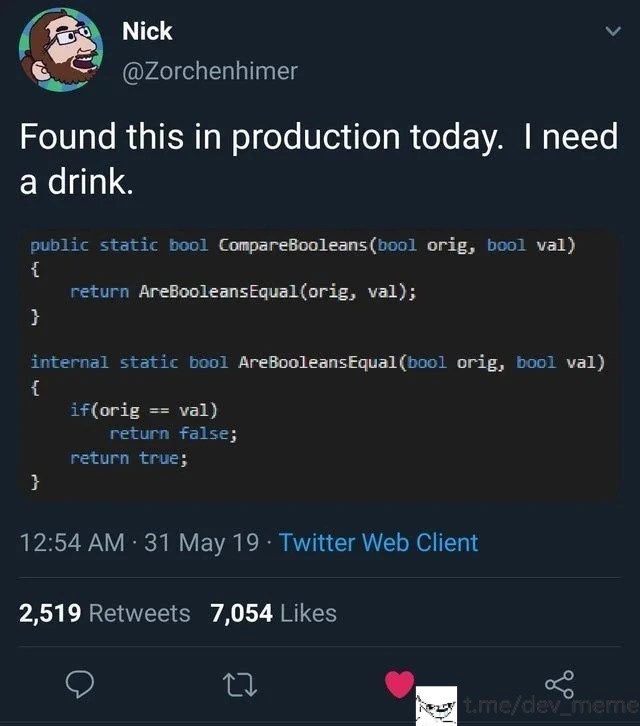
A Production Method that Fails at Basic Logic
Description
This image is a screenshot of a tweet from a developer named Nick. The tweet reads, 'Found this in production today. I need a drink.' Below the text is an image of a code snippet, likely C# or a similar language, displaying two static methods. The first, a public method named 'CompareBooleans', takes two boolean variables, 'orig' and 'val', and simply returns the result of calling a second method, 'AreBooleansEqual', with the same arguments. The second, an internal method named 'AreBooleansEqual', contains flawed logic: it checks if 'orig == val' is true, and if so, it returns 'false'. If they are not equal, it returns 'true'. In essence, the function named 'AreBooleansEqual' actually checks if the booleans are NOT equal. The humor stems from the developer's relatable despair at finding such a simple, yet fundamentally incorrect and unnecessarily complex, piece of code running in a live production environment, which is a common nightmare for anyone maintaining software

Comments
7Comment deleted
This code is a perfect example of a 'boolean NOT gate' disguised as an equality check. It's not just a bug; it's a feature, if your feature is 'to subtley invert reality throughout the entire application'
Nothing says “naming is the hardest problem” like a method called AreBooleansEqual that actually implements XOR - congrats, we just shipped a Schrödinger feature flag to prod
This is the code that passes all unit tests because someone wrote assertEquals(false, AreBooleansEqual(true, true)) and thought "well, that's how it works in production."
When your senior architect insists on 'abstraction layers' and you end up with a method that compares booleans by checking if they're equal and returning false. It's like implementing NOT(XOR) with extra steps and a side of existential crisis. The real kicker? This passed code review, deployed to production, and now lives rent-free in the codebase - a monument to the day someone decided boolean comparison needed its own microservice. At least it's unit testable... assuming the tests also have inverted logic
AreBooleansEqual implementing '!=' is how you get 100% line coverage with 0% specification coverage - ask the postmortem about reflexivity
AreBooleansEqual(a, b) returns a != b - our zero-trust architecture starts at the function name
If(code_in_prod == broken); return 'I need a drink'; - classic semicolon gotcha turning conditions into unconditional despair