
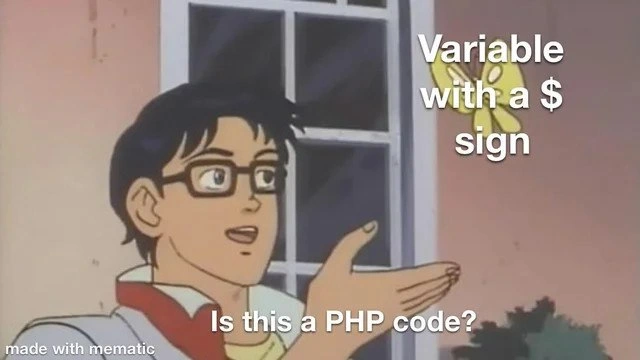
The Overly Eager PHP Detector
Description
A popular meme using the 'Is this a pigeon?' format, which features a male anime character with glasses gesturing towards a butterfly. In this version, the butterfly is labeled 'Variable with a $ sign'. The character is asking, 'Is this a PHP code?'. A 'made with mematic' watermark is visible in the bottom-left corner. The joke satirizes the strong and immediate association developers have between the dollar sign ($) prefix for variables and the PHP programming language. While PHP famously uses this syntax, the humor resonates with experienced engineers because the '$' symbol has many other uses in the tech world, such as in shell scripts for environment variables, as the primary function/selector in jQuery, in JavaScript template literals, or as an anchor in regular expressions. The meme playfully mocks the narrow perspective of someone who only associates the symbol with PHP

Comments
30Comment deleted
A junior dev sees a '$' and thinks 'PHP variable.' A senior dev sees a '$' and asks 'jQuery selector, shell variable, end-of-line regex anchor, or are we just talking about our budget again?'
Even after ripping out every last PHP monolith, a stray $ENV_VAR in Terraform still makes my IDE whisper “<?php”… legacy autocomplete is the real haunted dependency
After 20 years in the industry, I still can't decide if PHP's dollar signs are a feature that prevents variable name collisions or just Stockholm syndrome from maintaining legacy e-commerce platforms that somehow still process billions in transactions despite being held together by mod_rewrite rules and prayer
After 25 years, PHP developers still get asked 'why the dollar signs?' at every conference. The real answer? Perl influence and the need to distinguish variables from barewords. But the meme captures a deeper truth: in a world of let, const, var, and type annotations, PHP's sigil-based syntax remains instantly recognizable - like spotting a butterfly in a sea of modern language design. It's not a bug, it's a $feature
Seeing $var and yelling "PHP" is like seeing YAML and yelling "Kubernetes" - the real tell is $var being concatenated into a SQL query
Relying on a leading $ to identify PHP is the same heuristic that made our static analyzer label half the ops scripts as web tier - precision feels great until Perl, Bash, and PowerShell destroy your recall
PHP devs' sixth sense: every $ is a variable until proven a currency
No, it's bash Comment deleted
my thoughts exactly Comment deleted
no it's zsh Comment deleted
No it's PowerShell Comment deleted
*posix shell Comment deleted
no, its jquery Comment deleted
In Europe we use € Comment deleted
can confirm, we also use printc instead of printf. Comment deleted
Atmel assembler Comment deleted
It's a string in kotlin Comment deleted
kgay Comment deleted
Kotlin is godly Comment deleted
Man I tried it Comment deleted
Wtf? Comment deleted
You are so wrong Comment deleted
I mean val str = "some string" val newstr ="str data $str" And result of newstr will "str data some string" Comment deleted
Well yes? Comment deleted
It's a global variable in Ruby Comment deleted
No, it is Perl Comment deleted
Thanks, didn't know that Comment deleted
No, it's SASS Comment deleted
Ruby global variable Comment deleted
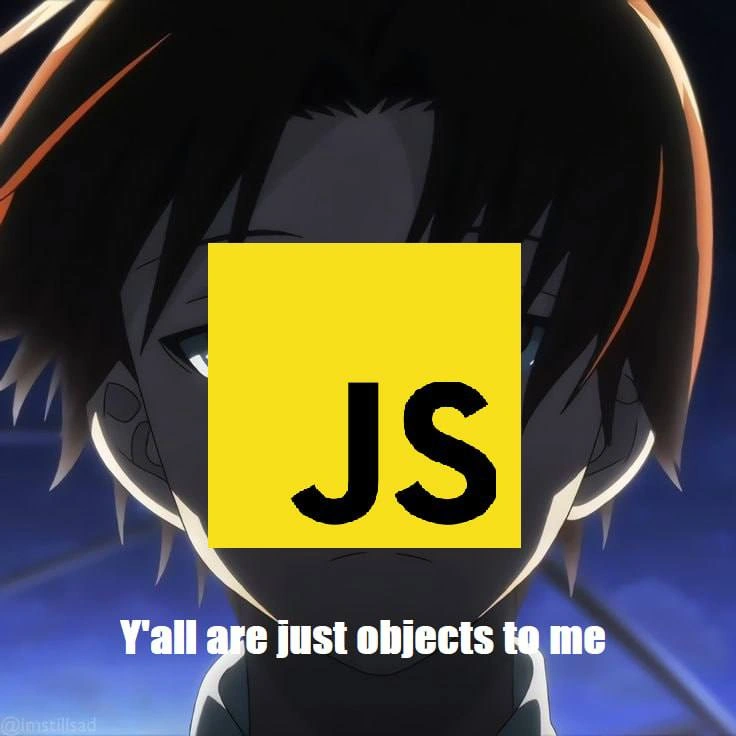
JS Observables Comment deleted