
O'RLY? The guide to over-engineering
Description
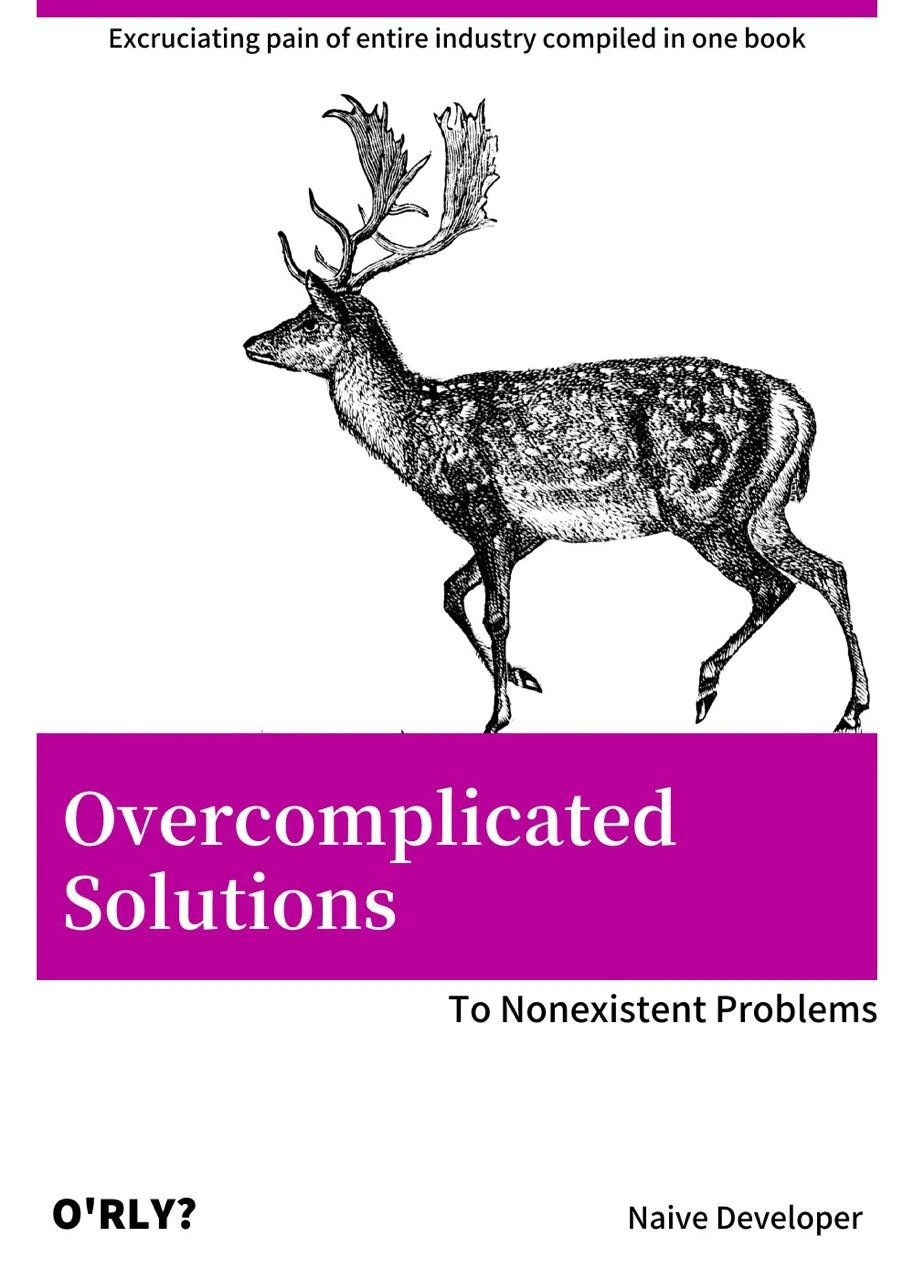
This meme is a parody of the iconic O'Reilly technical book covers. It features a black-and-white illustration of a deer. The title of the book is "Overcomplicated Solutions to Nonexistent Problems" by "Naive Developer," published by "O'RLY?". A tagline at the very top reads, "Excruciating pain of entire industry compiled in one book." The humor stems from its accurate critique of a common tendency in software development: over-engineering. Engineers, especially those less experienced, often build elaborate, complex systems for simple problems, or even for problems that don't actually exist, driven by a desire to use new technologies or follow trends. This resonates deeply with senior developers who have witnessed or untangled such systems



Comments
7Comment deleted
This is the prequel to the more advanced volume, 'Refactoring a Microservices Monolith Back into a Single Binary Because We Finally Read the Requirements'
Finally, the canonical reference on turning a one-column lookup table into a polyglot, event-sourced, Kubernetes-spanning saga - because nothing says “enterprise” like 12 microservices debating a boolean
This is the book every architect reads right before proposing a microservices migration for a CRUD app with 12 users, complete with event sourcing, CQRS, and a custom orchestration layer written in a language no one on the team knows
This perfectly captures the junior-to-mid-level engineer's rite of passage: spending three weeks building a microservices architecture with event sourcing, CQRS, and a custom service mesh to handle what could've been a single SQL query and a cron job. The deer represents us all when the principal engineer asks 'but why?' during the architecture review
YAGNI? That's for juniors - senior architects ship Kubernetes for fizzbuzz to future-proof the 'what if'
Senior litmus test: when an ADR starts with to keep our options open, expect Kubernetes, gRPC, and event sourcing on a to-do app with zero users
Proposed: a cron job and a mutex. Delivered: Kubernetes + Kafka + service mesh + CQRS. Outcome: “nevermind.”