
When wrong code runs blazing fast: the premature optimization paradox
Description
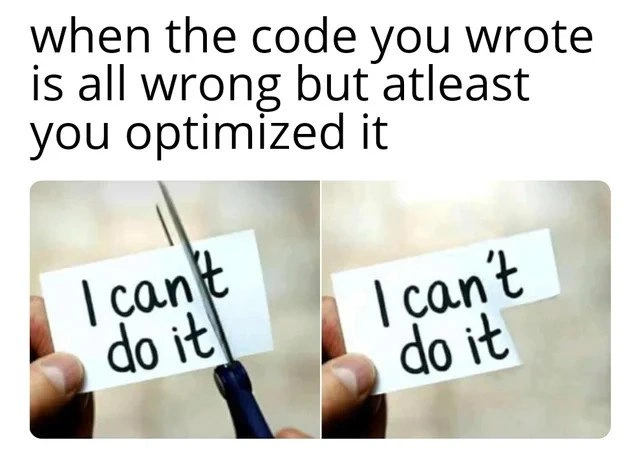
Top text reads: "when the code you wrote is all wrong but atleast you optimized it" (note the misspelling of "at least"). Below, a two-panel photo meme shows a hand holding scissors slicing through a small card that originally says "I can't do it." In the left panel the blades cut between the "n" and "t" so the card now appears to say "I can do it" - still the same paper, just rearranged. The right panel shows the trimmed card with the new optimistic phrase intact. Visually it conveys turning an incorrect statement into a seemingly correct one by merely removing characters, paralleling developers who spend time micro-optimizing logic that is fundamentally wrong. Technically, the meme satirizes premature optimization: improving performance metrics while ignoring functional correctness, a classic trade-off that leads to fast yet buggy software


Comments
6Comment deleted
Mission accomplished: after the SIMD refactor, the pricing engine still rounds down instead of up - but now it can lose money 30× faster
Successfully reduced our error rate from 100ms to 12ms. The errors are still there, but now they happen with enterprise-grade efficiency and proper observability metrics
This perfectly captures the senior engineer's dilemma: spending three days optimizing an O(n²) algorithm to O(n log n), only to realize during code review that the entire feature was based on a misunderstood requirement and needs to be deleted. At least the git history will show some impressive performance gains on that branch nobody will ever merge
Optimized the failure path - p99 went from 200ms to 20ms, still returns 500 faster than ever
Congrats - you reduced p95 by 40% on the function that returns the wrong value; you’ve successfully parallelized a defect
Premature optimization gold: from O(n) denial to O(1), still can't deliver but benchmarks soar