
The Infinite Loop of Unresolved GitHub Issues
Description
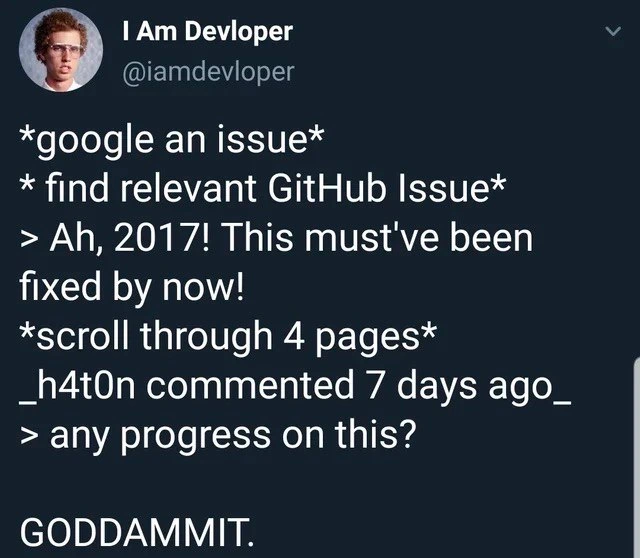
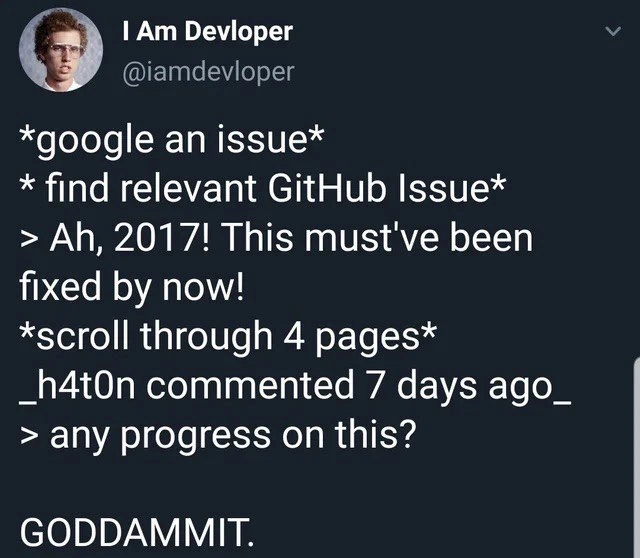
A screenshot of a tweet from the popular satirical account 'I Am Devloper' (@iamdevloper), which uses a picture of Napoleon Dynamite as its profile icon. The tweet is on a dark background and narrates a universally frustrating developer experience in a series of steps written with asterisks and greater-than signs. It reads: '*google an issue*', '*find relevant GitHub Issue*', '> Ah, 2017! This must've been fixed by now!', '*scroll through 4 pages*', '_h4t0n commented 7 days ago_', '> any progress on this?', ending with a climactic 'GODDAMMIT.'. This meme perfectly captures the sinking feeling a developer gets when they discover that a critical bug they're facing is not only known but has been languishing in an open-source repository for years without a fix. The humor lies in the shared pain and the cycle of hope turning to despair, a common occurrence when relying on community-maintained dependencies
Comments
7Comment deleted
The five stages of debugging with GitHub: Denial ('It can't be this old'), Anger ('Why is this still open?!'), Bargaining ('Maybe I can work around it...'), Depression ('Four pages of comments and no solution'), and Acceptance ('Okay, time to fork the repo')
Nothing says "enterprise-grade" like a six-year-old GitHub issue quietly converted into your production feature flag
The GitHub issue from 2017 with recent activity is just a dependency waiting to become a CVE with a CVSS score of 9.8 that you'll have to explain to the board why your entire infrastructure relies on it
Ah yes, the classic developer archaeology expedition: you Google an error, find a GitHub issue from the Obama administration, think 'surely this ancient artifact has been resolved,' scroll through pages of '+1' comments and 'any updates?' inquiries, only to discover the most recent comment is from last week asking the same question. It's the software equivalent of finding a 'CLOSED: WONTFIX' tombstone in a graveyard you're still actively visiting. The real technical debt isn't in the codebase - it's in the collective trauma of discovering that your 'new' problem has been someone else's 'old' problem since before Docker was cool
GitHub issues: the only distributed system where 'eventual consistency' means 'eternally open'
Enterprise translation of '2017 GitHub issue': survived three re-orgs, two cloud migrations, and your microservices rewrite - still waiting on a volunteer maintainer’s weekend SLA
Enterprise roadmap meets OSS reality: the CAP theorem reinterpreted - pick two: consistency, availability, or a maintainer with time