
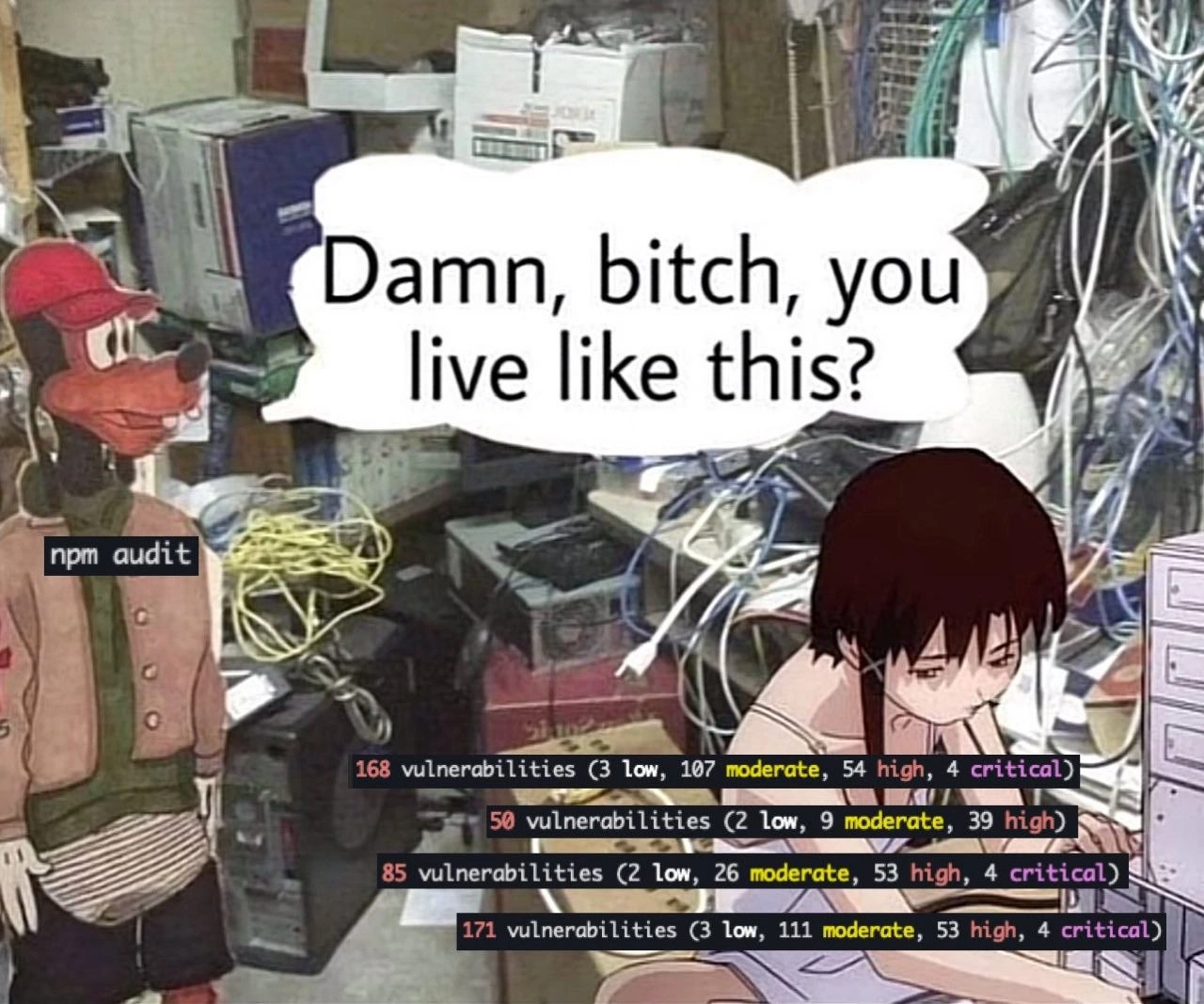
npm audit Confronts a Developer in Dependency Hell
Description
This is a multi-layered meme using the 'Damn, bitch, you live like this?' format. The background is a photograph of an extremely cluttered and messy room, filled with tangled wires, old computer equipment, and boxes, symbolizing a chaotic and poorly maintained project. On the right, the anime character Lain Iwakura from 'Serial Experiments Lain' sits hunched over her computer, looking weary, representing the developer working in this environment. On the left stands a cartoon character resembling Goofy, who is labeled 'npm audit' on his jacket. A large speech bubble from him contains the text 'Damn, bitch, you live like this?'. To the right, several lines of text are overlaid, simulating the output of a security scan, listing hundreds of vulnerabilities (e.g., '168 vulnerabilities (3 low, 107 moderate, 54 high, 4 critical)'). The meme humorously personifies the 'npm audit' command as a judgmental outsider, shocked at the overwhelming number of security vulnerabilities found in a developer's project dependencies. It's a deeply relatable scenario for web developers who often face a deluge of warnings from dependency scanners, reflecting the chaos of 'dependency hell' in modern JavaScript development
Comments
13Comment deleted
Running 'npm audit' is my favorite ritual. It's like reading a horror story where you're the main character and every chapter ends with a new critical vulnerability in a left-pad dependency
npm audit: “This isn’t a package.json, it’s a geological core sample - every caret version pin marks another epoch of tech debt we’ll need both archaeologists and a SOC to excavate.”
After 15 years in the industry, you realize 'npm audit fix --force' is just the JavaScript ecosystem's version of 'have you tried turning it off and on again?' - except each reboot adds 47 new vulnerabilities from yesterday's breaking changes in left-pad v2.0.0
When npm audit roasts your dependency tree harder than your code reviewer ever could - turns out your node_modules folder has more critical vulnerabilities than that server room has properly managed cables. At least the physical infrastructure chaos is contained to one room; your transitive dependencies are shipping to production
Transitive deps: turning 'npm install' into a vuln lottery where criticals are the jackpot you pray to ignore
npm audit is a CVSS-powered anxiety linter: four “critical” CVEs buried in a dev-only transitive dependency block the release while the real threat model is that wiring closet
npm audit walks into the server closet that is your dependency graph, flags 171 advisories in transitive devDeps, recommends “audit fix” that rewrites half the lockfile, breaks CI, and still leaves four criticals - security theater at scale
theres no budget to fix it so Comment deleted
This truth should be illegal Comment deleted
It's kinda low btw. Comment deleted
LAIN MENTIONED Comment deleted
O. Watching right now) Comment deleted
plot twist: 95% of them are garbage irrelevant issues happening only in development tools in a scenario that will never happen with the way you're using them the rest are genuine vulnerabilities that you'll never handle properly because bad tooling made you complacent to their existence Comment deleted