Skip to content
DevMeme
6524 of 7435
All Modern Digital Infrastructure Rests on Bitnami Container Images
Containerization Post #7152, on Sep 20, 2025 in TG

All Modern Digital Infrastructure Rests on Bitnami Container Images

Why is this Containerization meme funny?

Level 1: Wobbly Tower of Blocks

Imagine you built a super tall tower out of blocks, almost like a game of Jenga. Now, here’s the silly part: the whole tower is resting on one tiny block at the very bottom. All the other blocks are stacked on top of that little one. If someone sneaks in and pulls out that one tiny block, what do you think happens? The entire tower would crash down in an instant! You’d have a big mess of blocks everywhere.

This meme is basically saying our fancy computer systems – the ones that run websites, apps, and all the cool internet stuff – can sometimes end up like that wobbly tower. We might think the system is super strong, but if everything is balanced on one little thing and that thing is taken away, the whole system falls apart. It’s funny in the way it’s drawn (you see the huge “modern digital infrastructure” tower teetering on one block) because it feels a bit ridiculous. It’s like, “Who would build a tower on one block? That’s crazy!” And yet, in real life, sometimes we accidentally do that with technology.

So the joke is a mix of haha and uh-oh. We’re laughing because it looks absurd – a giant structure on one tiny piece – and we’re a bit nervous because it’s kind of true. It reminds everyone that even big, complicated things can depend on something small. If that small thing isn’t there anymore, oops! Down comes everything, just like a tower of blocks tumbling to the ground.

Level 2: The Fragile Foundation

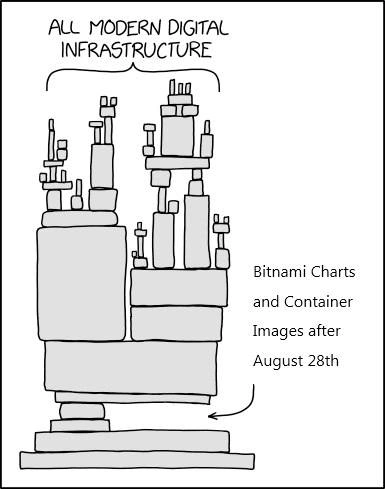
Let’s break down the meme in simpler terms. The drawing is like a game of Jenga or a precariously stacked tower of blocks. The whole tall stack is labeled “All modern digital infrastructure,” suggesting that all our fancy computers, cloud services, and internet apps are piled up together. Now, at the very bottom of this stack, there’s a tiny block that everything else is resting on. That little block has a label: “Bitnami Charts and Container Images after August 28th.” This hints that something significant changes with Bitnami’s charts/images after that date, and that change could impact everything built on top of them. In other words, the cartoon is saying: “Look, our entire digital world is (ridiculously) depending on this one little thing down here. If that gets pulled out, the whole tower could collapse.”

Who or what is Bitnami? Bitnami is a company (now part of VMware) that provides ready-to-use container images and Helm charts for a lot of popular software. Think of container images as pre-packaged apps: like a zip file that contains an application plus the environment it needs (all the settings, dependencies, etc.), so it can run anywhere. Helm charts are like templates or recipes for deploying those applications to Kubernetes, which is a system that manages containers across a cluster of machines. Using a Helm chart from Bitnami, you can quickly install complex software (like a MySQL database or WordPress website) on your Kubernetes cluster with one command, because Bitnami has done the work to bundle the configurations and images for you. It’s super convenient — kind of like getting a ready-made meal kit for cooking, instead of shopping for each ingredient yourself.

Now, what’s special about “after August 28th”? It sounds like Bitnami announced that, after Aug 28, something about how their charts or images are provided is going to change or be discontinued. Maybe they decided to remove their content from a popular site (like Docker Hub) or require a different setup. For example, they might have said “we’ll no longer update or support X after this date,” or “we’re moving these images to a new registry, update your links.” If a lot of people were using Bitnami’s old links or expecting those images to always be there, suddenly after that date, those people could be in trouble. It’s like if you were building houses and a brick supplier announced “we’re closing our factory on Aug 28.” Any construction still relying on those bricks would halt unless they stocked up or switched suppliers.

This ties into the idea of dependencies in software. A dependency is any external component your system needs. Here, Bitnami’s charts and container images are dependencies for many companies’ systems. Dependency hell is a fun term developers use to describe the nightmare that happens when too many things depend on each other and one of them breaks or conflicts. In this meme, the dependency hell is that everyone depended on Bitnami’s service remaining available, and now that dependency is a potential hellish problem if it goes away.

The term vendor lock-in appears in the tags too. Usually, vendor lock-in means you’ve become so tied to one vendor’s product or service that it’s really hard to switch away if you want or need to. In this context, even though Bitnami’s charts are open source, everyone using them is locked in to Bitnami’s way of doing things and their availability. If after Aug 28 Bitnami says “we’ve moved, please use our new system,” thousands of setups have to scramble to adapt. They can’t instantly swap out Bitnami charts for another provider without making changes to their configurations. That’s a form of lock-in — you got comfortable with that one vendor’s solution and now you’re stuck with the consequences of their business decisions or changes.

Think of it like relying on one power company for electricity: if that company announces an outage or a big change, your whole town might go dark unless you have a generator. In software, the equivalent of a generator would be a mirror or backup of the dependency. Interestingly, the post caption, “Spegel goes brrr,” is hinting at this idea. Spegel is Swedish for “mirror.” In software, a mirror is just a copy of a repository or files hosted in a different place. The phrase “goes brrr” is internet slang for something working super hard and fast (imagine the sound of a machine gun or an engine: brrr!). So if the main Bitnami repository became slow or unavailable, people might switch to a mirror site named Spegel (perhaps a Swedish mirror server) to get their container images. “Spegel goes brrr” jokes that this mirror server is now extremely busy, spinning furiously to serve everyone who’s rushing to use it. It’s as if the backup generator just kicked in and is now chugging away, keeping everyone’s infrastructure running since the main power (Bitnami) is down or restricted.

Now, why is the whole situation funny to developers? It’s a bit of a nervous laugh kind of funny. We always talk about how modern infrastructure (like cloud computing, Kubernetes, etc.) is very robust and fault-tolerant. You hear terms like multi-cloud, high availability, and redundancy. But then this cartoon comes along and says, “Actually, all that modern infrastructure is balanced on one skinny block that could be removed.” It’s ironic. It reveals a fragile foundation under what’s supposed to be an unshakeable system. Developers find this amusing in the “ha-ha-oh-no” sense because it’s a shared experience: many have encountered incidents where something trivial or external broke, bringing down an entire system. For example, if a single library or service that everyone uses suddenly disappears, everything that relied on it stops working — even if those systems were otherwise perfectly healthy.

A term often used here is “single point of failure.” This means a part of a system that, if it fails, will stop the entire system from working. In a well-designed system, you try to eliminate single points of failure by adding backups or alternate paths. The joke (or lesson) of the meme is that, despite all our efforts, we still end up with single points of failure – sometimes where we least expect them. In the picture, that one Bitnami block is the single point of failure for the whole tower. If it’s pulled out, the tower (the system) collapses. The meme is basically a cartoon exaggeration to say, “Hey, our big ‘modern’ systems can actually be taken down by something as small as a deprecated Helm chart repository!” It’s funny because it’s a bit absurd, and yet it rings true to anyone who’s seen a major outage caused by a tiny missing piece.

In summary, level 2 takeaway: The meme is highlighting how a huge complex system (like all our internet and cloud services) can depend on one small thing (Bitnami’s charts/images). When that small thing changes or goes away (after Aug 28, in this case), it endangers everything built on it. It’s calling out the fragility in our infrastructure due to over-reliance on a single vendor’s resource. And the caption about “Spegel goes brrr” adds that developers will try to cope by using backup copies (mirrors) — so much so that those backups will be working overtime. It’s a mix of humor and caution: we’re laughing, but we’re also kind of admonishing ourselves for letting our infrastructure become a tall, shaky Jenga tower resting on one block.

Level 3: Dependency Jenga in the Cloud

For seasoned DevOps engineers and SREs, this meme hits a nerve by portraying our cloud infrastructure as a giant game of Dependency Jenga. We’ve spent years architecting microservices, multi-region failovers, and auto-scaling clusters, bragging about “No single point of failure!” — yet many of us rely on one vendor’s artifact repository as a foundation. Bitnami, known for its convenient Helm charts and up-to-date Docker container images for popular apps, became a go-to building block for Kubernetes deployments. The cartoon’s joke is that all of our modern digital infrastructure is basically resting on that single block: “Bitnami Charts and Container Images after August 28th.” In other words, if Bitnami’s chart repository or image registry goes poof (or even just requires a new login) after that date, a huge chunk of the cloud will topple or at least wobble dangerously.

Why is this funny (in a painful way)? Because it’s true. We’ve all seen incidents where a tiny dependency breaks and causes cascading failures. This meme specifically references a moment of collective anxiety in the Kubernetes community: Bitnami/VMware announced changes effective August 28th (likely deprecating their public Helm chart repository or moving images off Docker Hub). The arrow pointing to that bottom block basically says: “If this piece gets pulled, everything above it (our applications, services, etc.) comes crashing down.” It’s exaggeration by scale — not literally all digital infrastructure uses Bitnami’s charts, but the feeling is that so many do that it might as well be all. Every senior engineer who’s been through outages knows the pattern: the thing you took for granted (here, a third-party container registry and chart source) suddenly becomes the thing causing production deployments to fail.

We’ve seen this pattern before, and some war stories still make us wince:

  • NPM left-pad incident (2016): One dependency (just 11 lines of code) was unpublished by its maintainer, and thousands of Node.js projects and builds broke instantly. CI/CD pipelines went red worldwide.
  • Helm stable repo deprecation: In 2020, the official Helm chart repository “stable” was shut down. Teams everywhere had to scramble to point their scripts to new chart sources (like Bitnami’s). It was a chaotic reminder that even package indexes can disappear, leaving Helm users in the lurch.
  • Docker Hub rate limits and image removals: When Docker Hub introduced pull rate limits (and later when rumours swirled about old images being purged), many CI pipelines and Kubernetes clusters started failing to pull images. Companies rushed to set up mirrors or purchase Docker Hub subscriptions.

Each of these felt like a tiny block being yanked out of a giant tower — plenty of folks experienced that “oh no, everything depends on THAT?!” moment. The meme captures that exact sentiment with the Bitnami scenario. We all implicitly trusted Bitnami’s convenience: one helm install command and you get a fully baked application deployed, courtesy of Bitnami’s charts and containers. But that convenience turned into a single point of failure. It’s a form of vendor lock-in that snuck in through the back door: you might not think using a “standard” open-source chart is lock-in, but if everyone gravitates to the same vendor-provided solution, the whole ecosystem becomes dependent on that vendor’s continued service.

The caption text above the drawing, “ALL MODERN DIGITAL INFRASTRUCTURE,” is written in shaky, hand-drawn letters encompassing the teetering stack. It humorously suggests that even our cutting-edge, cloud-native systems (which are supposed to be ultra-redundant) are effectively a wobbly tower of blocks. The blocks likely represent various layers and services — databases, microservices, cloud providers, container platforms — all piled up. Near the bottom, that one narrow block labeled “Bitnami Charts and Container Images after August 28th” is like the linchpin. The whole tower rests on it, and it’s visibly wobbling. Seasoned engineers chuckle (or groan) because it reminds them of that uncomfortable truth: “We are only one docker pull away from downtime.”

Consider how a Kubernetes cluster actually pulls in these dependencies: you might have in your deployment scripts something like:

# Using Bitnami's Helm charts was this simple
helm repo add bitnami https://charts.bitnami.com/bitnami
helm install my-site bitnami/nginx

# After Aug 28, if that repo or image moved or required auth, these commands break.

Millions of deployments use commands just like that, assuming Bitnami’s server is up and the images are available. If suddenly that charts.bitnami.com address stops serving charts (or returns errors unless you’ve migrated to a new source), every helm install or helm upgrade that depends on it will start failing. Likewise, the container images referenced in those charts (e.g., bitnami/nginx:latest) might fail to pull if they were removed from the public registry or rate-limited. Kubernetes would throw ImagePullBackOff errors, meaning it keeps trying and backing off when it can’t download the image. The result? Your shiny automated infrastructure grinds to a halt, all because of one external chokepoint.

The meme’s dark humor also lies in the contrast between “modern digital infrastructure” and the crude hand-drawn block tower. It’s a nod to the idea that no matter how advanced our tech, underneath, it can still be as shaky as a Jenga tower. That one block labeled with a date hints that there was probably an announcement like, “After August 28, Bitnami XYZ will be deprecated or require a new setup.” Engineers reading this likely had an immediate visceral reaction: “Oh no, did I update all our Helm repos in time? What if our clusters still refer to the old Bitnami charts?” It’s the kind of detail that gets missed until it triggers an outage.

And about that caption “Spegel goes brrr” in the post text: this is a bit of insider humor layered on top. “X goes brrr” is a meme phrase meaning something is working overtime, making a rapid “brrr” noise like a machine running full tilt (originating from the “money printer goes brrr” meme). Spegel is Swedish for "mirror". Likely, there’s a community-maintained mirror of the Bitnami repository (perhaps a Swedish university mirror site nicknamed “spegel”) that people would turn to if the official source had issues. So when they say “Spegel goes brrr,” they’re joking that the mirror server is now roaring to life, frantically serving everyone who’s trying to pull Bitnami charts/images after the official one became problematic. It implies that as soon as Bitnami’s primary service wobbled, everyone hit the backup (mirror) all at once — the poor mirror is heating up, fans whirring (“brrr”) under the load. It’s a witty, context-rich aside that DevOps folks find amusing because it’s exactly what happens: “Quick, find a mirror or alternate registry!” becomes the battle cry during such a crisis.

In essence, the meme resonates with anyone who’s been on-call and discovered that an entire deployment pipeline or system depended on an external service that suddenly changed. It’s poking fun at our industry’s tendency to repeat this mistake. No matter how many times we suffer a dependency-induced outage, we still fall for the convenience of a single source of truth for our packages or images. We’ll preach about multi-cloud and backup strategies, but then put all our container images in one basket. The shared laughter (or sigh) this comic elicits is a form of group therapy: “Yep, been there, done that.” It’s a reminder that even in the era of fancy Kubernetes operators and cloud automation, a forgotten dependency can yank the rug out from under us. The next time someone says “it’s fine, we can trust that vendor’s service,” you might recall this wobbly Jenga tower and think twice.

Level 4: One Chart to Fail Them All

At the highest level, this meme spotlights a single-point-of-failure paradox in modern cloud architecture. We design distributed systems for redundancy and resilience, yet here an entire Kubernetes ecosystem hinges on a tiny external dependency — a classic case of monoculture risk. In theoretical terms, our infrastructure’s dependency graph has a highly central node: the Bitnami Helm chart repository and its container images. In graph theory, this is akin to a cut vertex in a network: remove that one critical node and large swaths of the system become disconnected or inoperative. The humor (and horror) comes from seeing a supposedly robust microservices stack reduced to a fragile network where one tiny link has outsized betweenness centrality.

This scenario evokes lessons from past incidents like the infamous left-pad fiasco: an 11-line NPM package was unpublished, and suddenly thousands of builds and applications worldwide broke. It demonstrated how our dependency graphs often have unexpected single points of failure. Likewise, the meme’s Jenga-like tower shows “All modern digital infrastructure” balancing on one slender block labeled “Bitnami Charts and Container Images after August 28th.” It’s a tongue-in-cheek reference to a real supply-chain scare: after that date, a crucial repository of Helm charts and container images might become unavailable or change in a breaking way. Academically, this highlights the principle that system reliability is bounded by its least reliable critical component. If you model the system’s uptime as the product of each independent part’s uptime, one term dropping to zero zeroes-out everything:

$$ R_{\text{system}} = R_{\text{BitnamiChartRepo}} \times R_{\text{rest}} $$

If $R_{\text{BitnamiChartRepo}} = 0$ (say the service is withdrawn or unreachable), then $R_{\text{system}} = 0$. In plain terms, even a globally distributed, multi-region cloud with five-nines reliability collapses to zero if a foundational dependency disappears. This is a stark illustration of tight coupling hidden inside an ostensibly loosely-coupled architecture.

From a software supply chain perspective, the meme underscores the lack of redundancy and the dangers of a “single vendor monoculture.” In robust system design, we’d mitigate this by having mirrors, caches, or alternative providers (multiple block supports under that tower). But convenience often trumps caution: using the one official source for Helm charts or Docker images is easy and until it fails, it’s deemed “good enough.” Theoretically, we know that diversity and decentralization increase resilience — much like biodiversity prevents an entire ecosystem from collapsing due to one species’ extinction. Here, however, the industry’s drive for standardization and convenience led to a concentration of dependency. The meme thus hints at an almost inevitable truth of complex systems: as they scale, they often develop hidden keystone dependencies. And when those keystones falter, the collapse is not gradual — it’s sudden and cascading, just like a Jenga tower in free fall. It’s a nerdy reminder of the fragility beneath the complexity, where even cutting-edge cloud-native stacks can be brought low by an ironically old-fashioned issue: every chain is only as strong as its weakest (or in this case, sole) link.

Description

An XKCD-style black and white comic showing a massive, precarious tower of blocks labeled 'ALL MODERN DIGITAL INFRASTRUCTURE' at the top. The tower is complex and unstable-looking, with various components stacked haphazardly. An arrow points to a small foundational block near the bottom with the label 'Bitnami Charts and Container Images after August 28th.' This is a parody of the famous XKCD 2347 'Dependency' comic, adapted to reference the critical role Bitnami Helm charts and container images play in modern infrastructure, and the anxiety around changes to such foundational dependencies

Comments

39
Anonymous ★ Top Pick Somewhere, a single Bitnami maintainer is blissfully unaware that half the Fortune 500's prod environments depend on their weekend hobby project. The 'August 28th' cutoff is just the date they finally read the codebase
  1. Anonymous ★ Top Pick

    Somewhere, a single Bitnami maintainer is blissfully unaware that half the Fortune 500's prod environments depend on their weekend hobby project. The 'August 28th' cutoff is just the date they finally read the codebase

  2. Anonymous

    Our entire infrastructure's disaster recovery plan is basically hoping that the person who maintains that one critical base image doesn't decide to learn Rust on a Friday afternoon

  3. Anonymous

    Remember when we said containers made infra disposable? Turns out the disposal date was August 28th - Bitnami just scheduled our outage for us

  4. Anonymous

    The microscope metaphor is perfect - we spent so much time examining our microservices under high magnification that we didn't notice Bitnami was the lens holding the entire optical system together. Now we're all scrambling to migrate before our 'modern' infrastructure becomes a case study in why 'it's just a helm chart' is the new 'it's just a small library update.'

  5. Anonymous

    This perfectly captures the moment every senior engineer dreads: when you realize your entire production infrastructure is held together by a single Helm chart from a registry that just announced its deprecation. It's not technical debt - it's technical Jenga, and someone just pulled out a load-bearing block. The real kicker? You have 47 microservices, 12 environments, and exactly one weekend to migrate everything before Monday's deploy. Welcome to cloud-native architecture, where 'highly available' means 'available until a third-party decides it isn't.'

  6. Anonymous

    Our cloud‑native platform turned out to be 200 microservices and one Bitnami Helm chart tagged latest - Aug 28 taught us that digest pinning beats hope

  7. Anonymous

    Bitnami post-Aug 28th: Turning 'lightweight containers' into a Jenga game where pulling one dep collapses your entire namespace

  8. Anonymous

    We did multi‑region, blue/green, and chaos testing; turns out our actual SPOF was values.yaml pointing to bitnami/*:latest - Aug 28 converted our HA design into ‘docker login’ architecture

  9. @yevhen_k 9mo

    My DevOps was crying that day

    1. dev_meme 9mo

      It wasn't just this day Its still ongoing event 🌚

    2. @ddepau 9mo

      We're still crying to this day

    3. @Agent1378 9mo

      Bitnamin did not make him cry. He made himself cry.

  10. @levitvas 9mo

    tldr?

  11. @anchorwave 9mo

    Clusterfuck dependency deprecation, helm charts and docker images affected

  12. @anchorwave 9mo

    Happened because company managing many popular public images and charts, Bitnami, is acquired by Broadcom. Broadcom is moneyhungry and wants everyone to shift toward paid “Bitnami Secure” subscriptions, costing $50,000–$72,000 per year. https://northflank.com/blog/bitnami-deprecates-free-images-migration-steps-and-alternatives

    1. @RiedleroD 9mo

      bitnami as in moodle bitnami? fuck. fuuuck. shit. fuck!

      1. @RiedleroD 9mo

        wait nvm despite being in a "bitnami" folder, moodle doesn't seem to be related to bitnami at all =w= huh well, I'm glad

        1. @RiedleroD 9mo

          (context: I work a lot with moodle's backend. I was fearing the backend would get even worse because of broadcom)

    2. @icovada 9mo

      Oh that explains it

    3. @Johnny_bit 9mo

      fuck broadcom with a shovel...

  13. @spacenuke 9mo

    So just copy the chart and maintain it yourself pussy

    1. @ddepau 9mo

      No shit, why didn't anybody think of this before, you're such a genius

    2. @Lerentis 9mo

      Have you seen the bitnami stack? Their images are tailored to the charts, so no vanilla upstream available for the image, means also no possibility to just fork the chart

  14. @spacenuke 9mo

    You have fucking ai to do it now

    1. @chupasaurus 9mo

      now your nickname makes more sense

  15. @spacenuke 9mo

    We used to package everything our damn selves and it was fine

  16. @npcman 9mo

    sucks to suck

  17. @Agent1378 9mo

    I don't understand how we got to the point that unavailability of oss project or its parts results in failure of some local IT system or process.

    1. @TheFloofyFloof 9mo

      Would it be better if those IT departments took it in the rear (nonconsensually) from enterprise software providers?

      1. @Agent1378 9mo

        It's not about oss vs. paid services. It's about having local completeness to run, maintain and update some it system.

    2. @TheFloofyFloof 9mo

      Many IT departments are understaffed and underfunded. They don't have the time to manually build images and keep up with package updates

      1. @Agent1378 9mo

        Then dont use images. Just put linux server (vm or bare metal) run apt-get install until everything is in place and carry on.

      2. @chupasaurus 9mo

        Local caching image repo costs less to run than the traffic for constantly downloading from the interwebs.

        1. @TheFloofyFloof 9mo

          cached images aren't updated and would need to be replaced anyway

          1. @chupasaurus 9mo

            ORLY?

            1. @TheFloofyFloof 9mo

              Thats not what i mean

            2. @TheFloofyFloof 9mo

              The dependencies inside the image will become out of date and need updating

              1. @chupasaurus 9mo

                This particular problem is not about updating software but reliance on external services. Imagine servers becoming pumpkins the moment they don't have connection to their update servers (hi, Cisco🙂)

  18. @D13410N3 9mo

    just replace repo, bitnami=>bitnamilegacy, meh

Use J and K for navigation