
Performance Post #7184 · source on Telegram
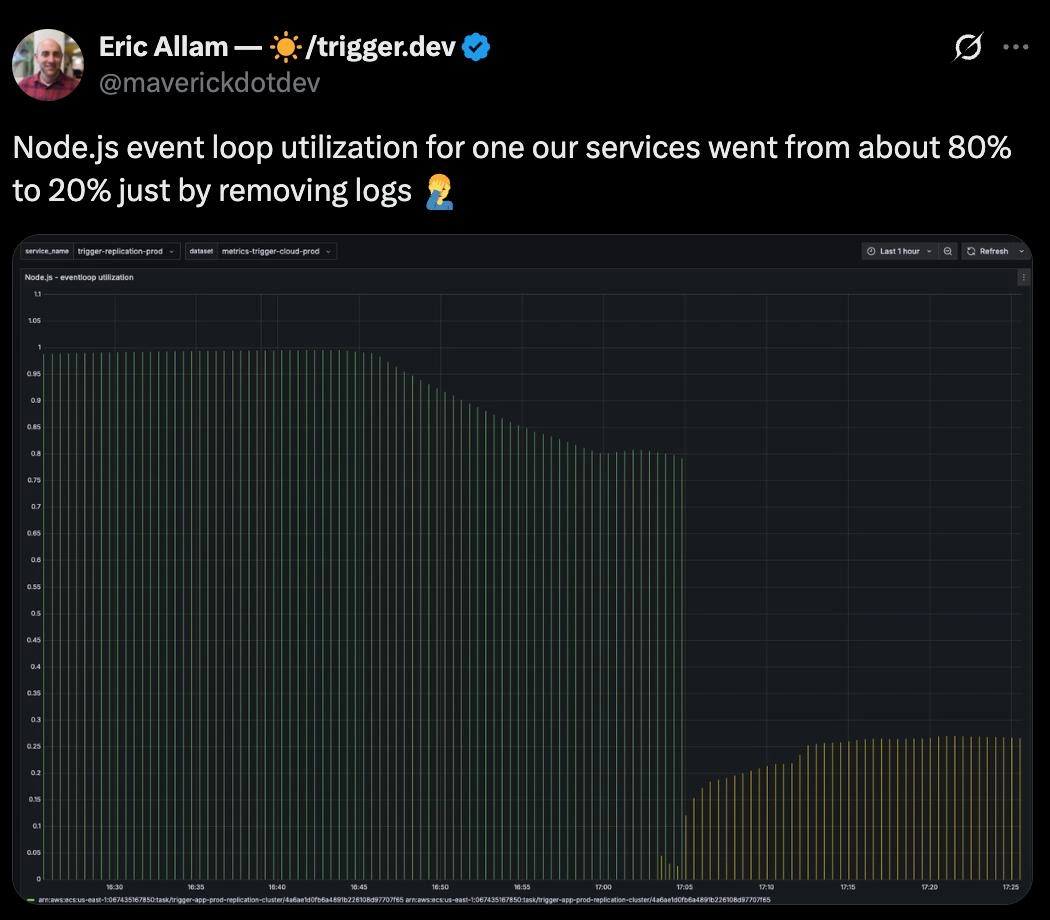
Node.js Event Loop Utilization Drops 80% to 20% by Removing Logs
Description
A tweet by Eric Allam (@maverickdotdev) from trigger.dev stating: 'Node.js event loop utilization for one our services went from about 80% to 20% just by removing logs' with a facepalm emoji. Below is a Grafana-style monitoring chart showing 'Node.js - eventloop utilization' over time. The graph clearly shows utilization around 0.95-1.0 (near 100%) that dramatically drops to approximately 0.25 (25%) at a specific point. The data is from trigger-replication-prod service on AWS ECS (arn:aws:ecs:us-east-1). The chart covers roughly 16:30 to 17:25 timeframe, with the dramatic drop occurring around 17:00
More like this
More like this in Performance →


Use J and K for navigation
Comments
30Comment deleted
console.log('why is the event loop blocked?') was literally the answer to its own question
The fastest code is the code that doesn't run. The second fastest is the code that doesn't log every single action to stdout in a blocking, single-threaded event loop
Turns out our hottest code path wasn’t business logic at all - it was printf debugging in production
The classic senior engineer moment: spending weeks optimizing database queries and implementing caching layers, only to discover your junior's console.log('HERE!!!') in a hot path was the actual bottleneck. Sometimes the most sophisticated monitoring systems just reveal the most embarrassing truths
Ah yes, the classic 'console.log() as a service' architecture pattern. Nothing says 'I care about observability' quite like synchronously blocking your event loop to write to stdout that nobody's reading anyway. At least now they have empirical proof that their logs were more expensive than their actual business logic - a 4x performance improvement just by admitting that maybe, just maybe, logging every single event in a high-throughput Node.js service wasn't the architectural flex they thought it was. The real kicker? Somewhere, a senior architect is updating their resume to include 'Achieved 300% performance improvement through strategic I/O reduction' while conveniently omitting the part where they were the one who approved logging everything in the first place
Profiler optional: in Node, grep -v 'console.log | commit' is the real hot path optimizer
When deleting console.log buys you 60% headroom, you didn’t have a Node service - you had a log shipper with a side hustle as an API
If your hottest code path is console.log(), you didn’t build a microservice - you built a diary. Deleting prose dropped ELU by 60%; turns out the event loop hates storytelling
logs are always really heavy, aren’t they? Comment deleted
Only for Node😂 Comment deleted
same thought still, 3/4 of the load looks hilarious Comment deleted
shouldn't it an async process? Comment deleted
I hope they don't mean console.log calls Comment deleted
You're saying it like there's a library dedicated just for logging Comment deleted
it's node Comment deleted
probably not because of logs itself, but because of custom formatting of nested structures Comment deleted
good logging is cheap Comment deleted
Async or not doesn't really matter Comment deleted
there are libraries for importing libraries Comment deleted
C has those too Comment deleted
But... don't you need logs? Comment deleted
there are different ways of doing that Comment deleted
I mean To utilize event loop isn't necessarily bad thing, is it? JS boys, correct me if I'm wrong Comment deleted
The event queue is the main thread. If it is 100% utilized on the core it runs on then even if you get more requests you wont be able to utilize the other cores even if you have like 255 more not being used TLDR: major bottleneck Comment deleted
But...wait Isn't that a work of scheduler to ensure that tasks are dispatched to multiple threads? Sorry if noob question, I'm from .NET background Comment deleted
There's some tasks you can only do from the main thread (typically UI stuff). Then it's the programmer's responsibility to make task that can only run on the main thread as small as possible, while allowing other work to run on other threads Comment deleted
That's for .NET / C# / Java and the like actually. If we're talking about JavaScript, in fact it's single-theaded and more or less will always be Comment deleted
An event queue is always single threaded and JavaScript isnt even multithreaded it can only handle async stuff but async isnt multithread its still even queue based Comment deleted
yes Comment deleted
You can use web workers to simulate multithreading but it's overkill for logs, doing logging async is asinine imho, they must have used something like colored logs or some other bs Comment deleted