
When a Random Poll Becomes a Monte Carlo Simulation
Description
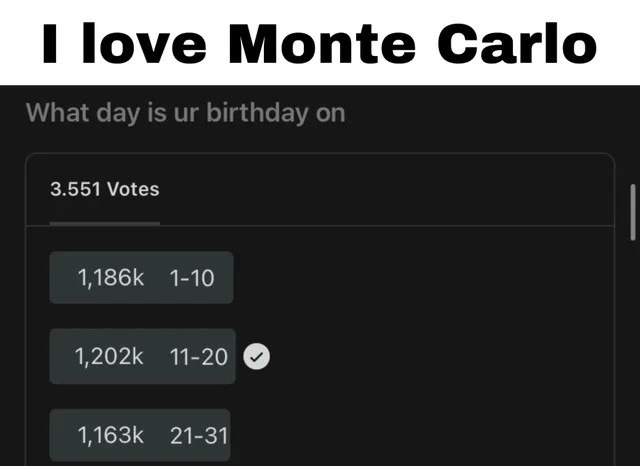
The image displays a large, bold caption, 'I love Monte Carlo,' above a screenshot of an online poll. The poll asks, 'What day is ur birthday on' and provides three options for ranges of days: '1-10,' '11-20,' and '21-31.' The results show a remarkably even distribution of votes across the options: 1,186k for 1-10, 1,202k for 11-20, and 1,163k for 21-31, with a total of 3.551 votes indicated (note: there is a visual discrepancy between the 'k' in the options and the total, but the distribution is the key). The joke is a clever reference to the Monte Carlo method, a class of algorithms that relies on repeated random sampling to obtain numerical results. The near-uniform distribution of birthdays across a large population is a perfect real-world example of the statistical principles that underpin Monte Carlo simulations. For anyone in data science, scientific computing, or quantitative fields, the image is a humorous nod to seeing a fundamental mathematical concept emerge organically from seemingly trivial data

Comments
60Comment deleted
A junior data scientist sees this and says, 'Cool, a uniform distribution.' A senior data scientist sees this, mutters 'PRNG seems solid,' and starts wondering if they can use the timestamps of the votes to estimate pi
We spent two sprints validating our PRNG; marketing’s “What day is your birthday?” poll hit χ² ≈ 0 before lunch - Monte Carlo-as-a-Service, powered by 3,551 unsuspecting users
Finally, a production environment where Monte Carlo actually converges to the expected distribution - turns out 3,551 random internet users are more reliable than our pseudo-random number generators, though I'm still waiting for someone to file a bug report about February having fewer days
When your production data accidentally validates a CS theory better than any academic paper ever could. 3,551 developers just proved that birthdays follow a uniform distribution - turns out the real Monte Carlo simulation was the friends we polled along the way. Now if only our load balancers distributed traffic this evenly
I love Monte Carlo too: run a poll to “simulate” birthdays, ignore that 21 - 31 has a bigger state space, and ship a date picker with a 4% bias - see you at the leap-year postmortem
Nothing says “data‑driven” like a Monte Carlo poll with 10/10/11‑day buckets and a locale‑broken “k” - PM calls it significant, we ask if anyone divided by bin width
Classic Monte Carlo: ideal uniform RNG in theory, Reddit-biased convergence to mid-month in prod
I guess it's this: https://en.m.wikipedia.org/wiki/Monte_Carlo_method Comment deleted
Actually it's a normal (Gauss) distribution Comment deleted
Yep finally smbody wrote that Comment deleted
And made an error Oopsie Comment deleted
Normal distribution has peak and 2 lows in both sides This is uniform distribution Comment deleted
Nope actually first and third options are those lows u are talking about so this is normal distribution it's just quite kinda low overall Comment deleted
+1 Comment deleted
Concerning amplitude of each portion small variation may be statistically insignificant Comment deleted
So it as well may be a normal distribution)) Comment deleted
Engineers don't operate with "may be"s)) There are exact formulas how to distinguish distributions by variety of criteria And for all I've learned during metrology&statistics course that's not looking like Gauss) Comment deleted
That's not uniform as well) Comment deleted
Take 100k+ survey and see yourself how BD are distributed, lol </thread> Comment deleted
And finally, as I found out from your russian texts, you lack not only knowledge in probability&statistics but also have problems with sense of humor and communication culture so yeah кек мда you are пиздец инженер))) btw we don't need 100k responses 3k is representative enough) u r welcome) Comment deleted
Тоесть все свелось к: "Это ж просто мем, ты не умеешь в юмор" Апелляции к культуре общения (будто комуто не насрать на нее) и телепатия по поводу знаний в статистике "Ну такто там будет равномерное распределение, но в этом то случае мы видим же что чиселки разные на картинке!!" А, ну и да, продолжать дальше отвечать на англ человеку знающему русский, это вообще за гранью) Comment deleted
Anyway well we are talking about three columns so that's kind of incorrect a little bit in terms of analysis) Comment deleted
. Comment deleted
Каким образом число родившихся людей по дням месяца у вас нормальное распределение? ебаный стыд. Может еще число родившихся людей по дню года у вас нормальное распределение? Comment deleted
Да смотрю тут пиздец инженеры собрались Comment deleted
/ Comment deleted
Определяют распределения по 3 точкам и с уверенностью находят нормальное, хотя тут его нет и не может быть Comment deleted
Кек мда Comment deleted
Well we were discussing these three columns on the meme and not the function of human birthdays (f(date)) so u r taking it too serious)) if we would like to analyze all 365 days for sure it will not be neither uniform nor normal distribution, but closer to the second one because there is some low peaks on the end of the spring-summer, likely a composition of a few normal distributions) Comment deleted
Those peaks locations through the year depends on tons of different factors including possibility of unexpected ones like pandemic) And about the dates distr. on meme - it's tricky and yeah, in general it will be uniform distribution but in this particular case those three columns can form (if we can say so lol, as I mentioned before it's kinda incorrect approach) low-peaked normal distribution (we still have those 3.4% of difference, as well as they may not so we cannot tell exactly because we don't know a lot of details) Comment deleted
well i know google translate service) Comment deleted
Ждем-с что будет дальше Comment deleted
so your only defense is that it can be statistical error? well, i`ll be waiting for your proof using those formulas you were talking about) Ive said enough and your message just confirms all that i said above) Comment deleted
my god, calm down Comment deleted
y u dont say same thing to the guy who thinks its cool to demonstrate his own ego by writing offensive phrases Comment deleted
…I can't speak russian man. Even so, it's the internet. Don't get offended, that's just pointless. Comment deleted
i cant too Comment deleted
but still it looks like he (or she) expected that i won't find out) Comment deleted
find out what? Comment deleted
that he says about people who got in the discussion that they`re shitty engineers Comment deleted
so what? Comment deleted
well i tried to explain my point of view so that was kinda disrespectful but well at least i feel my satisfaction in the end thankfully to my knowledge not the curses) Comment deleted
ok so I just translated his texts with google translate, and maybe I'm missing something, but from my point of view, you're just being obnoxous Comment deleted
Omg, it was just a joke Still you are not right At first, it's discrete so there are no "normal" or "uniform" distributions in here At second, it's even not discrete-uniform in the limit (there are less 29-31 days in months) Comment deleted
yep exactly! Comment deleted
then where's the problem? Comment deleted
''Yes, I look here asshole engineers gathered'' Comment deleted
translates to "yes, I look here fucking engineers gathered" on my machine but even if he called you an asshole… get over it, geeze Comment deleted
Your first point isn't really relevant but your second one is true Comment deleted
It's matter only in a context of being "statistically correct" which was mentioned earlier Comment deleted
here) Comment deleted
it was his message Comment deleted
well i already got) the last ten minutes i was exaplaining to you why i answered him but u still dont see the problem Comment deleted
no Comment deleted
and i will get over it too)) Comment deleted
then don't complain please Comment deleted
i wasn't going but ok Comment deleted
you were the whole time but ok Comment deleted
what? Comment deleted
привет я россия Comment deleted