
Mathematics Post #7814 · source on Telegram
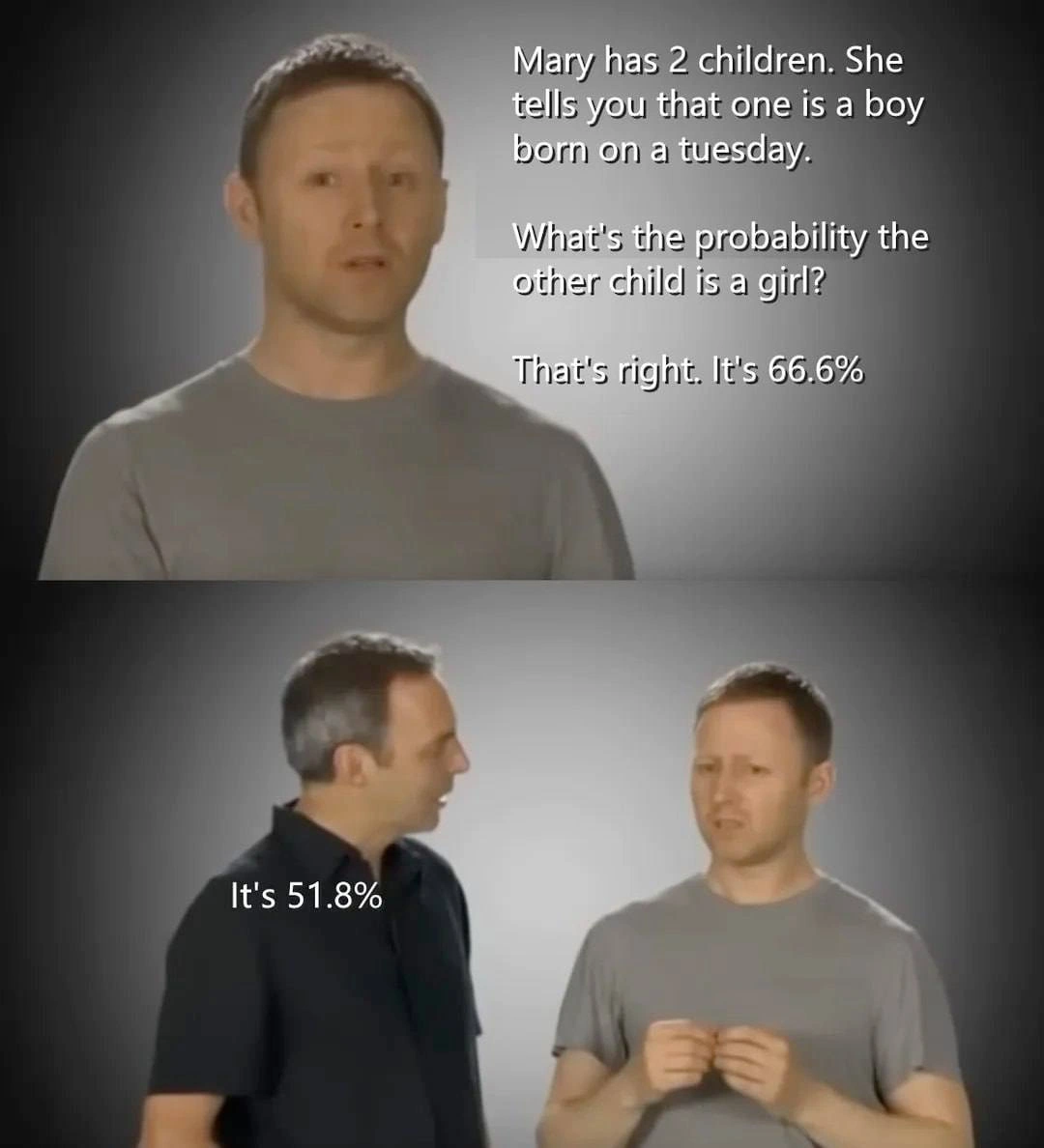
Boy Born on a Tuesday: 66.6% vs 51.8% Probability Standoff
Description
A two-panel meme using stills from the Limmy's Show 'steel vs feathers' sketch. Top panel: Limmy in a grey shirt faces the camera with overlaid text: 'Mary has 2 children. She tells you that one is a boy born on a tuesday. What's the probability the other child is a girl? That's right. It's 66.6%'. Bottom panel: a second man in a black shirt turns to him and says 'It's 51.8%', leaving Limmy visibly confounded. This references the famous 'Tuesday boy' conditional probability paradox: naive two-child reasoning gives 2/3 (66.6%), but conditioning on the extra 'born on Tuesday' information yields 14/27 ≈ 51.85% - a counterintuitive result beloved by probability nerds and interview-question sadists
More like this
More like this in Mathematics →
Use J and K for navigation
Comments
121Comment deleted
Like every estimate in engineering, the answer changes the moment someone adds one irrelevant-sounding detail to the ticket
Nothing turns a family into a Cartesian product faster than conditional probability.
Never understood combinatorics Comment deleted
But biologically it's 50% Comment deleted
Correct. After 1 the odds increase or decrease, depending on previous results though. Less likely to repeat the same thing basically Comment deleted
So answer should be 25% because 2nd child has also 50% chance for being a boy? Comment deleted
50% chance for being a girl but also higher chance for both to not repeat the same result Comment deleted
Ahhh, got it Comment deleted
Yeah, it otherwise would be a 50% chance every time with the exception of likelihood two things will be the same number. You could go further and calculate also based on family history and a bunch of other factors too Comment deleted
But the event are independent, isnt it? Explaining that (independent) events do not affect the probability of future events in a sequence is challenging because the human brain is wired to find patterns and assume that streaks will "even out". This cognitive error is known as the Gambler's Fallacy. Comment deleted
It's both, depending on how you look at it Comment deleted
Same thing with a coin toss Comment deleted
the interesting part is that since genetics are involved, they're not actually independent. e.g. https://www.science.org/doi/10.1126/sciadv.adu7402 says We observed that a balanced offspring sex [i.e. FM (female-male) or MF] was the most frequent family composition in sibship of size of 2, but a clustering of single sex (e.g. MMM and FFFFF) was generally more frequent in subship of size 3 or larger Comment deleted
Nice, 0.519 it says. Probably the meme refers to that exact value too Comment deleted
Is that really because of genetics, or because people are more likely to have another child if the first two have to same sex ? Comment deleted
The paper says they removed the youngest child from the consideration to account for the possibility of families stopping reproduction because their child was of a gender they didn't like, which I guess worsens this issue Comment deleted
see the "Sensitivity analysis" section of the paper Comment deleted
Therefore, in two separate analyses, we (i) excluded obvious “coupon collectors” (i.e., women who only stopped producing offspring after both offspring sexes are reached) and (ii) more conservatively excluded the last birth of every woman I guess they handled this issue at least somewhat Comment deleted
it's no posterior probability, second child is still either a girl or a boy Comment deleted
https://en.wikipedia.org/wiki/Gambler%27s_fallacy Comment deleted
This has nothing to do with it. Comment deleted
Yes it does, I explained why Comment deleted
It is forty something. Depending on woman’s age actually. 1. There are more boys than girls indeed, about 105:100. 2. Also the events are not fully independent, the kids tend to have the same sex as the previous births and the tendency grows stronger with the mother’s age. Comment deleted
Is that actually true? Wikipedia mentions the opposite figure here Comment deleted
https://www.pewresearch.org/short-reads/2013/09/24/the-odds-that-you-will-give-birth-to-a-boy-or-girl-depend-on-where-in-the-world-you-live/ You are right, this info is dated. And also incorrect, thanks AI While historically, there have been about 105 boys born for every 100 girls worldwide — which creates a “sex ratio at birth” of 1.05 — the share of boy babies has increased in recent decades. 2011 data from the World Bank show the global sex ratio at birth is now 1.07, or 107 boys born for every 100 girls. Comment deleted
When thinking on probability you can arrange the event results in a table G : girl b : Boy Plotting this out: B B B G G B G G Comment deleted
We know that one is a boy so GG is ruled out The remaining ones are BB BG GB BG GB Are both valid answers that result in one boy and one girl so 66.6% chance (2 of the 3 remaining options result in a boy girl set) This is the part 1 Comment deleted
It just breaks my mind how answer can be different depending how we put the question Comment deleted
In general it's 50% chance for a child to be girl but if we want to guess a childs gender when we already know that 1st is a boy it's 66% Comment deleted
The joke is that something that biologically is a 50% chance. Mathematics take that and make it no longer make sense (66.6% And then you apply mathematics even harder and it returns to normalcy 51.8% Comment deleted
But 66% makes sense for the problem Comment deleted
We should test their DNA to determine the answer more accurately Comment deleted
But 51.8% yeah, it's funny Comment deleted
I'm sorry, does no one here know math? Comment deleted
Part 2 Because we specify that the boy is born on a Tuesday you now have to count all the combinations of the two births in of a boy girl pair, while also accounting for the 7 days of the week. (I CBA do plot that out in text) By doing that you get 51.8% Comment deleted
https://youtu.be/JSE4oy0KQ2Q?si=RGRhsVeOcOGIgPCX Comment deleted
Here is the full video which explains this joke Comment deleted
Everyone take 7 minutes of your day to watch this video by this amazing channel about the topic Comment deleted
Thank you Comment deleted
Well, that can't be right. With the weekday added, the elements of the probability space are two tuples of (gender, weekday). There's 14^2 elements in the probability space in total, and by saying there's a boy born on Tuesday, we're limiting it to 14 * 2 - 1 = 27 elements (((Boy, Tuesday), (..., ...)) and ((..., ...), (Boy, Tuesday)), and ((Boy, Tuesday), (Boy, Tuesday)) is counted twice). Out of this set, exactly 7 * 2 = 14 elements contain girls (((Boy, Tuesday), (Girl, ...)) and vice versa). This gives 14 / 27 = 2 / 3 as well Comment deleted
14/27 =/= 2/3 Comment deleted
yeah, thanks. now I'm confused Comment deleted
=/= means does not equal Comment deleted
I understand what you're saying, I was mistaken Comment deleted
I guess this makes sense because you're making states more distinguishable Comment deleted
I'll proudly state I believed 3 * 7 = 27 for like five minutes. I should probably get more sleep Comment deleted
What I imagine the accounting department at Enron was circa 2001 Comment deleted
Does that mean that we can make the likelihood whatever we want just by tossing in whatever measurements we want into it? Comment deleted
ah, apparently I can't count. thanks Comment deleted
The first set on the left shows 7 sets in one row, then 6 Comment deleted
Which can be represented as 7, 6. The inverse being 6, 7 Comment deleted
B⁰ meaning Boy born on Sunday B¹ meaning boy born on Monday This table is showing all results in which have at least B² meaning at least one boy born on Tuesday You can't show the same result twice that's why there is one result 'missing' Meaning 14/27 Instead of 14/28 (50%) Comment deleted
I think I lost all 3 of my remaining brain cells reading this thread Comment deleted
Lost you mean you finally used them up? Comment deleted
No, I mean, this is maths brainrot Comment deleted
Watch the video Comment deleted
I understand the concept of the paradox, but the way the you are building the sample space is not correct. If you don't have info on the ordering of the children, then you cannot include it in the sample space and (Bx, Gy) and (Gy, Bx) are the same and are double counted in the video, now if we have the information on if the boy was born first or second, then either all BG are invalid or all GB are invalid. In both those cases the probability is back to 50% Comment deleted
That's not quite the right interpretation. The idea behind the choice of the sample space is that the birth of two children are treated as independent events, and so the sample space for event A followed by event B must be the cartesian product, that is, ordered tuples of events (A, B). By merging (girl, boy) and (boy, girl), you'd be implicitly saying that birthing a boy and a girl is just as likely as birthing two boys, even though it's equivalent to winning a coin flip once (first birth is "free", second birth to get a different gender) rather than twice (getting boys both times). Comment deleted
No, I am not. The point is that by not considering (Bx, Gy) and (Gy, Bx) the same you are implying that there is some kind of difference between them. From the text of the problem there is no difference between them, so they are double counting Comment deleted
There's also already a boy in the existing subset first, so no need for the statistics with girl first Comment deleted
Look at it this way. If I'm flipping a fair coin and, for whatever reason, instead of the sample space {heads, tails}, I use the sample space {heads, (tails and it's daytime), (tails and it's nighttime)}, then it's redundant, but as long as P(tails and it's daytime) + P(tails and it's nighttime) = 0.5, I'll get the exact same answers. Drawing a difference between boy+girl and girl+boy might be redundant in some way, but it's just a trick to keep the sample space uniform. You can, of course, replace the sample space with {{boy, boy}, {girl, girl}, {boy, girl}}, and make the 3rd option twice as likely as others. That'll give you the same results: P({boy, boy}|{boy, boy} or {boy, girl}) = 0.25 / 0.75 = 1 / 3 Comment deleted
You are assuming that the children are distinguishable, this was not given in a problem. Don't make assumptions about the sample space Comment deleted
Let's make it clearer. What exactly are you disagreeing with? Are you disagreeing with the claim that the probability of having a girl and a boy is twice as large as the probability of having two girls? Comment deleted
The 51.8% paradox and the 66.6% one Comment deleted
They stem from the same assumption of distinguishablity of objects Comment deleted
In my previous comment, I've mentioned that you can drop distinguishability as long as you can still assume that P(has girl and boy) = 2 * P(has two girls). Do you agree with this equality or not? Comment deleted
The issue with this is that if we know nothing about the probability space, we don't even know if it's uniform. You could argue that we're not told that children are distinguishable in the problem statement, but then we don't know if we're on Mars where there are three sexes, or where there are 10 times as many boys as girls, or where everyone can only birth people of a single sex. There necessarily has to be some inherent knowledge here, and the knowledge we're choosing is that births are independent. That implies distinguishability. Comment deleted
The only one making sense being the latter btw Comment deleted
But only if you keep in mind bg bb gg set would discredit the last one and still produce 50/50 Comment deleted
No it fucking doesn't. GB and BG are equivalent unless told otherwise. If you say that the boy was born first for example, then you have a way to distinguishe the children and suddenly GB and BG are not the same, but at the same time GG and GB are not valid, and we are back to 50% Comment deleted
I already explained this in the reply I added to expand upon it, as well as you already stating this earlier. It only makes sense in bg bb gg format, which excludes gg Comment deleted
You cannot assume this. You're not told they are equivalent, just as you're not told they are not equivalent, therefore you can't assume this, therefore the problem is not solvable without assumptions. You have to make some choice here, and that for that choice to consistently represent the real world, you have to make them distinguishable Comment deleted
That's the issue, I am not assuming anything, you are assuming that two children are distinguishable from each other Comment deleted
"GB and BG are equivalent" sounds like you're assuming equivalence Comment deleted
or, screw equivalence, you're assuming the sample space is uniform, which is worse and what we should actually be focusing on Comment deleted
so I repeat my question: do you think there are as many families with a boy and a girl as there are with two girls? does that match your intuitive understanding of the world or your experiences? Comment deleted
In the real world children are distinguishable, and we know that. In a math problem if you give me no way to distinguishe the children then I won't be able to, and will be forced to count them as indistinguishable Comment deleted
You're a free man, no one forces you to do anything, you can say the problem is not solvable as given and go for a walk Comment deleted
you don't have to go out of your way to invent defaults that don't match the real world and only come to your mind because it's the simplest alternative Comment deleted
There are no invented defaults, math does not exist in our physical world, it exists outside of it, so if you are using it in the real world, then you need to define all the assumptions you are making Comment deleted
Assuming the probability space is uniform is a (wrong, in this scenario) default Comment deleted
You are making the same assumption Comment deleted
If we don't define the probability of a boy and girl as .5 and the probablity of a child being born on a certain day of the week as 1/7 the paradox falls apart anyways Comment deleted
The only one making any sense would be 66% and only if the boy didn't already exist Comment deleted
If you are such a stickler for the rules, just add assume uniform model in the end of the problem, my point still stands Comment deleted
If you add the uniform assumption, then of course I'll agree with you. It's just that it doesn't agree with reality, so it no longer works as a gotcha, but rather becomes an abstract mathematical trick, at which point what are we even doing. Comment deleted
You are assuming uniformity as well, so what you are says, you agree with me Comment deleted
I'm assuming a) uniformity of genders of a single child, b) independency and distinguishability of child births. I am not assuming uniformity or non-uniformity of the overall probability space, not directly Comment deleted
I hope this finally resolves it. i took your assumtions Comment deleted
> [...] the “14/27 paradoxical result” arises only when the problem ambiguously mixes cases without specifying which child is meant. yes, this ambiguity is the whole point... Comment deleted
Honestly, truce? I am kinda tired of this argument. I already written a pdf on this shit Comment deleted
bro wrote a pdf yea, same Comment deleted
Wait till they're offered to choose door and allowed to change their decision later 🌚 Comment deleted
Girl has 0 chances when there's boy next door Comment deleted
If you have no input to distinguishe them, then that are equivalent, not assuming anything Comment deleted
bro thinks children and fermions Comment deleted
GB can't be used in the existing set because B already exists Comment deleted
can you elaborate? Comment deleted
Think of it as an equation. B is already given and you're trying to determine all possible sets with G and B. You'll get BG, BB Comment deleted
My example doesn't include all combinations of both B and G because B already exists Comment deleted
I understand what you're saying but you couldn't have said it more confusingly Comment deleted
Boy already exists, ooga Chance of girl, booga Boy boy or boy girl, unga 50/50 booga 50 percent ooga Comment deleted
When you're saying this, you're implicitly saying that "boy boy" and "boy girl" are equivalently likely. Phrased otherwise, you're saying that having two children of same gender is twice as likely as having two children of different gender. Does that sound right to you based on your experience? Comment deleted
You're starting to get it now. It's almost as if two variables have a 50/50 or 50% chance of getting picked, just like a coin toss Comment deleted
Do you have a coin nearby? Comment deleted
Do you? Preferably of solid gold Comment deleted
Do me a favor, run an experiment like 20 times. Throw two coins and count the occurrences of "two heads", "two tails", and "head and tail". Tell me if you'll get a 33/33/33 distribution or a 25/25/50 Comment deleted
do me a favor as well, do this too Comment deleted
If only the boy didn't exist already or you were looking for the chances of a specific pairing if two kids were made Comment deleted
If you take all the families that have at least 1 boy out of 2 children, like in The problem, then yes, BB and BG are .5 each Comment deleted
Otherwise 66% makes sense if you're determining the likelihood you'll have a girl or boy when having two kids Comment deleted
Not with one though, because boy already exists Comment deleted
Change the problem to red and blue pencils instead of children and recalculate. Your answer must not change, since mathematically the problems are the same Comment deleted
But with indistinguishable objects the (x, y) and (y, x) are equivalent Comment deleted
The only major issue with this is it's not a coin toss, so there's no real controllable factor to determine this and so it still just goes back to 50%, despite all the gambling and statisical likelihood percentages Comment deleted
Exactly my point, they are independent Comment deleted
The correct answer should be even less than 50%, because on average, there are more newborn boys than girls (in human race) Comment deleted
Canon event Comment deleted
#whalegang 🐳 Comment deleted
Fascinating thread. Brightest example of how bureaucracy is solving a made up problem with math without applying common sense Comment deleted
@victorbratov @purplesyringa conditional probability is meaningless until the selection rule is specified. You are only allowed to study probability if you have two kids and at least one son born on Tuesday. You are selected at random from all eligible contestants. What is the probability that your other child is a girl? and you get 14/27 if it's a real life talk about your kids, then Tuesday condition doesnt bring anything meaningful to the context - it's just noise. Therefore you can guess the gender of the other child with 50% possibility - no info whatsoever, 2 variants Comment deleted