
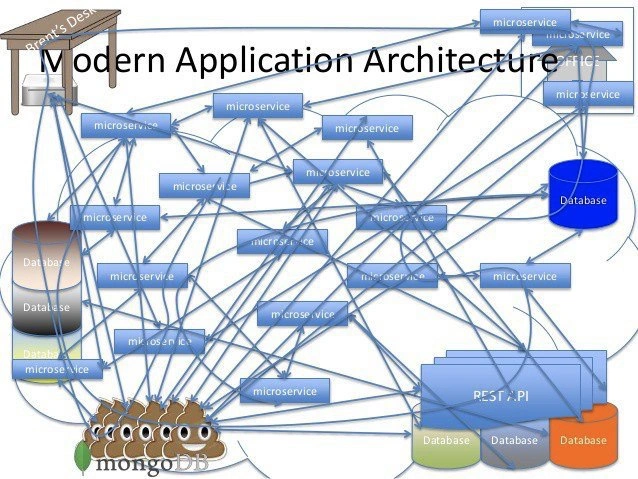
Modern Application Architecture: A Microservices Spaghetti Diagram
Description
A satirical architectural diagram titled 'Modern Application Architecture'. The diagram depicts a chaotic and tangled web of dozens of blue boxes labeled 'microservice', all connected by a dense mesh of intersecting blue arrows, creating a classic 'spaghetti architecture' visualization. Various database symbols are scattered throughout: a blue cylinder for a generic 'Database', a stack of three cylinders on the left, a stack of three colored cylinders connected to a 'REST API' layer, and most notably, a cluster of smiling poop emojis labeled 'mongoDB'. In the top left, a simple desk labeled 'Brent's Desk' is also connected into this mess. The image humorously critiques the often-overhyped and poorly implemented reality of microservice architectures, which can devolve from an organized, decoupled system into an unmanageable, tightly-coupled monolith, often referred to as a 'distributed monolith'. The pointed jab at MongoDB plays on old criticisms of the database regarding data consistency and reliability, humorously depicting it as a pile of... well, you know



Comments
7Comment deleted
Ah, the 'Modern Application Architecture' - also known as the 'dependency graph that looks like a Jackson Pollock painting.' The best part is the single sign-on is managed by that service connected to Brent's desk
Turns out giving every squad its own microservice just implements Conway’s Law in O(n²) network calls - and the tracing budget in O($∞)
We successfully decomposed the monolith into microservices. Now we have 47 ways to lose the same customer order and a distributed tracing setup that costs more than the revenue it's supposed to track
This diagram perfectly captures the moment when 'Let's break the monolith into microservices' transforms into 'We've created a distributed monolith with network calls.' Every senior architect has seen this evolution: start with 3 well-defined services, end with 47 'microservices' that all need to talk to each other synchronously, turning your O(1) function call into an O(n²) network topology problem. The real kicker? That MongoDB at the bottom is probably being hit by 15 different services with no clear data ownership, and the 'REST API' box is desperately trying to orchestrate this symphony of cascading failures. At least with the old monolith, you could debug it with a single breakpoint
We didn’t decompose the monolith - we just horizontally scaled the outage across 37 chatty services and five ‘single’ sources of truth
We didn’t build a service mesh - we built a complete graph; every request tours 12 “independent” services, consistency is eventual, and the trace ends at the client’s desk
Microservices: trading monolith simplicity for a distributed system where tracing a request feels like debugging a kernel panic across 50 pods