
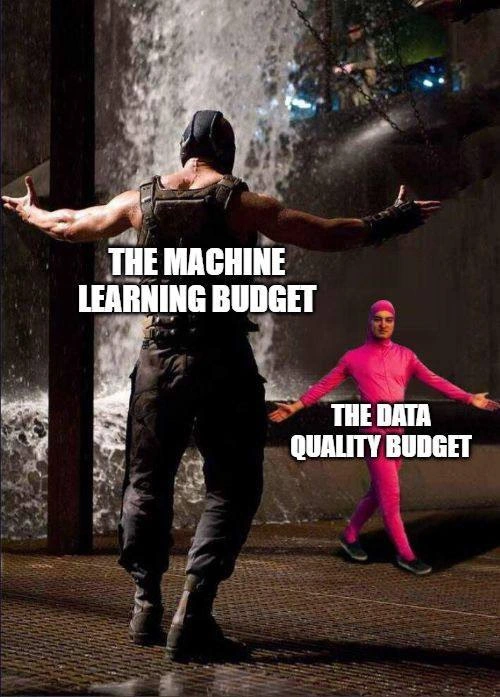
When your machine learning budget towers over the measly data quality funds
Description
A dramatic cinematic scene shows a tall, muscular masked villain in dark tactical gear standing center-stage with arms spread wide while water crashes behind him in a dim industrial tunnel. Off to the right, a much smaller person in a full-body neon-pink morph suit imitates the same open-armed pose. Bold white impact-font captions overlay the figures: "THE MACHINE LEARNING BUDGET" sits across the large villain’s torso, and "THE DATA QUALITY BUDGET" sits across the tiny pink figure. The stark size and costume contrast visually lampoon the disproportionate investment many organizations make - lavish funds for sophisticated machine-learning projects versus token amounts for essential data-quality work. The meme resonates with engineers who know that without clean, validated data pipelines, the most expensive models quickly crumble



Comments
6Comment deleted
Quarterly planning be like: $4 M to fine-tune a transformer on petabytes of clickstream noise, and a $25 Starbucks card for whoever figures out why “NULL” is a valid SKU in half the tables
We spent $10M on GPUs to train a model that predicts customer churn with 99.8% accuracy, which would be impressive if our data pipeline didn't think every NULL was a churned customer from 1970
Every ML team's budget allocation perfectly captures the industry's collective delusion: we'll throw millions at GPUs and the latest transformer architectures, but suggest hiring a data engineer to actually clean the training set and suddenly it's 'let's revisit this next quarter.' Turns out you can't BERT your way out of garbage data, but try explaining that to a VP who just read about ChatGPT on LinkedIn
Stakeholders flood the compute budget like Bane's waterfall, starving data pipelines - classic recipe for models that ace benchmarks but hallucinate in prod
Pro tip: if the data quality budget fits in a Jira subtask, your A100s will just optimize for missingness - turns out you can’t backpropagate integrity
Execs drop millions on GPUs, then wonder why the ‘SOTA’ model drifts whenever a vendor flips commas to semicolons - turns out gradient descent can’t backpropagate into broken data contracts