
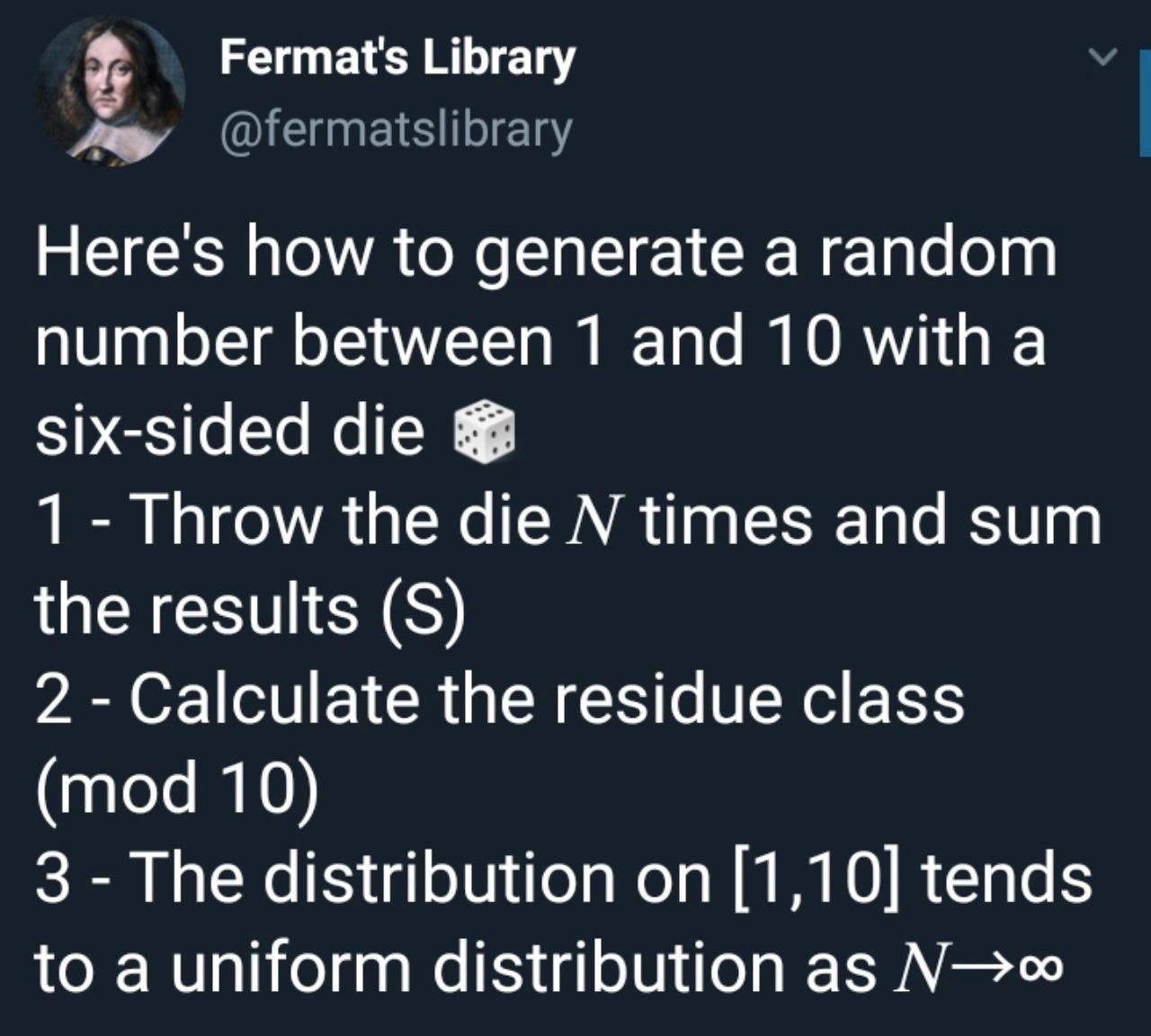
Enterprise-Grade Random Number Generation
Description
A screenshot of a tweet from the account 'Fermat's Library' (@fermatslibrary) against a dark blue background. The profile picture is a classical portrait of a man. The tweet presents a complex, three-step method to generate a random number between 1 and 10 using a standard six-sided die, complete with a small die emoji. The steps are: '1 - Throw the die N times and sum the results (S)', '2 - Calculate the residue class (mod 10)', and '3 - The distribution on [1,10] tends to a uniform distribution as N→∞'. This meme finds its humor in the academic and overly-engineered approach to a simple problem. For developers, generating a random number is a trivial one-line command. The method described, while mathematically sound and related to principles like the central limit theorem, is comically impractical for a real-world application. It's a joke about the gap between theoretical computer science/mathematics and practical programming, satirizing solutions that are technically elegant but absurdly complex for the problem at hand


Comments
7Comment deleted
This is how you generate a random number when the PM asks for it to be 'enterprise-ready' and 'infinitely scalable'
Sure, it’s O(∞) in wall-clock time, but at least the statistical test suite passes in the limit - just ship it behind a feature flag called ‘eventual entropy.’
This is exactly how we designed our random number service: it achieves perfect uniformity after infinite API calls, but the infrastructure team keeps complaining about the AWS bill approaching infinity at the same rate
When your random number generator is so enterprise-grade that it requires O(N→∞) time complexity and a PhD in number theory to explain why rolling a d6 repeatedly is 'better' than just using Math.random(). Meanwhile, production is down because someone's still waiting for N to approach infinity before they can generate their first random number for the load balancer
Summing d6 rolls and taking S mod 10 is the RNG version of eventual consistency - mathematically uniform as N→∞, but your SLA and on-call both sample at very finite N
Mathematician’s RNG: a random walk on Z10 with a uniform stationary distribution; engineer: great, but what’s the p99 for N - can we just use base‑6 rejection sampling before the heat death of the universe?
rand() % 10 for juniors; real uniformity demands N→∞ dice throws and infinite patience