
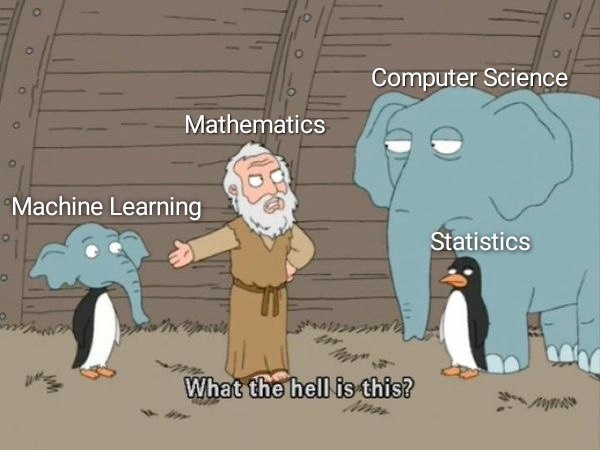
The Unholy Offspring of CS and Stats
Description
A meme using the 'What the hell is this?' format from the animated show Family Guy, set on Noah's Ark. Noah, labeled 'Mathematics,' looks bewilderedly at a hybrid creature that is part elephant and part penguin. This creature is labeled 'Machine Learning.' To the right, a full-sized elephant labeled 'Computer Science' and a penguin labeled 'Statistics' stand together, implied to be the parents. The scene humorously portrays Machine Learning as the strange and unexpected offspring of Computer Science and Statistics, with Mathematics as the foundational discipline looking on in confusion. This resonates with developers and data scientists who understand that ML is an interdisciplinary field combining algorithmic principles from CS with theoretical foundations from statistics

Comments
7Comment deleted
Machine Learning is what happens when you let statisticians write production code and software engineers play with probability
Machine learning: too statistical for CS faculty meetings, too CS-heavy for statisticians - and the mathematician still wants a proof of convergence
Machine Learning is just linear algebra wearing a trench coat, trying to convince venture capitalists it invented thinking while Statistics quietly does all the actual work and Computer Science takes credit for the GPU bills
Machine Learning: the field where statisticians think you're doing computer science, computer scientists think you're doing statistics, and mathematicians are just confused why you keep calling matrix multiplication 'deep learning.' Meanwhile, ML practitioners are too busy tuning hyperparameters to care about their existential identity crisis
ML engineer after years of GPUs: 'Wait, statistics? Isn't that just the prior for my next ensemble model?'
Machine learning is statistics in an elephant costume with a CUDA budget; CS asks about complexity, math wants a proof, and prod just wants an SLA
Every roadmap meeting says “AI,” data science says “statistics,” engineering says “Kubernetes,” and we ship regularized logistic regression behind a REST endpoint - prompting the mathematician to ask, “What the hell is this?”