
The Personal Apple Silicon Supercomputer Cluster
Description
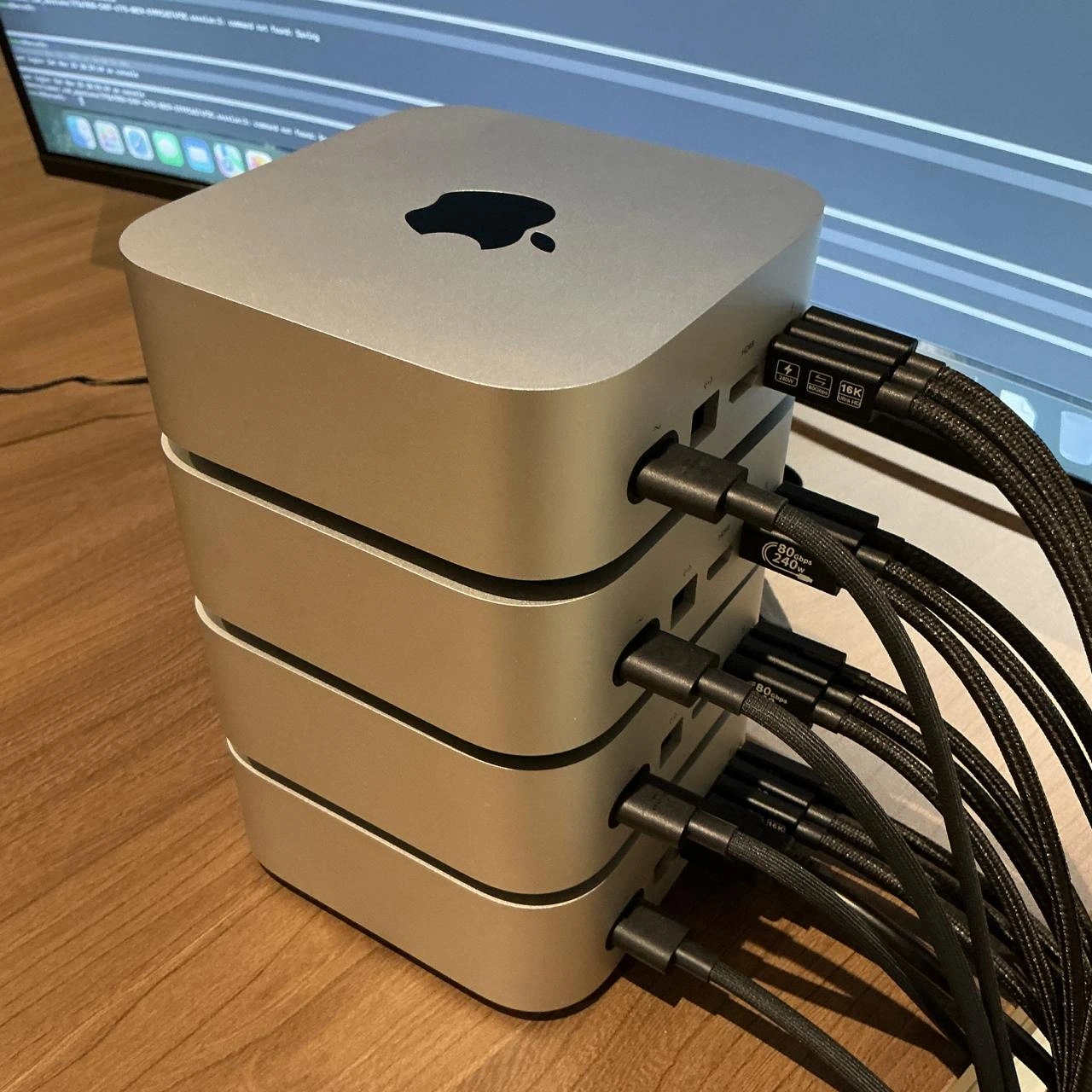
A high-resolution photograph shows four silver Apple Mac Studio (or Mac mini) computers stacked vertically on a wooden desk. A multitude of thick, black braided cables are plugged into the various ports on the back of each machine, suggesting a complex, interconnected system. Some of the cable connectors have visible labels indicating high-performance specifications, such as '16K' and '80Gbps 240W'. In the out-of-focus background, a large computer monitor displays lines of code or terminal output. This image showcases a powerful, do-it-yourself compute cluster. By linking multiple high-performance machines, the user has created a personal supercomputer, likely for demanding, parallelizable tasks such as training large AI models, running complex scientific simulations, or high-resolution video rendering. It's a testament to the power of modern prosumer hardware and a practical example of building a 'homelab' data center, leveraging Apple's potent unified memory architecture for workloads traditionally dominated by server-grade hardware
Comments
7Comment deleted
This is a senior engineer's homelab, also known as 'what happens when someone says 'just scale horizontally' and you have an expense account with a rounding error.'
Because nothing says “enterprise-grade scalability” like Kubernetes nodes you can accidentally knock over while reaching for your coffee
When you realize your "distributed system" is just three Mac Studios held together by $2000 worth of Thunderbolt cables and the desperate hope that Apple's warranty covers whatever happens when you explain this setup to finance
When your CI/CD pipeline needs more horsepower but AWS bills are giving you anxiety, so you build a Mac Mini cluster and tell yourself it's 'cost-effective infrastructure' while ignoring the Thunderbolt cable budget that rivals a small country's GDP. At least when it goes down, you can't blame 'the cloud' - just your questionable life choices and the realization that you've essentially built a very expensive, very pretty space heater that occasionally compiles code
Kubernetes who? This cluster scales infinitely - until physics intervenes
iOS CI at scale: four headless Xcodebuild agents and a Thunderbolt octopus - throughput still capped by codesign/notarization; autoscaling means buying another Mac mini
Autoscaling our iOS pipeline: add another Mac mini until codesign starts failing in parallel - CAP theorem says portable, compliant, cheap; we picked compliant and cable spaghetti