
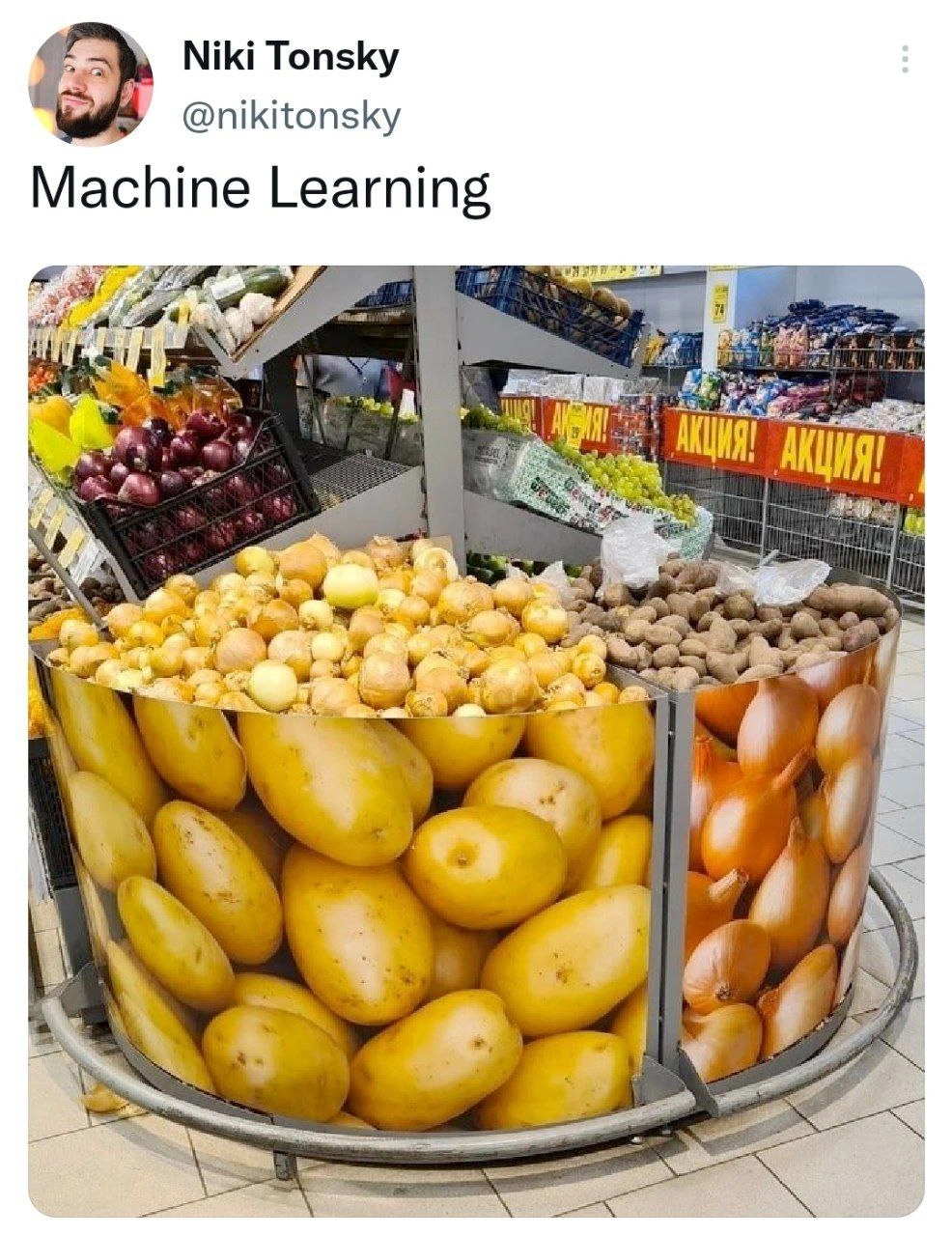
When the training labels come from marketing, not the dataset
Description
Screenshot of a tweet from user “Niki Tonsky @nikitonsky” with the caption “Machine Learning.” The attached photo shows a circular produce stand in a grocery store. Around the outside, large printed photos depict golden potatoes on one panel and brown onions on another, visually indicating where each vegetable should go. Inside the bins, however, the contents are mismatched: heaps of onions sit behind the giant potato image, while piles of potatoes are behind the onion image - an almost perfect real-world confusion matrix. The bright retail signs read “АКЦИЯ!” (sale) and the surrounding aisles are packed with typical supermarket goods. For engineers, the scene mirrors a model that confidently but incorrectly classifies images, highlighting the perils of poor labeling, dataset drift, and unvalidated production deployments



Comments
6Comment deleted
Proof that if your data engineers outsource labeling to the produce aisle, your confusion matrix will literally be edible
Finally, a machine learning model with 100% accuracy, zero false positives, and no need for a data scientist to explain why it thinks a banana is a stop sign
When your grocery store's produce sorting algorithm achieves better separation than your k-means clustering implementation, but with O(rotation) time complexity and zero GPU requirements. Turns out the real machine learning was the mechanical engineering we met along the way - no training data, no overfitting, just good old-fashioned deterministic sorting with 100% accuracy and a confusion matrix that's literally just potatoes confused with onions
Deployed ResNet straight from ImageNet: now potatoes, onions, and nuts share the 'earthy blob' superclass
Classic shortcut learning: the model keyed on the potato poster, aced validation screenshots, then faceplanted in production produce
The model is fine; your annotator overfit to the signage budget