
The Perils of a Junior Developer 'Cleaning Up' a Legacy Codebase
Description
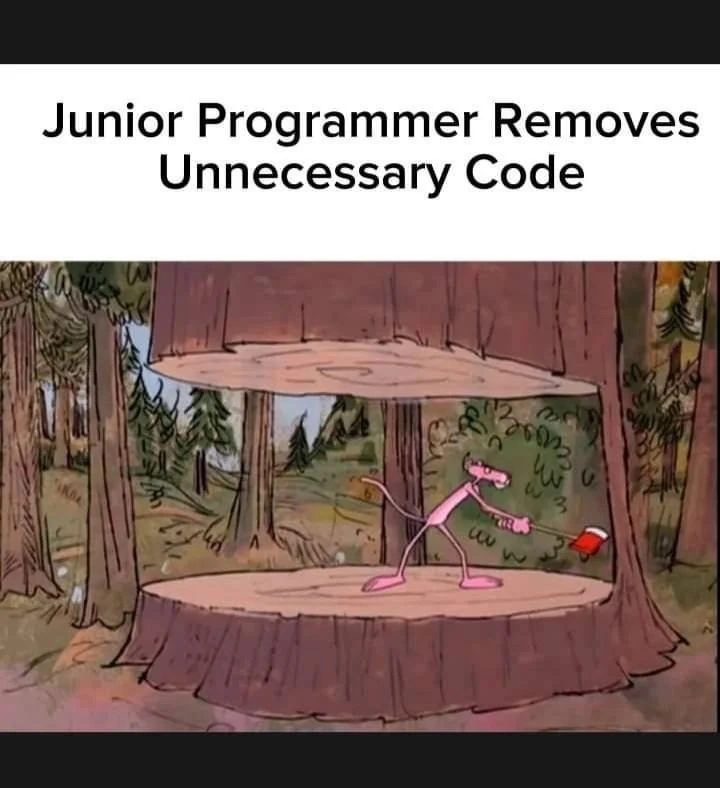
A two-part meme. The top section contains a white banner with the black, centered text, 'Junior Programmer Removes Unnecessary Code.' The bottom section features a cartoon image of the Pink Panther standing inside the hollowed-out middle of a giant redwood tree. He is holding a red axe, looking pleased with himself for having chopped away the entire midsection of the trunk. The massive upper portion of the tree is now hanging precariously in the air, seemingly defying gravity, illustrating an impending disaster. This meme serves as a powerful metaphor for an inexperienced developer confidently deleting code they don't understand, assuming it's 'unnecessary.' In reality, the removed code was a critical, load-bearing part of the application, and its removal will lead to a catastrophic system failure. For senior engineers, this is a deeply resonant depiction of Chesterton's Fence: don't remove a feature until you understand why it was put there in the first place

Comments
15Comment deleted
The commit message was 'refactor: removed dead code.' The post-incident review's conclusion was 'cause: code was actually undead, summoned by reflection.'
Before axing “dead” code, run git grep - because in a 15-year monolith anything can be resurrected by reflection, an XML bean, or a forgotten cron job, and that’s when the tree remembers gravity
After 20 years in tech, I've learned that 'unnecessary code' is usually just code whose necessity reveals itself precisely 3 minutes after deployment - right when the junior discovers they've removed the one setTimeout() that was preventing a race condition in a legacy WebSocket handler nobody documented
Ah yes, the classic 'git blame' moment waiting to happen. That 'unnecessary' code was probably added by a senior engineer three years ago after a 2 AM production incident, complete with a cryptic comment like '// DO NOT REMOVE - prevents race condition in payment processor.' But the junior dev ran a static analysis tool, saw zero direct references, and confidently deleted it during a 'cleanup sprint.' Now the entire checkout flow collapses under load because that code was actually a critical circuit breaker pattern preventing cascading failures in a distributed transaction. The real kicker? The original engineer left the company, taking all tribal knowledge with them, and the only documentation is a Slack thread from 2021 that nobody bookmarked. Welcome to the 'load-bearing comment' hall of fame, where every line you don't understand is probably holding up three microservices and a legacy monolith
Naively tree‑shaking the “unused” init module that patched a race condition - build passes, SLOs fall, and Git blame hands you the axe
The tree was load-bearing, Timmy
That “unnecessary code” was the load‑bearing sleep() masking a cross‑service race - pull it out and you’ll learn CAP the hard way, during the outage
Well the program does get shorter Comment deleted
The junior programmer learns sth about the system and nothing bad actually happens because there are at least 3 levels of testing that would catch the removal of some critical piece of code before it gets anywhere beyond his local env, maybe it gets as far as a feature branch where automated checks failure prevent it from being merged. Other programmers notice the glaring lack of documentation that led the junior to the wrong conclusion (of the code being good for removal) and proceed to write the missing docs. Comment deleted
okay that last part is straight up fiction, but the rest is probably real Comment deleted
And then they kiss. Comment deleted
And then the alarm rings them "Good morning!" after the whole team spent the entire night fixing the production environment. 👌 Comment deleted
Alarm rings, senior wakes up and chooses violence realizes that it was just a fever dream Comment deleted
Or else: there's no testing and processes are a joke leading to junior programmer deploying his disastrous change to production... Himself. The senior programmer who had written crappy, unmaintainable, unreadable, undocumented "critical" code succeeds in laying off the blame onto the junior. Then proceeds to convince everyone that nothing of this is his own failure, rather: it's the proof of how awesome of a programmer he is and that the system he has written mostly himfels is a very special snowflake that requires his own level of "genius" to maintain. Perhaps the junior gets laid off. Comment deleted
Then tons of error appears Comment deleted