
JavaScript as the 'College Experiment' of Programming
Description
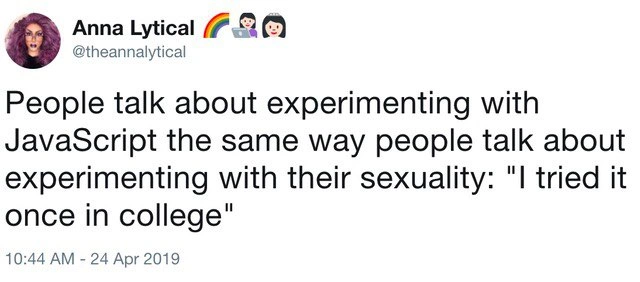
A screenshot of a tweet from the user Anna Lytical (@theannalytical). The profile picture shows a person with voluminous curly purple hair and dramatic makeup. The tweet, dated 10:44 AM - 24 Apr 2019, reads: 'People talk about experimenting with JavaScript the same way people talk about experimenting with their sexuality: "I tried it once in college"'. The humor comes from comparing the often-chaotic, experimental phase of learning JavaScript to a common euphemism for youthful exploration. For experienced developers, this resonates deeply. It evokes memories of early career struggles with browser inconsistencies, callback hell, and the language's quirks before the modern ecosystem of frameworks and tools brought more structure. The phrase 'tried it once in college' perfectly captures the feeling of a rite of passage that many endured but few would willingly repeat without the safety of modern abstractions

Comments
8Comment deleted
Some of us tried JavaScript in college. The rest of us were forced into a committed relationship with it by the browser DOM, and now we're just making the best of it with frameworks as marriage counseling
“I swore JavaScript was just a college fling - two decades later I’m explaining to auditors why our core banking ledger depends on a 12-year-old npm package named ‘left-pad.’”
Twenty years later, you're maintaining a React codebase, arguing about TypeScript configs, and explaining to your therapist why you have strong opinions about bundler performance
Everyone 'tried JavaScript once in college' - and like most experiments, it's now in production, load-bearing, and nobody will admit ownership
The comparison is apt: both JavaScript and college experimentation involve questionable decisions made under peer pressure, a lot of confusion about what's actually happening, and the lingering question of 'why did I think `this` binding would work that way?' Years later, senior engineers either embrace it fully (TypeScript counts as therapy), or they mention it only when explaining why they're now strictly typed and functional
JS: that college fling where you tried prototypal inheritance once, then architected your career around sane types ever since
“I tried JavaScript once” - now prod is a microfrontend parliament where CommonJS, ESM, and TypeScript argue about imports while 80k transitive deps vote by breaking CI
We call JS a college phase; a decade later prod still dials it through transitive dependencies - so we only see it under TypeScript, for closure