
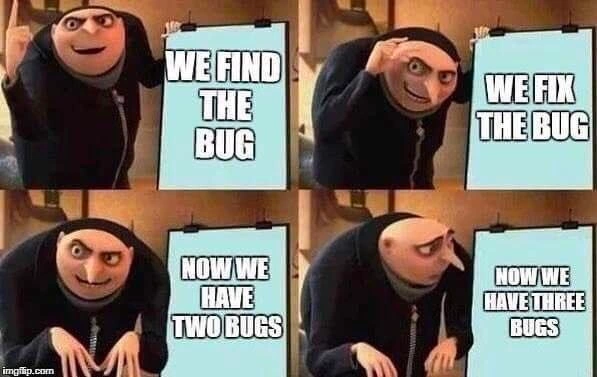
The Vicious Cycle of Bug Fixing
Description
A four-panel meme using the 'Gru's Plan' format from the movie 'Despicable Me.' Gru is presenting a plan on a flip chart. In the first panel, he enthusiastically points to the first step: 'WE FIND THE BUG.' In the second panel, he looks at the next step with a confident, scheming expression: 'WE FIX THE BUG.' The third panel shows him looking back at the chart with a puzzled expression, revealing the third step: 'NOW WE HAVE TWO BUGS.' The final panel shows him with a look of defeated realization, as the chart now reads, 'NOW WE HAVE THREE BUGS.' This meme humorously illustrates the concept of software regression, where a seemingly simple bug fix inadvertently introduces new, often more numerous or complex, bugs. It's a painfully relatable experience for any developer, especially those working in large, tightly-coupled legacy codebases where the ripple effects of a small change can be unpredictable and catastrophic

Comments
8Comment deleted
Fixing a bug in a legacy system is like trying to change a single lightbulb in a house where all the wiring is a single, tangled Christmas light string
Looks like our defect backlog finally achieved eventual consistency - the bug count only moves monotonically upward
The senior engineer who confidently said "it's just a null pointer, I'll have it fixed in 5 minutes" is now explaining to the CTO why half the microservices are down and the database is somehow returning customer data in Mandarin
Bug-fixing in a legacy monolith is just mitosis with extra steps - the only fix that never causes a regression is the one still sitting in the backlog
This meme perfectly captures the Hydra principle of legacy systems: fix one bug in a tightly-coupled codebase without comprehensive integration tests, and two more emerge from the shadows of your inadequate test coverage. Senior engineers know this isn't just Murphy's Law - it's the inevitable consequence of high cyclomatic complexity, implicit dependencies, and that one 'quick fix' that seemed safe because it only touched three files... which turned out to be imported by seventeen others
Gru's Law: Fix one bug, spawn two more - the CAP theorem of debugging, where consistency is always partitioned
When your “quick fix” touches a shared util in the monorepo, you don’t close a bug - you trigger a distributed regression; turns out our contract tests are just optimism in YAML
Welcome to RDD - Regression-Driven Development - where a hotfix breaks an implicit contract, mocks keep CI green, and production discovers the real integration tests