
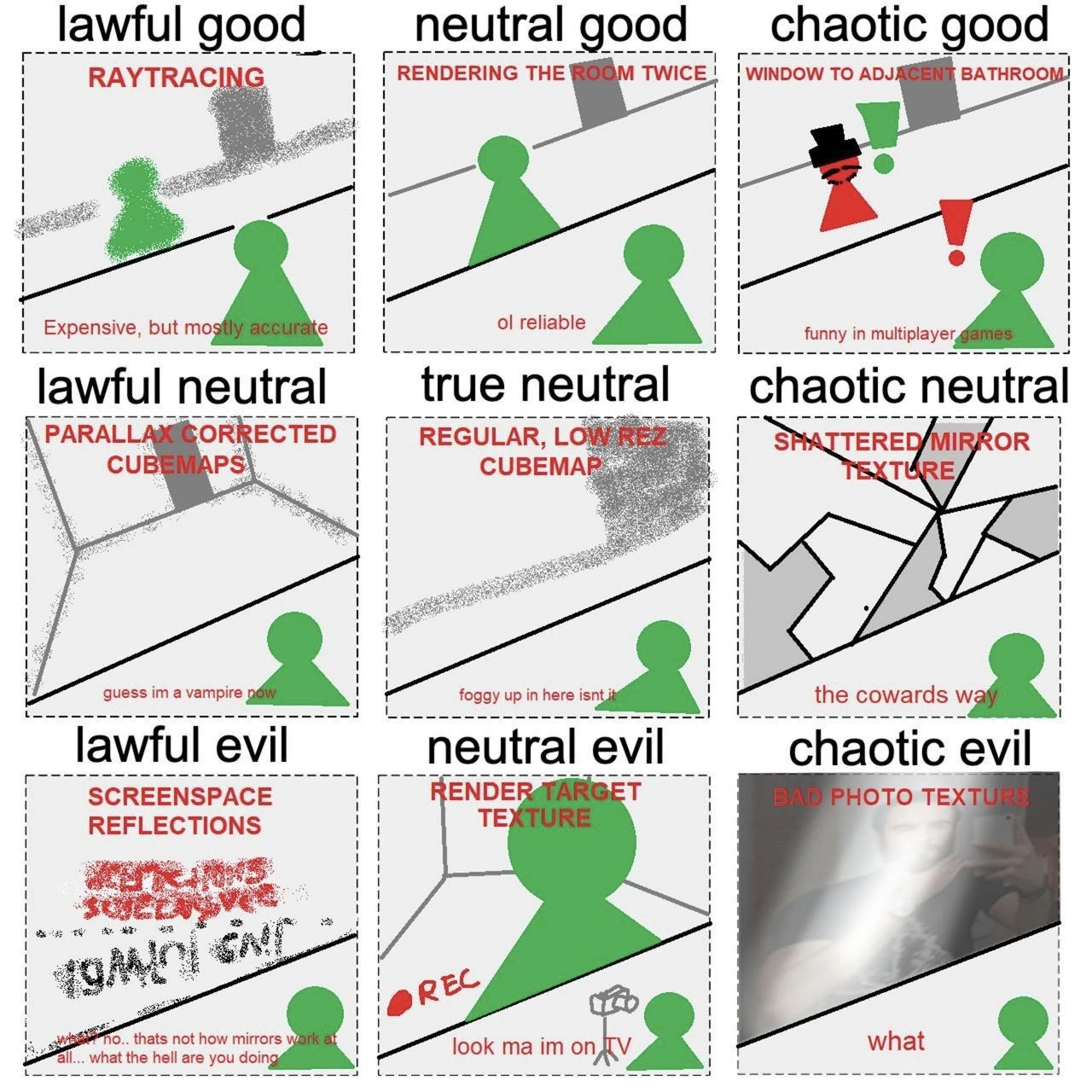
An Alignment Chart of Game Development Reflection Techniques
Description
A 3x3 alignment chart meme categorizing nine different methods for rendering reflections in computer graphics, from 'Lawful Good' to 'Chaotic Evil.' The chart visually demonstrates each technique with a simple scene of a green pawn looking at a reflective surface. Techniques range from the accurate and expensive 'Raytracing' (Lawful Good) and the reliable 'Rendering the room twice' (Neutral Good), to common shortcuts like 'Parallax Corrected Cubemaps' where the pawn has no reflection, joking 'guess im a vampire now' (Lawful Neutral). The 'evil' options showcase technically flawed or lazy hacks, culminating in 'Chaotic Evil,' which uses a 'Bad Photo Texture' of a real person's selfie as the reflection. The meme is a humorous commentary on the trade-offs between performance, realism, and development effort in real-time graphics, resonating with game developers and graphics engineers who have implemented or encountered these various visual tricks
Comments
13Comment deleted
The difference between a junior and senior graphics programmer is the junior strives for Lawful Good raytracing, while the senior knows when to ship a Chaotic Neutral shattered mirror and call it an 'environmental storytelling feature'
Picking a mirror technique feels like choosing a consistency model: ray tracing is linearizable, cubemaps are eventual, and screen-space reflections are that coworker insisting the glitches are “just visual.”
The real chaotic evil is when you ship the 'bad photo texture' solution to production and then gaslight the QA team by claiming it's 'artistic direction' and definitely not because you spent the entire reflection budget on particle effects for that one boss fight nobody remembers
Thirty years of graphics research and the industry's most robust mirror solution is still 'canonically, it's broken.'
This alignment chart perfectly captures the eternal struggle of graphics programming: you can have it fast, accurate, or sane - pick two. Raytracing sits in 'lawful good' because it's the only technique that actually follows the laws of physics, while screenspace reflections occupy 'lawful evil' as the technically-correct-but-morally-bankrupt solution that breaks the moment your camera moves. The real genius is 'parallax corrected cubemaps' being labeled a vampire - because like any good graphics engineer knows, when your reflection technique doesn't work in mirrors, you just gaslight yourself into thinking that's a feature, not a bug
Game mirrors are a morality play: ray tracing if you have budget, parallax‑corrected cubemap if you have taste, SSR if you’re okay with reality disappearing off‑screen, and the shattered‑mirror texture if you renamed “out of scope” to “art direction.”
Raytracing: lawful good accuracy that turns your GPU into chaotic evil at 30fps
Mirrors are where GPU budgets go to die: you spec ray tracing, then the perf review replaces it with parallax-corrected cubemaps and SSR that TAA smears into a crime scene, shipped as a design choice
And who are the competitors? Comment deleted
Chaotic evil is the winner Comment deleted
I hate the shattered mirror workaround, it's so lazy Comment deleted
Then make shattered mirror with each piece rendering every single angle from the room Comment deleted
the only true way Comment deleted