Skip to content
DevMeme
3861 of 7435
DevOps Engineers Achieve Herd Immunity Through Homelabs
DevOps SRE Post #4204, on Feb 12, 2022 in TG

DevOps Engineers Achieve Herd Immunity Through Homelabs

Why is this DevOps SRE meme funny?

Level 1: Staying In, Staying Safe

Imagine a kid who loves building with LEGO blocks so much that he stays in his room all day happily creating castles and cities. Meanwhile, his friends are outside playing together, and some of them catch a cold from one another. But the LEGO-loving kid doesn’t get sick at all – simply because he wasn’t out there to catch the germs. This meme is making the same kind of point, but with grown-up tech toys. The DevOps engineer is basically that kid who stays home to play with his favorite gadgets (in this case, doing computer projects). He’s not mixing with people as much, so he doesn’t catch the virus going around. It’s a funny way to say that sometimes just staying home with your hobbies can keep you safe, even if you’re doing it for fun rather than for health. In other words, being a bit of a homebody tech geek turned out to be a superpower during the pandemic – and that’s why this cartoon makes us smile.

Level 2: Homelab Hideout

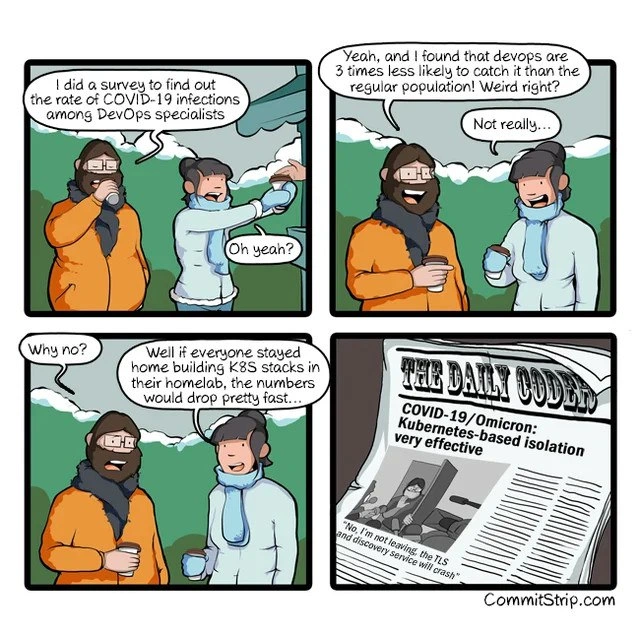
In plain terms, this four-panel comic is joking that DevOps engineers didn’t catch COVID-19 as much as other people because they tend to stay home absorbed in their tech projects. In the comic, two developers are chatting on a cold day. The first (in the orange jacket) says he did a survey on COVID-19 infection rates among DevOps specialists, and he found they were “3 times less likely to catch it” than the general population. He’s surprised by this result. The second developer (in the blue jacket) isn’t surprised at all. He basically says, “Well, if everyone stayed home building K8s stacks in their homelab, cases would drop pretty fast.” In the final panel, the joke is blown up into a fake newspaper headline from “The Daily Coded” that reads “COVID-19/Omicron: Kubernetes-based isolation very effective.” There’s also a funny quote on the newspaper: “No, I’m not leaving the TLS and discovery service ’til crash.” This is pretending to be a statement from a DevOps person who refuses to leave their computer because they’re busy with something technical (TLS and service discovery are just parts of their system). The overall humor is that playing with Kubernetes at home all day accidentally makes DevOps people great at social distancing.

Let’s break down some of those terms and references:

  • DevOps – Short for “Development and Operations.” These are IT professionals who handle the infrastructure and automation that let software run smoothly. If you’re new to tech, think of DevOps as the people who set up servers, deploy applications, manage cloud services, and make sure websites and apps stay up 24/7. They often create pipelines so that code can go from development to production reliably (known as CI/CD pipelines). A DevOps specialist is comfortable with both coding/scripting and system administration.
  • Kubernetes (K8s) – Kubernetes is an open-source platform for managing containers at scale. Containers are like lightweight mini-virtual machines that bundle an application with everything it needs to run. Kubernetes helps deploy, coordinate, and scale these containers across many machines. It’s very popular in modern cloud computing because it automates a lot of work (like restarting a crashed app, or moving it if one server goes down). The comic uses “K8S” – that’s a common abbreviation for Kubernetes (“Kubernetes” has 10 letters, so people replace the middle 8 letters with “8”). DevOps folks are crazy about Kubernetes, because it’s a powerful tool to run large applications reliably.
  • Homelab – This is a personal tech lab at home. Imagine having a few computers or servers in your house that you use to experiment with technology. Many DevOps engineers and hobbyists set up homelabs to try out things away from work. For example, they might run a mini Kubernetes cluster on a couple of old PCs or Raspberry Pi boards. It’s like a playground or training ground for tech skills, right in your home. So when the comic says “building K8s stacks in their homelab,” it means these DevOps folks spend their free time setting up complex systems (a “stack” usually means a set of technologies working together) on their own equipment at home.
  • Remote Work – This refers to working from home (or anywhere outside the traditional office). Due to COVID-19, a huge number of developers started working remotely full-time. Meetings went virtual and office commutes vanished. DevOps engineers can do most of their job remotely because they can connect to servers and cloud systems over the internet. In the joke, since DevOps people were mostly home already even off the clock (busy with their homelab), switching to remote work during the pandemic was natural for them. Less going out means less chance to catch a virus.
  • TLS and discovery service – TLS stands for Transport Layer Security, which is a protocol that keeps internet connections secure by encryption (for instance, it’s what makes websites use https://). A service discovery service is a system that helps different parts of an application find each other on a network (think of it like a phonebook for services in a big application). If a DevOps engineer says “I’m not leaving the TLS and discovery service ’til crash,” they’re humorously suggesting they will not step away from their computer until these components crash (or until they’re sure they won’t crash). It exaggerates how dedicated (or obsessed) they can be with monitoring their systems.

Now, why is all this funny? The comic is mixing a serious situation (a global pandemic) with a nerdy tech twist. The idea of infection rates dropping because people stay home isn’t new – that’s exactly why lockdowns and stay-at-home guidelines were used. But here, the cause is comically specific: everyone staying home to build Kubernetes clusters! It’s humor targeted at tech folks (TechHumor). The joke suggests DevOps engineers unintentionally did what health experts recommend, simply by indulging in their normal geeky passions (working on their computers for hours). For a junior developer or someone outside tech, picture this: while many people were bored or baking bread during lockdowns, the DevOps crowd was happily configuring servers in a spare room. They had fewer face-to-face interactions, so of course they caught fewer viruses. The comic takes that scenario and makes it cartoonishly official with a fake newspaper headline – as if the world is acknowledging the heroic effort of those who isolate via Kubernetes. It’s a gentle poke at DevOps culture (lots of stay-at-home tinkering) and a playful observation about pandemic life (staying home works!).

Level 3: Social Distancing Stack

This comic hits home for anyone in DevOps or SRE because it jokes about a truth of tech culture during the pandemic. DevOps engineers are known for their obsessive tinkering with tools like Kubernetes (aka K8s). It’s not unusual for a hardcore DevOps specialist to have a homelab – basically a mini data center in their basement or living room – running all sorts of containerized workloads. They might be experimenting with a personal K8s cluster, deploying apps with kubectl apply on YAML configs, and tweaking networking rules for fun. Now, pair that with pandemic-era Remote Work: these folks were already primed to stay glued to their screens at home. So when the orange-parka character announces a survey finding that “DevOps are 3 times less likely to catch COVID-19 than the regular population,” it sounds comical but oddly plausible. His friend’s deadpan “Not really…” retort highlights the punchline: of course DevOps aren’t catching viruses as much – they barely leave their home office when they’re knee-deep in a Kubernetes project!

The humor here riffs on how pandemic life and DevOps life accidentally aligned. In early 2022 (during the Omicron wave of COVID-19), everyone was talking about isolation and infection rates. Tech workers already had the infrastructure to work from anywhere (or specifically, from home) using VPNs, cloud dashboards, and video calls. Many developers half-joked that they had been training for quarantine their whole lives by staying in coding on weekends. This strip takes that idea and runs with it. The DevOps dude effectively did a “developer survey” about COVID infections in the IT crowd, and found a stark statistic – something you might see reported in a techie blog or forum poll. The reason behind it isn’t some genetic super-immunity; it’s simply lifestyle. DevOps engineers often spend their free time exactly like their work time: in front of a screen, deploying containers, managing servers, reading documentation, and troubleshooting cluster issues. If everyone stayed home like that – immersed in a Kubernetes stack rather than going out to bars or concerts – naturally infection numbers would drop across the board. It’s a nerdy twist on the public health message: “stay home and save lives” becomes “stay home and spin up your cluster.”

The final panel nails the joke by framing it as a news headline from "The Daily Coded". This is a classic CommitStrip-style gag, where a ridiculous tech scenario is treated as breaking news. The headline declares “COVID-19/Omicron: Kubernetes-based isolation very effective” – a tongue-in-cheek acknowledgement that a techie approach to social distancing works wonders. The smaller quote on that newspaper – “No, I’m not leaving the TLS and discovery service ’til crash” – epitomizes the DevOps mentality. It parodies the idea of an engineer refusing to step away from their setup because they’re in the middle of some crucial cluster babysitting: maybe monitoring a service mesh, waiting for a TLS certificate issue or a service discovery glitch to manifest. It’s an absurd scenario to imagine in a mainstream newspaper, which makes it funnier. Essentially, the comic is saying: DevOps folks are such homebody tech-whizzes that even a pandemic can’t pry them from their terminals. They’ll voluntarily isolate for days on end, not due to fear of disease but because they’re deep in the rabbit hole of configuring their homelab’s CI/CD pipeline or figuring out why their pod isn’t connecting to the database.

For senior engineers, this resonates on multiple levels. We’ve all heard the jokes or lived the life: spending a Friday night upgrading your Docker containers instead of going out, or skipping social events because “I have an incident to monitor” or “the cluster is deploying.” During COVID, that quirk became a superpower for public health. The comic wittily acknowledges that yes, if everyone was as passionately isolated with tech as the DevOps crowd, the virus would have a lot less hosts to infect! It’s a lighthearted celebration of the often introverted, hyper-focused lifestyle in IT. And let’s be honest – many of us did use lockdown time to play with new technologies, whether it was Kubernetes, a new programming language, or automating the home coffee maker. The result? We inadvertently lived in our own little containerized world, safe from Omicron outside. No wonder “DevOps catch fewer viruses” – their hobby doubled as social distancing. The comic finds humor in this silver lining: being a geek with a fully decked-out homelab might just keep you healthier in a pandemic, albeit at the cost of being that person who won’t leave until the server says it’s OK!

Level 4: Pods vs Pathogens

At the highest level, this meme cleverly parallels container isolation in tech with social isolation in a pandemic. In Kubernetes (often called K8s), applications run inside containers grouped as pods, each sealed off by kernel mechanisms like Linux namespaces and cgroups. These ensure one container’s processes and network are quarantined from others – a kind of digital “germ bubble” for software. A pod can’t just wander into another pod’s memory or filesystem, much like a person in quarantine can’t accidentally spread germs to their neighbors. This isolation is fundamental for security and stability: if one container crashes or even gets infected by a computer virus, the damage is contained within that sandbox. The meme’s punchline leans on this concept of isolation: DevOps engineers staying home with their home-lab Kubernetes stacks are basically treating themselves like a highly isolated Kubernetes workload on a dedicated node.

There’s also a nod to the plumbing of distributed systems. The fake newspaper headline highlights “Kubernetes-based isolation” as effective, and the quote about not leaving the TLS and discovery service ’til crash hints at the nitty-gritty of cluster management. Service discovery is how microservices locate each other (in K8s, typically via an internal DNS or a registry backed by etcd consensus). TLS (Transport Layer Security) ensures encrypted communication between those services. Both are critical components that DevOps engineers obsess over to keep a system healthy. In advanced practice, reliability engineers even perform chaos engineering – deliberately pushing services until they crash – to verify systems recover gracefully. So when the DevOps character insists “I’m not leaving the TLS and discovery service ’til crash,” it satirically reads like a dedication to resilience testing: he’s essentially camping in front of his cluster, waiting for a failure to happen (or forcing it) to make sure everything is bulletproof. This is a tongue-in-cheek reference to how deeply DevOps folks can immerse in their work: they’ll isolate themselves physically and digitally, fine-tuning cluster configs and watching logs at 2 AM, all in the name of uptime.

From an epidemiological angle, the humor has a kernel of truth aligned with real science. In disease terms, an individual’s exposure can be modeled by the R₀ (basic reproduction number) – how many others one infected person will pass a virus to. If a DevOps engineer has basically zero in-person contacts because they’re glued to their homelab, their personal R₀ is effectively 0.0. That’s as if they’ve put themselves in air-gapped isolation: no network of people for the virus to traverse. In computing, we strive for something similar when securing containers or VMs – minimal attack surface and no unexpected connections. A truly isolated container (say, running with --network=none) has no pathway to infect or be infected by other systems, akin to a human who literally never meets another soul during an outbreak. The comic exaggerates this parallel for effect: the DevOps crowd, by virtue of extreme hobbyist containerization at home, inadvertently achieve pandemic-proof isolation. It’s a geeky illustration of “quarantine-as-a-service” – where staying engrossed in your Kubernetes cluster not only deploys microservices but also deploys a formidable shield against microbes.

Description

This is a four-panel comic strip from CommitStrip.com, illustrated in a classic webcomic style. In the first panel, a woman tells a bearded male colleague she conducted a survey on COVID-19 rates among DevOps specialists. In the second, she reveals that DevOps professionals are three times less likely to get infected. The man isn't surprised. In the third panel, she explains her theory: if everyone stayed home building Kubernetes (K8S) stacks in their homelabs, infection rates would plummet. The fourth and final panel is the punchline: a close-up of a fictional newspaper, 'The Daily Coder,' with a headline reading, 'COVID-19/Omicron: Kubernetes-based isolation very effective.' The article features a picture of a frantic engineer clinging to a server rack, quoted as saying, 'No, I'm not leaving, the TLS and discovery service will crash.' The humor targets the stereotype of DevOps engineers being so deeply engrossed in their complex and often fragile homelab projects that they become hermits, effectively self-isolating. The specific mention of TLS and service discovery in a Kubernetes context is a deeply relatable pain point for senior engineers, who know how easily those critical components can fail, making the engineer's panic both funny and painfully realistic

Comments

8
Anonymous ★ Top Pick The best pandemic isolation strategy is a self-hosted Kubernetes cluster. You won't want to leave the house, and even if you did, the ingress controller probably isn't configured correctly to let you out
  1. Anonymous ★ Top Pick

    The best pandemic isolation strategy is a self-hosted Kubernetes cluster. You won't want to leave the house, and even if you did, the ingress controller probably isn't configured correctly to let you out

  2. Anonymous

    Public-health breakthrough: every additional Helm chart in your homelab cuts your R₀ in half - apparently the most effective isolation pod is still running `kubectl apply` at 2 a.m

  3. Anonymous

    The real reason DevOps engineers survived the pandemic better wasn't their N95 masks - it was their ingress controllers blocking all human traffic while they debugged why their 47-node homelab cluster couldn't handle a single Hello World deployment

  4. Anonymous

    Quarantine was easy: his etcd quorum already required him within arm's reach 24/7

  5. Anonymous

    Turns out the real herd immunity was the Kubernetes clusters we built along the way. While everyone else was panic-buying toilet paper, DevOps engineers were already practicing social distancing - from production, from their families, and from any semblance of work-life balance. The CDC should've just recommended 'kubectl apply -f isolation.yaml' from the start

  6. Anonymous

    DevOps COVID strategy: Deploy isolation pods to basement namespace years ahead of the pandemic

  7. Anonymous

    Study says DevOps are 3x less likely to catch COVID - turns out their social life runs behind a default-deny NetworkPolicy, bars are tainted NoSchedule, and parties fail pod anti-affinity; Kubernetes finally shipped isolation that works

  8. Anonymous

    We didn’t beat Omicron - we just kubectl cordoned our apartments, drained the pods to the homelab, disabled Ingress, and let mTLS terminate any remaining small talk

Use J and K for navigation