
Galactic Overkill for Integer Multiplication
Description
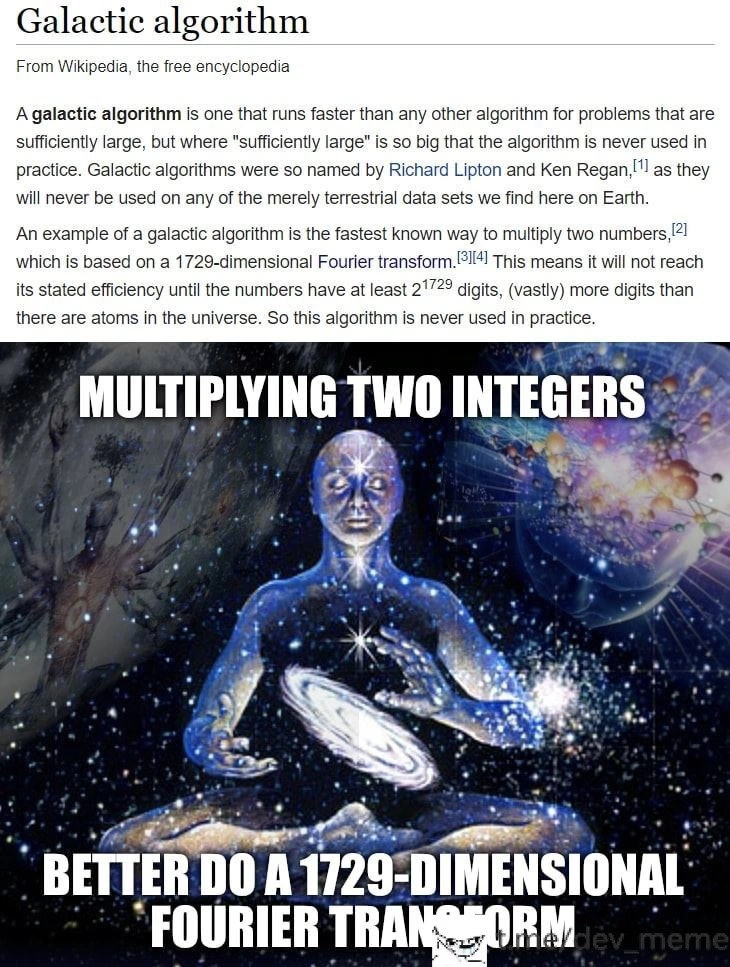
A two-part meme. The top section is a screenshot of the Wikipedia article for "Galactic algorithm," defining it as an algorithm that is asymptotically superior but practically unusable due to the immense scale required for it to become efficient. The article cites an algorithm for multiplying two numbers using a 1729-dimensional Fourier transform that only becomes practical for numbers with more digits than there are atoms in the universe. The bottom section uses the "Galaxy Brain" meme format, showing a cosmic, meditating figure surrounded by stars and galaxies. White impact-font text is overlaid, reading: "MULTIPLYING TWO INTEGERS" at the top and "BETTER DO A 1729-DIMENSIONAL FOURIER TRANSFORM" at the bottom. The meme humorously contrasts the simple task of multiplication with an absurdly complex, theoretical solution, mocking academic over-engineering and the pursuit of theoretical performance over practical application. This resonates with experienced engineers who have seen simple problems get over-architected with needlessly complex solutions


Comments
7Comment deleted
The junior dev suggests using a galactic algorithm for the login page. The senior dev agrees, noting it will be the most performant solution once our user base exceeds the number of Planck volumes in the observable universe
Lead dev: “Sure, Karatsuba is fine for MVP, but wait until product asks for 10^520-digit SKUs - better ship the 1729-D Fourier multiplier now and call it ‘future-proofing.’”
Ah yes, the classic senior engineer move: spending six months implementing a 1729-dimensional Fourier transform for multiplication because 'it has better asymptotic complexity,' only to discover your production integers never exceed 64 bits and the naive approach would've been 10^400 times faster. But hey, at least the whiteboard interview went great!
Ah yes, the galactic algorithm - proof that in computer science, you can be technically correct (the best kind of correct) while being cosmically useless. It's the ultimate 'well actually' of algorithmic complexity: sure, your O(n²) multiplication works fine for every number humanity will ever compute, but have you considered that for numbers with more digits than there are atoms in the observable universe, this 1729-dimensional Fourier transform would be *slightly* faster? It's like optimizing your startup's database queries for when you have more users than sentient beings in the galaxy - technically sound architecture, questionable product-market fit
Great news - the asymptotically optimal multiplier kicks in right after 2^1729 digits; until then we’ll ship Karatsuba and save the cluster for the heat death sprint
Galactic algorithms: Big O nirvana for inputs larger than the heat death of the universe - every CTO's favorite 'scales perfectly' white lie
Galactic algorithm thinking: 1729‑D FFT to multiply two ints - provably faster once n has more digits than the universe; practically, the ALU’s MUL finishes before Kubernetes even schedules the pod