
Functional Programming: The Pure Ideal vs. The Side-Effect Reality
Description
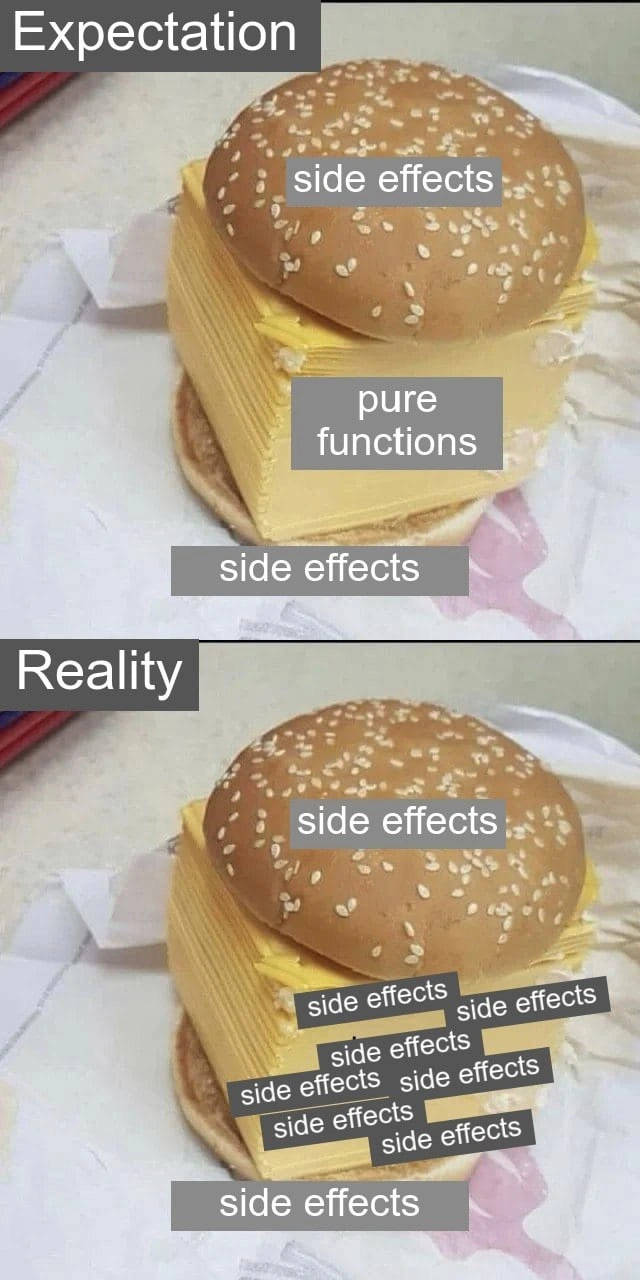
A two-panel "Expectation vs. Reality" meme using an image of a cheeseburger ridiculously overloaded with cheese slices. In the top panel, labeled "Expectation," the burger buns are labeled "side effects" and the massive stack of cheese between them is labeled "pure functions." This illustrates the ideal software architecture where the core logic is pure and isolated, with side effects being minimal and cleanly separated. The bottom panel, labeled "Reality," shows the same burger, but the stack of cheese is now littered with numerous smaller labels, all reading "side effects." This humorously depicts the common scenario in real-world applications where, despite intentions, side effects become entangled with the core logic, making the codebase complex and less predictable. The meme resonates with developers who appreciate the principles of functional programming but have experienced the practical challenges of maintaining that purity in large, evolving systems


Comments
14Comment deleted
Every project starts as a beautiful Haskell monad. Six months later, it's a global mutable state cheeseburger held together by a singleton pattern and a prayer
Architect: “Side effects belong at the edges.” Six sprints later every ‘pure’ function takes a DB session, a Kafka producer, and the entire request context - apparently the edge has expanded to fill all available cheese
After 15 years of preaching functional purity, you realize the real monad was the side effects we accumulated along the way - and no amount of IO wrapping can hide the fact that your 'pure' microservice still needs to talk to that legacy Oracle database running COBOL stored procedures
Ah yes, the classic functional programming journey: you start with a beautiful architecture where side effects are neatly contained at the boundaries, pure functions form the core business logic, and everything is composable and testable. Then production happens - database calls leak into your domain layer, API timeouts need handling everywhere, logging becomes essential for debugging, and suddenly your 'pure' function stack is drowning in IO monads, error handling, and state mutations. Turns out the real world has a lot of side effects, and they're not content staying at the edges of your carefully crafted functional sandwich. Welcome to the reality where every 'pure' function eventually needs to talk to something impure, and your type signatures grow longer than your actual implementation
Functional core, imperative shell was the plan; we shipped a fractal boundary where every function returns IO and a little regret
Pure functions: one clean slice. Reality: side effects stacked so high, your type checker files for divorce
Functional core, imperative shell: expectation. After logging, tracing, flags, retries, auth, and compliance…the core is IO[SideEffect]
даа Comment deleted
чо я тут забыл Comment deleted
Подписаться на канал Comment deleted
And also you forget to use proper language here ;) Comment deleted
Oh you from Anglia Comment deleted
Indeed Comment deleted
बिल्कुल, याद दिलाने के लिए धन्यवाद Comment deleted