
Free Antivirus to the 'Rescue'
Description
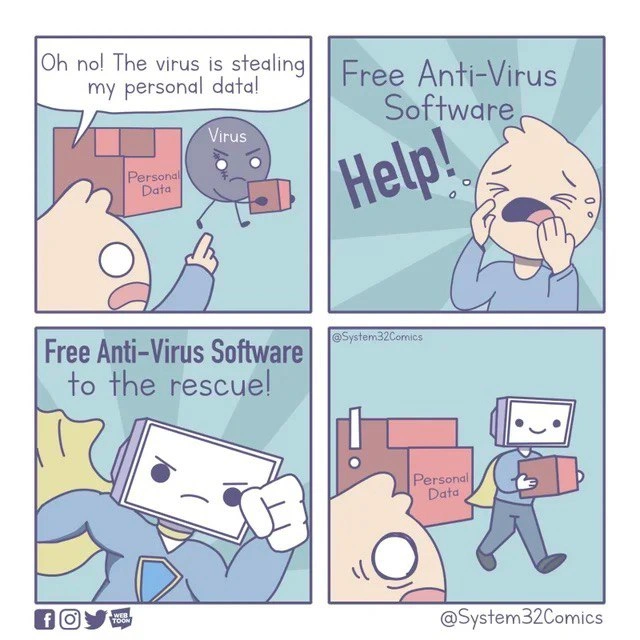
A four-panel comic from 'System32Comics' that satirizes the business model of free antivirus software. In the first panel, a user exclaims, 'Oh no! The virus is stealing my personal data!' as a grey, menacing 'Virus' character runs off with a box labeled 'Personal Data'. In the second panel, the user cries for 'Help!', with the text 'Free Anti-Virus Software' displayed prominently. The third panel shows a heroic superhero with a computer monitor for a head, labeled 'Free Anti-Virus Software to the rescue!', striking a powerful pose. The final panel delivers the punchline: the now-smiling antivirus superhero is calmly walking away with the 'Personal Data' box, leaving the user looking on in shocked silence. The comic humorously illustrates the cynical view that many free security products, while protecting from traditional malware, often engage in their own form of data collection, effectively making the user the product

Comments
7Comment deleted
The main difference between malware and some free antivirus is that the antivirus gets your consent to exfiltrate data via a 40-page EULA you agree to at 3 AM
Free AV vendors perfected zero-day collection long ago - they call it their analytics pipeline
The real vulnerability was assuming anything with 'free' and 'enterprise-grade protection' in the same sentence wasn't harvesting telemetry to sell to the highest bidder
The real virus was the friends we made along the way - specifically, the 'free' antivirus that's now selling your browsing history to data brokers while proudly displaying a green checkmark on your system tray. At least the original malware had the decency to be honest about its intentions
In threat modeling, “free antivirus” turns the adversary into an approved vendor with admin rights - the attack surface doesn’t shrink, it just gets a EULA
Free anti-virus: the supply-chain attack where the 'dependency' owns your data pipeline
Endpoint agent taxonomy: malware exfiltrates data; “free AV” ships the same feature behind an EULA, a tray icon, and a scheduled telemetry job