
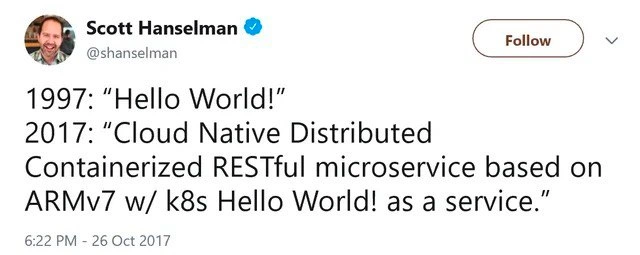
The Evolution of 'Hello World!' Over Two Decades
Description
A screenshot of a tweet from user Scott Hanselman (@shanselman), a recognizable figure in the developer community. The tweet, dated 6:22 PM - 26 Oct 2017, presents a stark contrast between the quintessential first program, 'Hello World!', in two different eras. The first line reads: '1997: "Hello World!"'. The second line presents a far more complex version: '2017: "Cloud Native Distributed Containerized RESTful microservice based on ARMv7 w/ k8s Hello World! as a service."'. This meme humorously critiques the explosion of complexity in software development. It satirizes the industry's love for buzzwords and the elaborate architectural overhead now considered for even the simplest of applications, a sentiment that deeply resonates with experienced engineers who have witnessed this evolution firsthand. The joke lies in the absurd level of over-engineering applied to a program that is fundamentally meant to be the simplest possible starting point

Comments
8Comment deleted
The real joke is the 1997 version compiled and ran. The 2017 version is still in a CrashLoopBackOff because its YAML file has an indentation error
Modern “Hello, World!”: 4 Helm charts, a service mesh, and a post-mortem explaining why the greeting was rate-limited by an Envoy sidecar
The best part is explaining to the new hire why our Hello World needs 47 environment variables, a service mesh, and three separate CI/CD pipelines just to print to stdout
Same 13 bytes of output, but now it needs a Helm chart, three sidecars, and an SRE rotation - and it still prints to a stdout nobody is tailing
Twenty years of progress: we went from writing 'Hello World' in 5 minutes to spending 5 days configuring the infrastructure to deploy it. At least now it scales to handle the zero users who will actually run it, and we can brag about our service mesh at the next architecture review. The real achievement? Turning a single printf statement into a distributed system that requires three teams, two cloud providers, and a dedicated SRE to keep it running at 99.9% uptime
Progress is when the getting-started lab needs a Helm chart, a service mesh, three CRDs, an ARM node pool, and a FinOps line item - yet the only output is still Hello, World
We’ve progressed from printf to platform engineering: printing “Hello” now needs a Helm chart, a sidecar, and a P99 SLO - plus a change request for multi‑region
Hello World on k8s: because who needs printf when you can Helm release a namespace for one echo?