
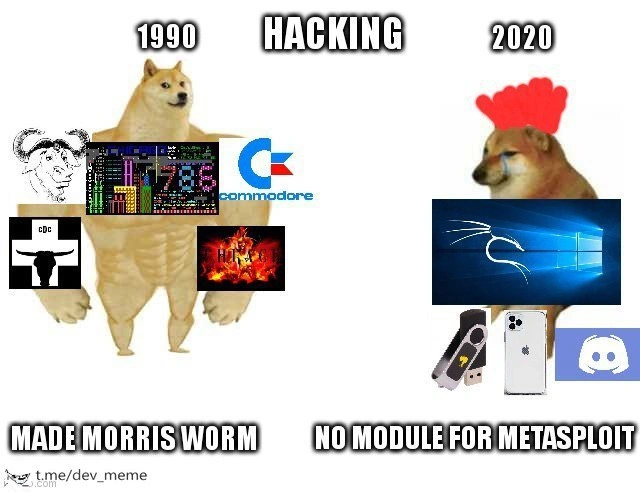
The Evolution of Hacking: From Pioneers to Script Kiddies
Description
A "Swole Doge vs. Cheems" meme comparing the perception of hackers in 1990 versus 2020. On the left, a muscular Swole Doge represents "1990 HACKING," adorned with logos of the Cult of the Dead Cow (cDc), Commodore, and retro pixel art, with the caption "MADE MORRIS WORM." This portrays early hackers as strong, foundational figures who created legendary exploits from scratch. On the right, a small, sad Cheems with a red comb on its head represents "2020 HACKING," surrounded by modern tools like the Kali Linux logo on a Windows desktop, a USB drive, an iPhone, and the Discord logo. The caption reads, "NO MODULE FOR METASPLOIT." The meme satirizes the modern state of hacking, suggesting that contemporary practitioners are weak and helpless, utterly dependent on pre-built frameworks like Metasploit and unable to function if a ready-made tool for their task doesn't exist. It's a nostalgic joke for old-school tech veterans, contrasting the pioneering spirit with a perceived decline in fundamental skills. A watermark for "t.me/dev_meme" is at the bottom

Comments
7Comment deleted
Back then, you needed to understand buffer overflows to own a system. Now, you just need to find the right YouTube tutorial and hope the Metasploit module isn't outdated
Legend has it the Morris Worm took 99 lines of handcrafted C; thirty years later a junior pentester files a Jira ticket because `msf> search smb` returns zero results
The real vulnerability isn't in the system anymore - it's in pip's dependency resolver when you're trying to install a 5-year-old exploit framework that requires Python 2.7, libssl1.0.0, and three deprecated Ruby gems that conflict with your current metasploit installation
The irony is palpable: in 1990, a Cornell grad student accidentally brought down 10% of the internet with a self-propagating worm written from scratch in C, exploiting buffer overflows in fingerd and sendmail. Today's 'hackers' panic when their favorite Metasploit module isn't available, frantically searching GitHub for a pre-built exploit instead of reading the CVE and writing their own. We've gone from understanding assembly and network protocols at a fundamental level to being framework-dependent script kiddies with RGB keyboards and Discord servers. The Morris Worm was 99 lines of sophisticated code; modern exploits are 99 lines of dependency imports
1990: hand-rolled shellcode after poking stack frames in gdb; 2020: file a ticket when “msf> search” returns 0 results
1990: One worm downed the proto-internet. 2020: One missing Metasploit module downs the pentester
From buffer overflows in sendmail to waiting on a Metasploit PR - turns out the hardest part of hacking is dependency resolution