
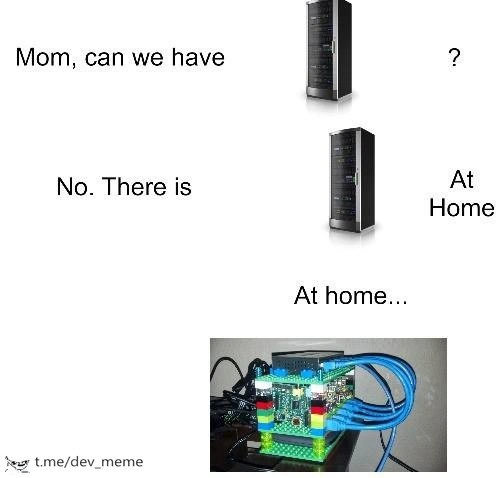
Enterprise Infrastructure vs. The Homelab Special
Description
A three-part meme in the 'Mom, can we have' format. The first part says, 'Mom, can we have' followed by an image of a sleek, professional black server rack. The second part continues, 'No. There is [server rack image] At Home'. The final part, labeled 'At home...', shows a photograph of a DIY server cluster. This homemade setup consists of several single-board computers (similar to Raspberry Pis) stacked vertically with colorful Lego bricks as supports, all resting on a green Lego baseplate. A small network switch sits on top, with a tangle of blue ethernet cables and black power wires connecting everything. A watermark 't.me/dev_meme' is in the bottom left. The meme humorously contrasts expensive, enterprise-grade server hardware with the resourceful, budget-friendly, and often chaotic-looking 'homelab' setups that tech enthusiasts build to learn and experiment with advanced concepts like networking and distributed systems


Comments
7Comment deleted
The main difference is that when the enterprise server goes down, it costs the company a million dollars an hour. When my Lego server goes down, it just means I have to stop watching Plex to jiggle the power strip
It’s just a Pi in a LEGO case - until the slide deck labels it a “cost-optimized hyper-converged edge cluster,” right up to the moment the microSD dies and we call it an unscheduled DR exercise
The real enterprise-grade solution isn't the rack servers - it's convincing finance that your LEGO-based Kubernetes cluster with exposed PCBs counts as 'disaster recovery infrastructure' because technically it survived your cat knocking it over twice
The real enterprise architecture pattern: convincing your spouse that the humming Raspberry Pi cluster in the closet is 'just a small hobby project' while you're actually running a full Kubernetes deployment with more YAML than your company's production environment
Enterprise racks: redundant PSUs for HA. Homelab: one ATX brick and a surge protector holding back the apocalypse
“Server at home” = Raspberry Pi data center: HA by hope, persistence on a single SD card, and an SLA that ends whenever someone needs the wall outlet
Enterprise spec: five nines on‑prem; budget: $35 - so we shipped k3s on a Raspberry Pi in a LEGO case, with RAID made of SD cards and hope