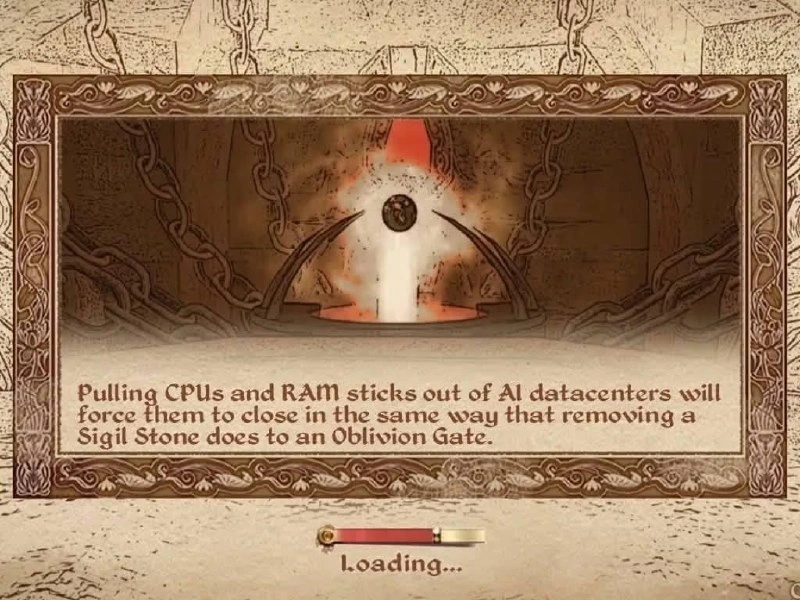
Oblivion Loading Screen Explains How to Shut Down AI Datacenters
Why is this Games meme funny?
Level 1: The Plug Behind the Monster
Imagine a video game tip screen that says, with a completely straight face: "If the giant scary robot factory bothers you, just take out its batteries — it works exactly like unplugging a night-light." The funny part is the calm, helpful tone applied to something enormous and complicated, as if shutting down the most expensive machines on Earth were a handy tip you'd read while a game loads. It's the comfort of pretending a huge, confusing problem has one simple off switch.
Level 2: Portals, Pedestals, and PC Parts
Key pieces for decoding this:
- Oblivion Gate / Sigil Stone: in the 2006 RPG The Elder Scrolls IV: Oblivion, fiery portals to a hell dimension open across the map. Each is sustained by a single magical artifact, the Sigil Stone; grabbing it destroys the gate. It is the canonical "one keystone holds up everything" mechanic.
- CPUs and RAM sticks: the processor and memory modules in a server. They are hot commodities during shortages, and during the AI boom they (along with GPUs) became the scarce resource entire corporate strategies orbit around.
- AI datacenter: a warehouse of servers built to train and serve machine-learning models. The 2024–2026 buildout of these facilities — their power draw, their cost, their sheer number — is a constant background hum in tech news, which is why "how do we turn them off" works as a punchline at all.
- Loading screen meme: a genre where you put your own text into a game's loading-tip template, borrowing its authoritative tone for absurd claims.
The early-career lesson hiding in the laugh: real systems are supposed to have no Sigil Stone. The first time you trace an outage to one unlabeled machine under someone's desk, you understand why "single point of failure" is said in the same tone as "Daedric invasion."
Level 3: Sigil Stones and Single Points of Failure
The craftsmanship here is the format fidelity. This is a pixel-faithful recreation of an Oblivion loading screen — the parchment texture, the ornate knotwork border, the sepia concept-art panel of a Sigil Stone blazing atop its pedestal inside an Oblivion Gate tower, chains draped exactly as Bethesda drew them in 2006, right down to the red progress bar and the patient little Loading... underneath. Into that frame, in the game's actual loading-tip typeface, someone has inserted:
Pulling CPUs and RAM sticks out of AI datacenters will force them to close in the same way that removing a Sigil Stone does to an Oblivion Gate.
The joke operates on two layers, and both reward domain knowledge. The first layer is mechanical equivalence: in The Elder Scrolls IV, every demonic portal is anchored by exactly one Sigil Stone — yank it and the entire interdimensional invasion infrastructure collapses instantly. The meme deadpans that AI datacenters share this architecture. Anyone who has worked in Infrastructure knows this is both hilariously wrong and uncomfortably right. Wrong, because hyperscale facilities are built on redundancy: N+1 power, failover regions, thousands of interchangeable nodes — you could wheelbarrow DIMMs out of a hall for a week before a well-run orchestrator did more than mark hosts unhealthy. Right, because every veteran has lived the inverse: the load-bearing single box nobody documented, where removing one component really did close the portal — along with payroll.
The second layer is tonal. Oblivion's loading tips were famous for their bone-dry, lore-encyclopedia register ("Clannfears attack with their claws and headbutt attacks"), stating wild metaphysics with the affect of a appliance manual. The meme weaponizes that deadpan for the 2026 zeitgeist: anti-AI sentiment and datacenter buildout anxiety reframed as in-game lore, as if Luddite sabotage were a gameplay mechanic the tutorial helpfully explains. It satirizes how the discourse around AI infrastructure has acquired exactly this mythic flavor — gates opening across the land, towers rising, locals alarmed — while the proposed countermeasure is touchingly physical. No regulation, no alignment research: just a guy with anti-static gloves and conviction.
Description
A parody of a loading screen from The Elder Scrolls IV: Oblivion, rendered in the game's signature parchment-and-ornate-border style with sepia tones and decorative chain motifs. The illustration shows a glowing Sigil Stone hovering above a fiery pedestal inside an Oblivion Gate tower, flanked by curved spikes and heavy chains. The caption text, in Oblivion's loading-tip font, reads: 'Pulling CPUs and RAM sticks out of AI datacenters will force them to close in the same way that removing a Sigil Stone does to an Oblivion Gate.' Below the framed image is the classic red loading progress bar and the word 'Loading...'. The meme maps the game's lore mechanic (removing the Sigil Stone collapses the demonic portal) onto Luddite-flavored humor about physically decommissioning AI infrastructure, satirizing both AI datacenter buildout anxiety and the game's famously deadpan loading tips

Comments
9Comment deleted
Decommissioning a datacenter by yanking RAM is technically valid - it's just a hard delete with no transaction log, and Kyne help whoever's on call when the Daedra fail over to us-east-1
please use English in this chat Comment deleted
It's a bot Comment deleted
ah, thanks, didn't notice Comment deleted
I am, but not in this group. Comment deleted
😔 Comment deleted
Amen Comment deleted
A man Comment deleted
You aren't notn't an admin Comment deleted