
The Hidden Architecture of AWS DynamoDB
Description
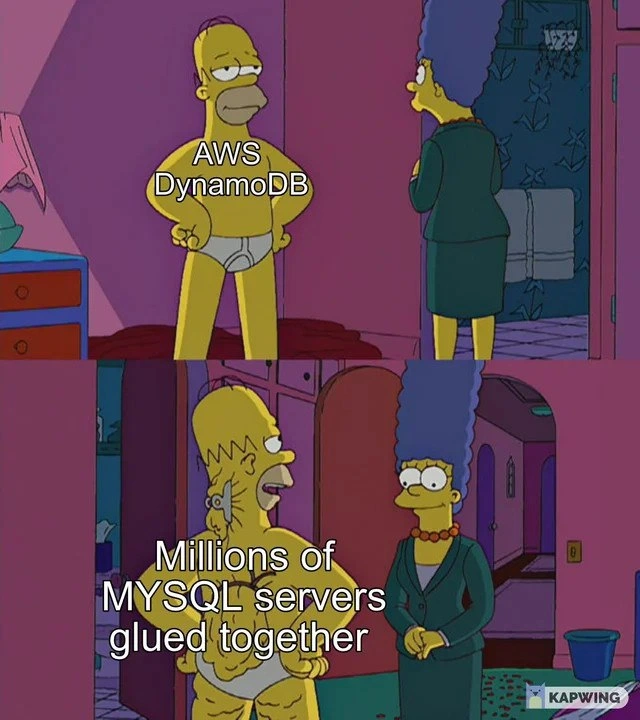
This is a two-panel meme using the 'Homer Simpson's Back Fat' format from The Simpsons. In the first panel, Homer is shown from the front, looking composed, with the text 'AWS DynamoDB' overlaid on his chest. In the second panel, the view shifts to Homer's back, revealing that his seemingly smooth appearance is a facade created by numerous clips holding back rolls of fat. This messy reality is labeled 'Millions of MYSQL servers glued together'. The meme humorously and cynically speculates on the internal workings of AWS DynamoDB, a popular and sophisticated NoSQL database. The joke is that behind its sleek, modern, and highly scalable interface lies a chaotic and makeshift assembly of a much older, more traditional technology (MySQL). While not factually accurate, it's a classic engineering joke about abstraction - that elegant, simple services often hide immense, messy complexity



Comments
8Comment deleted
The DynamoDB paper talks about merkle trees and consistent hashing, but we all know the real innovation was just replacing foreign key constraints with a million 'ON DUPLICATE KEY UPDATE' statements and a prayer
Whenever product brags that DynamoDB is “pure serverless magic,” I picture ten thousand MySQL boxes in a trench coat praying no one asks for a cross-partition join
After 15 years of explaining CAP theorem to executives, you realize the real distributed systems challenge isn't achieving consistency - it's consistently explaining why your 'simple' DynamoDB migration just discovered 47 different MySQL-specific behaviors your entire codebase silently depended on
This meme perfectly captures the architect's dilemma: DynamoDB presents itself as a sleek, fully-managed NoSQL solution, but seasoned engineers know that underneath every 'serverless' abstraction lies a sprawling constellation of traditional databases held together by distributed systems duct tape, eventual consistency prayers, and enough sharding logic to make your head spin. It's the cloud equivalent of 'it's just MySQL all the way down' - except now you're paying per request and can't SSH into anything when it breaks at 3 AM
DynamoDB: sharded MySQL with better marketing - pick the wrong partition key and you'll learn RCUs, WCUs, and the cost of a hot partition the hard way
DynamoDB: the elegant art of sharding MySQL into oblivion with AWS duct tape, because CAP theorem says pick two - except when billing says pick all
Calling DynamoDB “millions of MySQL servers glued together” is cute - because the only join across those shards is your AWS bill when a hot partition meets on-demand writes
wait, it's all MySQL servers? always has been Comment deleted