
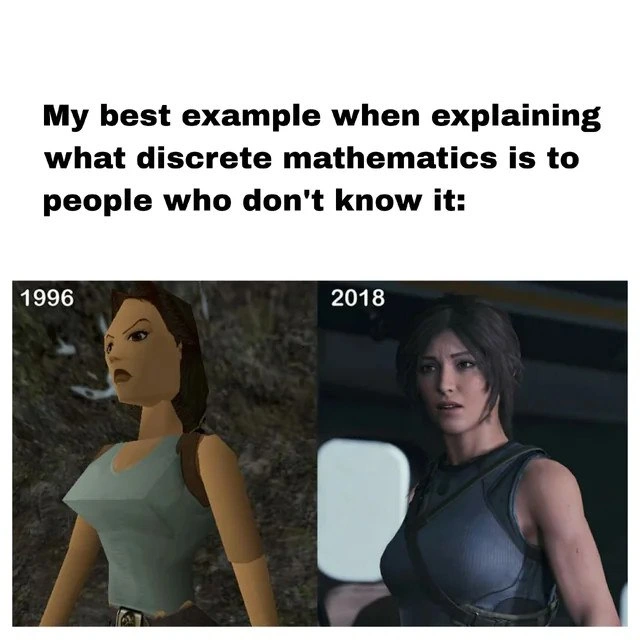
Explaining Discrete Mathematics with Lara Croft's Evolution
Description
A two-panel meme used to explain the concept of discrete mathematics. The top text reads, 'My best example when explaining what discrete mathematics is to people who don't know it:'. Below, two images of the video game character Lara Croft are shown side-by-side. The left image, labeled '1996', shows the original, highly angular and low-polygon version of the character, famous for its blocky, geometric construction. The right image, labeled '2018', displays a modern, photorealistic, and smoothly rendered version of the same character. The humor and educational value come from the visual analogy: the 1996 Lara is a clear representation of a 3D model built from a small number of discrete geometric shapes (polygons), the fundamental building blocks of computer graphics. The 2018 version, while appearing smooth and continuous, is still composed of a vastly larger number of discrete polygons. It cleverly illustrates how complex, continuous-looking surfaces in the digital world are approximations made from a finite number of distinct, countable units - the core idea of discrete mathematics
Comments
57Comment deleted
Modern frameworks are like the 2018 Lara Croft - smooth, high-level abstractions. But every senior engineer knows that when you're debugging a performance issue, you're just staring at the pointy, low-poly 1996 version written in raw SQL
1996 Lara: 540 ints in an index buffer; 2018 Lara: 60 000 ints in an index buffer with better normal maps - proof that under all the photoreal hype, it’s still just the same adjacency matrix your discrete math prof made you hand-draw
The real discrete mathematics lesson here is calculating how many triangles you can render before your PM discretely asks why the frame rate dropped to single digits in production
This is actually a brilliant pedagogical example: discrete math is like 1996 Lara - you can literally count the vertices and see the distinct states. Continuous functions are 2018 Lara - smooth interpolation everywhere, but under the hood it's still discrete vertices with enough tessellation to fool the eye. The real irony? Both are discrete at the hardware level; we just got better at lying about it with more triangles and fragment shaders
As the triangle count approaches ‘photorealistic,’ marketing calls it reality, SRE calls it a thermal incident, and the math still calls it discrete
Discrete math: curves are just marketing’s word for “more triangles” - 1996 shipped at eight, 2018 ships at two million, and your render loop still only gets 16 ms to pretend calculus
Low-poly Lara to photoreal: discrete math proving finite triangles approximate any curve - if your GPU budget converges
I didnt get it Comment deleted
I'm sure that joke is somehow about her four-polygon breasts Comment deleted
That's exactly wrong, by the way. Vertices in polygons stored in float, which is not discrete mathematics. Also mesh is not a graph, it's just oner array of vertices, and another array of of indexes. 3 index = polygon. Meaning it's doesn't explained by discrete mathematics. Comment deleted
floats, as defined by IEEE754, are discrete values, and therefore fall under the umbrella of discrete math ALSO, the ps1, which is where this game ran iirc, used whole numbers for vertexes (that's where the awful vertex jittering comes from) Comment deleted
where is in IEE754 float defined as discrete number? It may be stored as discrete number, but that is far abstraction level from mesh storage Comment deleted
→ it's stored as a discrete number there is the definition. If you abstract that away, that's on you. 2^16 might be a lot of values, but they're still finite. Comment deleted
well that's stupid. First of all ps1 supported fixed-point data type, which is not integer. Second - polygons where cut cause of rendering limitations, not because non-decimal data types where not supported (which were supported, anyhow). I'm pretty sure rendering process doesn't include graph search. Comment deleted
integers and fixed point numbers are one and the same in how you handle them. The only difference is if you have a little dot somewhere imagined in the number. in other words, 1.2/3.4 is the same as 12/34. both are equally discrete, anyway. you're right about the second point, but nobody claimed something else, so you really just made an obvious statement. graph search is part of discrete math, but not required if you want to make a joke referencing it. keep in mind that I do agree that the joke is kinda bad Comment deleted
The only difference is if you have a little dot somewhere imagined in the number. Yes, that's the point. Comment deleted
doesn't matter for the argument Comment deleted
What's the main difference between float and integer as data interfaces? Not the floating point? Comment deleted
integers and fixed-point numbers just count from the lowest to the highest value in equal sized steps (ignoring two's complement) and if you hit the highest or lowest number, you're out of luck. floating point numbers have variable sized steps, which makes them good for general application, no matter how small or large numbers get (to an extent) - also, there's infinity, negative infinity, NaN and all sorts of black magic included. actual non-discrete fractions can store any number, not just a finite amount of them. That's often represented by higher-level objects instead. While technically still limited by the amount of RAM and the address size of the cpu architecture, in theory those objects are meant to be infinite. Comment deleted
Otherwise, if we agreed on your defenition, then everything is descrete mathematics, meaning term will lose any sense. Comment deleted
no, everything in digital computing is discrete mathematics, which is inherent, since digital means only being able to store a finite amount of information, unlike analogue systems. Comment deleted
That's what I meant. That you can post any computer related image and paste "My best example when explaining what discrete mathematics". More, applying your definition on planck units - everything is descrete mathematics, cause on planck scale everything is integral. Which is again, stupid, ad ruin purpose of any terminology - specific contexts is given specific meaning Comment deleted
planck units are a theory, and, if correct, would mean that physics is discrete math, yes. However, much like gravity not actually being 9.82m/s everywhere, or for everything, we can usually model physics much easier with non-discrete math. All math is just knowing where and how to approximate effectively. Comment deleted
>> ad ruin purpose of any terminology - specific contexts is given specific meaning It doesnt. Main context we have here is CS and jokes should be perceived (first of all) through this context Comment deleted
So the joke is that in both cases meshes stored in non integral data. But non integral data is stored in integral view in raw memory binary, hence it's discrete math? That's just great, isn't it? (no, it's obviously bad, and doesn't fit) Comment deleted
The joke here is that (in most cases) for purpose of computational science we would consider all FP operations as done over finite number and in wide range of tasks (on theoretical level) you can just remove dot and on those numbers as with integers This is answer if your main problem is about discrete math to work specifically over field of 𝐙 Comment deleted
@qwnick and another fun fact: many game engines of old time heavily relied on CPUs for grapphical tasks and not solely on GPUs (partially) because GPUs alghs were targeting approximate solution instead of exact solution possible with CPUs Comment deleted
So joke is not related to the picture, from your words. Cause you said nothing about breast low poly count. Comment deleted
I did some more research. The CPU had fixed-point data, but the GPU only had integers; one pixel on screen got exactly one number. That's it. The ps1 didn't even support subpixel verteces. Comment deleted
Wtf is not sub-pixel vertex? Comment deleted
subpixel vertex as in e.g. a triangle that has its points defined somewhere between pixel positions. Comment deleted
But polygons are not defined in pixel space Comment deleted
I assume they convert the numbers somewhere between cpu->gpu interaction and rasterization. Comment deleted
So they are not stored in pixel space? They just rasterized in pixel space, same as now without AA? Comment deleted
they're stored in multiple places, in multiple ways, as most things in computation. AA is something else entirely Comment deleted
but yes, I assume they don't have a dedicated cache for verteces between the 3d transformation step and the rasterization step Comment deleted
wdym stored in multiple places? Mesh is not stored in multiple places. Mesh is stored in 2 arrays, one is vertex, other is index. Index taken in a loop by 3 points. 3 index = 1 polygon. Rendering direction is defined by indexes order in polygon. Comment deleted
you need to store 3d models at least once in ROM, once in RAM, and once inside the GPU, unless the CPU and GPU share RAM, which might be possible inside the ps1, but idk tbh Comment deleted
it's just how data is transfered to vram, it doesn't change fact that meshes are not stored in pixel space. They are rasterized in pixel space, but after this they are not meshes, but frame (or draw call result). Comment deleted
now that I think of it, I think the ps1 didn't even have vertex transformations on the GPU, since programmers needed to pre-sort verteces anyway because of the lack of z-buffer, so they also had to apply camera angle transformations in CPU to know the correct order… or maybe the had a chip dedicated to 3D transforms that supplied the transformed positions to CPU RAM? Comment deleted
plus, the way they implement shading is also completely CPU-controlled - basically, you have to define light levels per vertex. no "oh, there's a light over there, let me compute the shading for each model", no, you had to find that out yourself and tell the GPU which vertex is how bright Comment deleted
I'm getting this info from here btw → https://www.copetti.org/writings/consoles/playstation/ check it out, it's interesting Comment deleted
If you don't have z-buffer, you need to make draw calls in correct order. Any mesh is stored subpixel space and rasterized into pixel space. It worked same way on ps1, and it working same way now. Wobble on ps1 was caused not by vertex logic, but that in order to rasterize mesh you need to check every pixel, and then take texture by UV and apply to this pixel. PS1 didn't did divides (cause they are pricey) and instead of deciding on each pixel color based on UV, squeezed whole texture in this polygon. Which is, again, doesn't include discrete mathematics. And also, does not related to small polygon count Comment deleted
yes, they did have to do that. ps1-era GPUs and modern GPUs are so far apart in terms of how they do things that they're basically incomparable. Again, they didn't even have vertex shaders on the ps1. no depth buffer. no perspective. no, that is the texture wobble, not the vertex wobble. And they had to do that because they lacked perspective (haha, but yes, very literally, no vertex transforms→no perspective info) nobody was talking about small polygon count, except for my initial guess about "haha boob pointy" being the go-to joke for tomb raider Comment deleted
basically, as I understand it, the ps1 GPU literally only rasterized. Comment deleted
yep, they had a coprocessor for that lol Comment deleted
they also didn't have z-buffer, as an aside. They really cut corners whereever possible. The N64, its competitor at the time, had not only floating point numbers, but a z-buffer and mipmapping. Comment deleted
they also hat better games, har har Comment deleted
What is not sub-pixel vertex? Comment deleted
hm I guess that's what the joke is about, isn't it? The ps1 integer verteces Comment deleted
All those memes about 0.1 + 0.2 are not wasted 🎉 Comment deleted
This is a good one too: let a = 9999999999999999; let b = 1; if (a - b == a) { alert(‘wtf?’); } else { alert(‘everything is fine’); } Comment deleted
🤓🤓 moment Comment deleted
Pun intended Comment deleted
Wow the debate on top 👍🏼 Comment deleted
BREAKING: Guy's humor is not tingled by meme, decides to make it a big deal Comment deleted
I didn't get it Comment deleted