Skip to content
DevMeme
6613 of 7435
Your Skin Has Triangles Because You're a Low-Poly Mesh
Graphics Post #7246, on Oct 10, 2025 in TG

Your Skin Has Triangles Because You're a Low-Poly Mesh

Why is this Graphics meme funny?

Level 1: Wrinkled Gift Wrap

Imagine you’re trying to wrap a round ball with a flat piece of paper. Pretty tricky, right? 🏀✂️ You can’t get the paper to lie down nice and smooth all around the ball. What happens is the paper starts to fold and crumple in places. Those little folds kind of make pointy shapes – almost like little triangles – in the paper. You might end up with something that looks like a bunch of wrinkles or facets as you smooth the paper around the ball. That’s because a flat thing (the paper) just can’t cover a curvy thing (the ball) without either folding or tearing. Now, think about video games or 3D cartoons. If a game character, like a hero or a monster, has a round face or body, the computer also has to “wrap” a surface over that shape. But computers do it by using lots of tiny flat pieces, usually triangles, to build up the curved shape. It’s a bit like a digital version of cutting up paper into little pieces to cover a ball. If the game doesn’t use enough triangles (to save memory or processing power), the character starts to look a bit rough and pointy – you might see the flat sides, like a low-detail action figure.

This meme jokes that you (and your skin) have those triangles, as if you were a low-detail 3D model in a game. One person says, basically, “Don’t listen to the science guy, your skin is made of triangles because you’re low-quality graphics!” That’s silly and funny because of course in real life we’re not made of computer polygons. But then the science-minded reply comes back with, “Actually, your skin does end up with triangle shapes because of how thin material wraps over curved surfaces.” In other words, even in real life, when your skin stretches over your body (which has round parts like arms and legs), it can form teeny tiny wrinkles or stress lines that are kind of triangular patterns. It’s like saying the reason is not that we live in a video game, but a real-world physics reason – yet it also involves triangles! The funny part is how these two very different ideas unexpectedly meet in the middle. It makes us smile because it takes a goofy idea (being a low-detail video game character) and connects it to a real phenomenon (wrinkles forming when you wrap a flat thing over a curved thing). So whether in a computer or in your real skin, triangles pop up, and that’s the punchline: triangles are everywhere! It’s a nerdy joke, wishing everyone (whether they feel like a simple “low-poly” cartoon or a fancy “high-poly” realistic model) a happy Friday, by uniting them under this triangle-covered view of the world.

Level 2: Buckling vs Budget

Let’s break down the joke in simpler terms. First, why triangles? In computer graphics and GameDevelopment, any 3D object – whether it’s a human face or a barrel – is made out of a mesh of polygons. Most often, those polygons are triangles. A triangle is the simplest 2D shape that is always flat, so it’s super handy for building surfaces in 3D. If you have enough tiny triangles, you can approximate a curved surface pretty well. Think of making a sphere out of little pieces of cardboard: using enough small triangular pieces, you can get a shape that looks round. Graphics hardware (GPUs) are optimized to handle triangles really fast, so everything gets chopped into triangles for drawing. When the meme says “you’re actually a low-poly mesh,” low-poly means “low polygon count” – i.e., not many triangles, so the surface (like your skin in this joke) would look jagged or faceted rather than perfectly smooth. This is a playful jab at the idea that maybe we live in a video game universe with limited graphics detail, so our skin isn’t high resolution – it’s just a bunch of big triangles! The GPU budget mentioned is about how much detail you can afford: GPUs have limits, so artists often budget a certain number of polygons for each model. If you exceed that, the game might lag. So a low GPU budget for a character’s skin would mean using fewer, larger triangles, making it visibly angular. That’s the graphics side of the humor – it’s very ComputerGraphics insider lingo delivered as a joke.

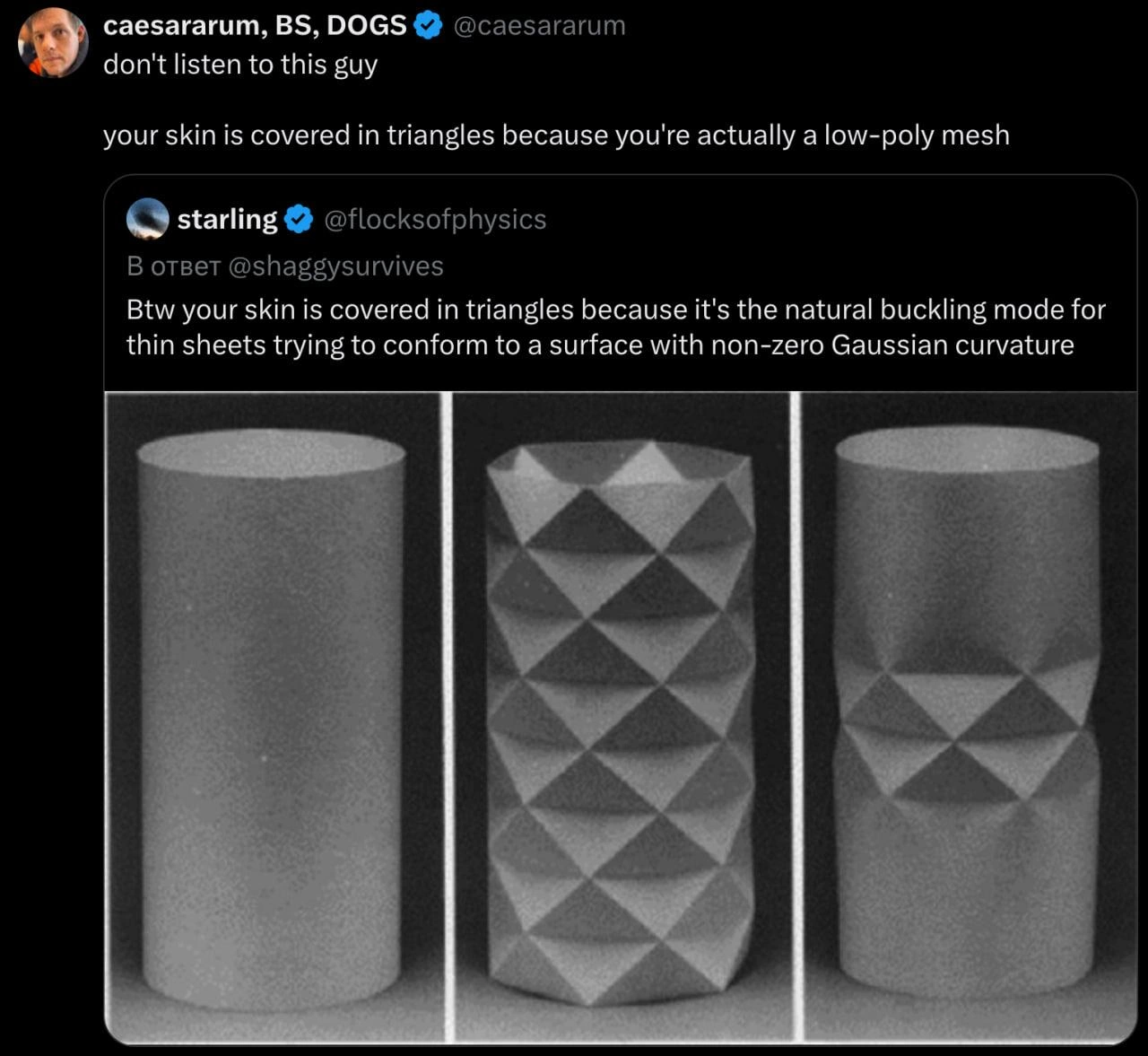
Now the other side: the physics and geometry. “Non-zero Gaussian curvature” sounds fancy but it’s basically about shapes like spheres or saddles that are curvy in a way you can’t flatten without warping. For example, a cylinder (like a soup can) has zero Gaussian curvature – it’s curved in one direction, but flat in the other, so you can cut it open and lay it flat as a rectangle. But a sphere (like a ball) or an irregular curved body (like a human knee or shoulder) has Gaussian curvature that isn’t zero, meaning if you try to lay flat stuff over it, something’s gotta give. Thin-sheet buckling is what happens when you press a flat or slightly stretchy sheet onto a curved surface: since it can’t smoothly flatten, it will form folds or wrinkles. Those wrinkles often make triangle- or diamond-like shapes. Imagine trying to gift wrap a ball – you can’t do it without making little folds; those folds radiate out and kind of partition the surface into curved triangles of paper between the seams. The tweet’s reply basically says: “By the way, your skin has triangles (wrinkles or facets) because that’s how a thin sheet (your skin) naturally behaves when stretched over a surface with curvature (your body).” The three images in the meme show this idea visually: the first image is a smooth cylinder (no wrinkles, like an ideal perfectly smooth surface). The second image shows that cylinder covered in a tessellation of neat triangles – it looks like a deliberate low-poly 3D model. The third image shows a real physical phenomenon: a cylinder with a buckling pattern – notice the band where it has caved in with a crisscross pattern (like an accordion or the way a pressed soda can crumples). That crisscross is essentially a bunch of triangular facets that appeared when the smooth surface couldn’t remain smooth under stress. So the middle image (intentional triangles for rendering) and the right image (natural triangles from buckling) look surprisingly similar! The meme cleverly connects these by text: one person jokes “don’t listen to him, you have triangles because you’re low-poly” and someone else jokes “actually it’s because of Gaussian curvature and buckling.”

In simpler terms, the humor comes from using two different explanations that both feature triangles. One is a silly video game logic explanation (we’re made of polygons like game characters), and the other is a real science explanation (wrinkles on curved surfaces often form triangle patterns). Both explanations, wildly different in seriousness, end up talking about triangles on the skin. For a junior dev or a student, it’s a fun reminder that the stuff you learn in math or graphics class actually can intersect in unexpected ways. It’s also an example of tech folks’ humor – taking an absurd statement and half-seriously backing it up with academic-sounding facts. And of course, it’s all happening in a Twitter screenshot meme, which is a popular way the developer community shares these niche jokes. You see the text in dark-mode tweet style, the handles, and a reference image – all typical twitter_screenshot_meme format to deliver a quick, witty insight with visuals. In summary: the meme jokes that whether by GPU rendering shortcuts or by physical laws of curvature, our skin might as well be made of triangles. It’s a playful mashup of engineering humor and real-world science.

Level 3: Triangles All the Way Down

This meme is a Twitter screenshot exchange that blends TechHumor with bona fide physics. It starts with a tongue-in-cheek tweet claiming “your skin is covered in triangles because you’re actually a low-poly mesh.” Any seasoned developer in GameDevelopment or 3D GraphicsProgramming will chuckle here: a low-poly mesh means a 3D model made of relatively few polygons, so you see the faceted, pointy surfaces. It’s the hallmark of 90s video games and modern indie art styles – characters with visible flat planes where there should be smooth curves. The joke is basically, “Hey, maybe reality runs on an outdated graphics engine with limited GPU budget!” – a classic nerdy twist on the simulation hypothesis, implying we’re all just avatars rendered with not-quite-enough triangles. This is highly relatable developer experience for anyone who’s had to optimize a 3D scene: you’ve probably swapped in lower-detail models (LODs) or reduced polygon counts to hit a frame rate, watching smooth objects turn chunky. If you’ve ever laughed at a game’s graphics where a round character looks like a faceted gemstone up close, you know exactly what low-poly means.

Then comes the quoted reply from @flocksofphysics, which takes the joke up a notch by dropping real science: “your skin is covered in triangles because it’s the natural buckling mode for thin sheets trying to conform to a surface with non-zero Gaussian curvature.” In plain terms, this person is saying: actually, triangles on skin could be a physics phenomenon. And hilariously, they’re right! They’re referencing how thin materials behave when you try to wrap them over something like a sphere (which has Gaussian curvature). Any veteran engineer or graphics nerd knows the classic example: try to gift-wrap a soccer ball or put a sheet of paper over an orange. You’ll inevitably get wrinkles or have to make cuts. You can’t do it perfectly flat because a spherical surface is intrinsically different from a flat sheet (that’s Gaussian curvature in action, a bit of CSFundamentals meeting real life). Those wrinkles? They often arrange into a crisscross pattern that forms little triangular or diamond shapes – essentially a buckling pattern. Even a metal can will develop a geometric buckle pattern if you squeeze it — engineers studying structural stability of thin-walled cylinders are very familiar with that diamond-shaped buckle lattice. So @flocksofphysics isn’t really contradicting the first tweet so much as yes-and-ing it with a legit explanation: our skin (a “thin sheet”) over our curved bodies might form microscopic wrinkle facets under tension, akin to a triangle tessellation. It’s both a nerdy comeback and a mini physics lecture in one tweet.

The humor lands because it fuses two worlds. On one hand, you have the computer graphics perspective: everything can be broken into triangles for rendering. On the other, the physics/geometry perspective: triangular patterns emerge naturally when flat stuff meets curved surfaces. Both perspectives meet on the common ground of triangles! It’s “triangles all the way down,” whether you’re talking about GPU rendering or mechanical buckling. Seasoned folks appreciate this because it’s an unexpected connection – the kind of witty observation you’d share with your team in a late-night debugging session: “Haha, even Mother Nature uses low-poly when conforming surfaces!” It’s also a subtle nod to the reality that a lot of our engineering solutions borrow from nature’s playbook and vice versa. Plus, the meme format being a Twitter reply means it has that casual, coffee-break EngineeringHumor vibe: one person making a cheeky claim, another dropping knowledge with a dash of snark. The poster’s follow-up message with clown and heart emojis (“🥰🤡🥰 Good morning and happy Friday to all low and high poly followers”) caps it off with a playful tone — greeting fellow geeks as either low-poly (simple) or high-poly (sophisticated), inclusive of all. In short, experienced devs laugh because the meme melds a trivial GPU joke with an actually correct fact about Gaussian curvature. It’s an ode to triangles – the one shape to rule them all in both rendering and reality.

Level 4: Conform or Buckle

In this meme, a seemingly silly Twitter quip actually nods to deep principles of geometry and mechanics. The reply about Gaussian curvature references Gauss’s famous insight that you cannot smoothly map a flat sheet onto a surface with non-zero Gaussian curvature without distortion. Mathematically, Gaussian curvature $K$ at a point on a surface is the product of the two principal curvatures $k_1$ and $k_2$ at that point:

$$ K = k_1 \cdot k_2 $$

If $K \neq 0$ (as on a sphere or a saddle shape), no amount of gentle stretching will let a flat sheet lie down perfectly — it must tear, stretch, or buckle. Gauss called this result his Theorema Egregium, highlighting how fundamentally intrinsic curvature is. A sphere (positive $K$ everywhere) or any shape with double curvature frustrates flat material. The thin sheet has to relieve stress somehow, and the lowest-energy escape path is often to form a wrinkled, faceted pattern. This is where the “natural buckling mode” mentioned in the tweet comes in: a thin cylindrical shell under compression, for instance, will typically crumple into a repeating diamond-shaped buckle pattern. Each diamond is essentially two joined triangles. This isn’t random: those triangular facets are the sheet’s way of creating piecewise flat regions so it can conform to the curved geometry without uniformly stretching. We’re witnessing an eigenmode of buckling – the sheet spontaneously finds a regular pattern (often triangular symmetry) that satisfies the physics of minimal energy under constraints. It’s like the sheet is solving a calculus of variations problem and the answer comes back: “triangles.”

Meanwhile, in computer graphics (the domain of game engines and rendering), there’s a well-known adage: everything is triangles. Graphics programmers reduce every 3D model — yes, even high-res human skin in a AAA game — to a mesh of tiny triangular polygons. This happens because triangles are planar by definition (any 3 points in 3D space define a flat plane). Complex curved surfaces are hard for GPUs to render directly, but a bunch of flat triangles can approximate curves arbitrarily well. The GPU hardware is specifically optimized for rasterizing triangles rapidly (thanks to algorithms like barycentric interpolation and three-edge clipping being simpler than for higher polygons). So whether you’re modeling a sphere, a cylinder, or a human face, eventually your fancy high-level model gets broken into a triangle tessellation. Even techniques like GL_TRIANGLE_STRIP or modern tesselation shaders in GraphicsProgramming ultimately emit triangles. The GPU budget refers to limits on how many of these triangles you can afford to draw per frame — a fundamental trade-off in GraphicsAndMultimediaProcessing.

Now here’s the delightful convergence: the physics and the graphics end up agreeing on triangles. The meme’s reply jokes that your skin is covered in triangles due to a physical buckling effect from Gaussian curvature, while the original tweet jokes it’s because you’re “actually a low-poly mesh.” Ostensibly they’re opposite realms (biology and rendering), but both explanations invoke triangulation. Intrinsically curved surfaces naturally produce triangular buckles when constrained, and rendering pipelines intentionally use triangular meshes to approximate curved surfaces. It’s a rare nugget of GeekHumor that connects a high-brow math principle to everyday GameDevelopment practice. As Gauss might smirk, even reality itself succumbs to a low_poly_mesh when under pressure – nature and GPUs alike seem to shout, “conform or buckle, everything into triangles!”

Description

A Twitter/X thread showing caesararum (@caesararum) quoting a tweet from starling (@flocksofphysics) that reads: 'Btw your skin is covered in triangles because it's the natural buckling mode for thin sheets trying to conform to a surface with non-zero Gaussian curvature.' caesararum adds: 'don't listen to this guy. your skin is covered in triangles because you're actually a low-poly mesh.' Below are three grayscale images of cylinders showing smooth, heavily triangulated/buckled, and lightly triangulated surfaces demonstrating the physical phenomenon of sheet buckling on curved surfaces

Comments

9
Anonymous ★ Top Pick Turns out humans are just under-tessellated meshes -- God ran out of GPU budget and had to reduce the polygon count on skin textures
  1. Anonymous ★ Top Pick

    Turns out humans are just under-tessellated meshes -- God ran out of GPU budget and had to reduce the polygon count on skin textures

  2. Anonymous

    Finally, a production bug where the fix isn’t more pixels - just increase the vertex count on the human body prefab and ship a hot-reload skin patch

  3. Anonymous

    After 20 years optimizing render pipelines, I've finally realized why my skin looks terrible in harsh lighting - God's LOD system hasn't updated since the Paleolithic era and we're all stuck at 'Medium' quality settings with no DLSS support

  4. Anonymous

    When your physics PhD explains why your game character looks like they were modeled in 1997, but makes it sound like a fundamental property of spacetime. Turns out we're not using low-poly meshes because of performance constraints - we're just accurately simulating how reality itself handles non-Euclidean surfaces. Who knew that 'it's not a bug, it's a feature' had a mathematical proof?

  5. Anonymous

    Nature uses the same primitive as the GPU - under non‑zero Gaussian curvature it switches to Delaunay tessellation; my face just drops to LOD‑1 after on‑call

  6. Anonymous

    Wrinkles are just the tessellation shader kicking in; aging is the renderer increasing LOD while procurement refuses to bump the polygon budget

  7. Anonymous

    The ultimate shader alibi: 'Not buggy normals - it's just thin-sheet buckling enforcing triangular topology on your Gaussian-curved prod model.'

  8. @JackOhSheetImSorry 9mo

    Happy Friday mate!

  9. @ZmEYkA_3310 8mo

    This shit peaks im reposting it

Use J and K for navigation