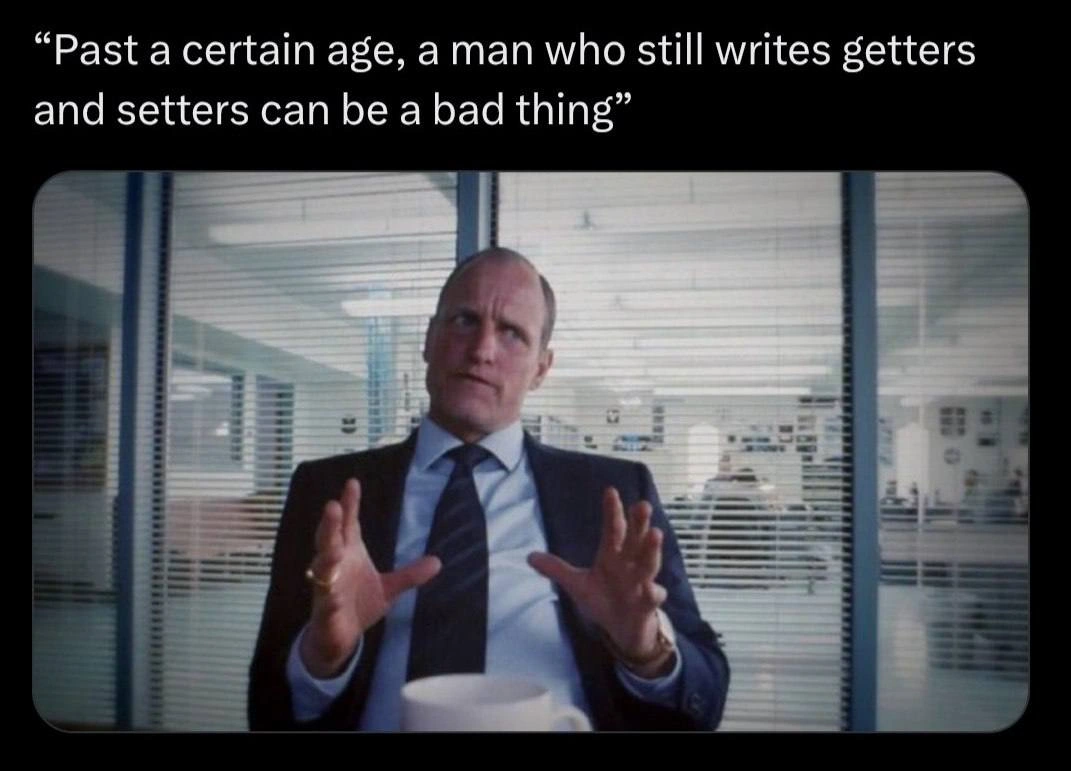
The Bell Curve of Engineering Wisdom
Why is this DesignPatterns Architecture meme funny?
Level 1: Don’t Overthink It
Imagine three people trying to fix a problem, like making breakfast in the morning. The first person is a kid who’s hungry. He opens the fridge, sees some bread and peanut butter, makes a quick peanut butter sandwich, and happily starts eating. Simple solution, done.
The second person is a culinary student who just learned all sorts of fancy cooking techniques at school. She says, “No, no, a breakfast must be done properly!” She pulls out a recipe book, starts whipping egg whites into meringue for soufflé pancakes, carefully measures twenty ingredients, and tries to create a gourmet dish. In the process, she uses a ton of bowls and pans, the kitchen gets messy, and it’s taking a really long time. She’s stressed out, yelling that “it has to be perfect and follow all the rules of fine cooking!” By the time her complicated dish is half-done, the kid has long finished the simple sandwich.
The third person is a master chef with decades of experience. He watches the scene, smiles to himself, and in a calm way says, “You know what, I’ll just fry a couple of eggs.” He heats a pan, crack-crack, a bit of salt, and within minutes he has perfectly cooked eggs ready to eat. They’re not fancy soufflé pancakes, but they’re delicious and satisfying. Simple solution, done.
Now, here’s the funny part: the child and the master chef both ended up with a quick, simple breakfast that solved the hunger problem, each saying something like, “Eh, I’ll just do this the easy way.” The culinary student in the middle is the one who made things super complicated, insisting it had to be done in a very elaborate way (and she’s the one looking frustrated and exhausted!). The kid’s approach was simple out of innocence, and the master chef’s approach was simple out of wisdom, but in practice they were similar – both didn’t overthink it. The person in the middle, with some knowledge but less experience, was overthinking the task.
This is exactly what the meme is joking about with coding. Sometimes, when you don’t know much (like the kid), you do the straightforward thing and it works. If you know a bit more (like the student), you might feel you must do a lot of extra stuff because you’ve learned there’s a “right way” – and you can end up making a simple job way harder than it needs to be. But if you become an expert (like the master chef), you realize that often the simple, straightforward way is best unless there’s a good reason to complicate it.
So the moral is: don’t overthink it! It’s funny and comforting to see that sometimes the simplest solution not only saves time and stress but can also be the smartest approach, whether you’re fixing breakfast or writing code.
Level 2: Principles vs Pragmatism
This meme uses the bell curve meme format to compare how different developers approach a coding problem. On the left, a beginner-level developer character says “I’m just gonna use a simple solution.” In the middle, an upset intermediate developer shouts “Noo! The code must follow the SOLID principles!!” On the right, an expert (the “enlightened” hooded figure) again says “I’m just gonna use a simple solution.” The joke here is that both the newbie and the seasoned expert want to keep things simple, while the person in the middle insists on doing things in a very structured, complicated way. It’s a funny take on simple vs. complex design in programming.
Let’s clarify what the shouting middle person is so concerned about. SOLID principles are five well-known guidelines in object-oriented software design intended to make code more maintainable and flexible. They are:
- Single Responsibility Principle (SRP): a class or module should have one and only one reason to change. In plain terms, give each component one job.
- Open-Closed Principle (OCP): software entities (classes, functions, etc.) should be open for extension but closed for modification. That means you design your code so new features can be added by writing new code (like adding new classes or methods), rather than having to modify existing code all the time.
- Liskov Substitution Principle (LSP): objects of a superclass should be replaceable with objects of a subclass without breaking the application. This is a formal way of saying subtypes must be usable wherever their parent type is usable, without unexpected results. For example, if you have a class
Animaland a subclassBird, any code usingAnimalshould work fine if you pass in aBird. If theBirdclass violated expectations (say, aBirdcouldn’t do something everyAnimalis expected to do), that would break LSP. - Interface Segregation Principle (ISP): no client (meaning no piece of code) should be forced to depend on methods it does not use. This encourages using many specific, smaller interfaces rather than one big, do-it-all interface. In short, don’t make interfaces fat; break them up so classes only implement what they actually need.
- Dependency Inversion Principle (DIP): depend on abstractions, not on concrete implementations. This often means your high-level code (like business logic) shouldn’t directly depend on low-level code (like database or network calls). Instead, both should depend on abstract interfaces. This makes swapping out the actual implementation (say, switching databases or using a mock for testing) easier. Essentially, invert the normal dependency: high-level modules dictate the abstraction, and low-level modules must conform to it.
All together, SOLID is about writing code that’s organized, modular, and easy to change or extend later. It’s a cornerstone of what people call Clean Code principles or good software architecture. So our middle developer in the meme is basically saying, “We must do this properly, following all the best practices to the letter!”
Now, why would someone argue against doing things “properly”? The issue is that real-world coding is about balance. Yes, SOLID principles are good, but applying them in every single situation can lead to over-engineering. Over-engineering means you’ve made something more complicated than it needed to be. It’s like designing a spaceship when all you needed was a bicycle. In coding, this could mean using a whole bunch of classes, patterns, and abstractions for a task that could have been done with simple straightforward code. The meme highlights this by showing the intermediate dev essentially overthinking and over-complicating the solution in the name of “code purity,” whereas the other two just go ahead and solve the problem in a direct way.
There’s also a known motto in engineering: KISS – “Keep It Simple, Stupid.” (No offense intended by the word “stupid” – it’s just a famous phrase meaning don’t unnecessarily complicate things.) The KISS principle says that when designing systems or writing code, you should aim for the simplest solution that works, and avoid adding complexity unless it’s truly needed. In our meme, the novice and the expert are both basically following the KISS principle. They want a simple solution that likely just solves the problem at hand. The expert, of course, has the experience to ensure the simple solution is elegant and not a dead end, whereas the novice is keeping it simple mostly because they don’t know a more complex way. But on the surface, they’re doing the same thing: writing simple code.
The middle developer, on the other hand, is perhaps worried that a simple solution might be bad code since it doesn’t visibly follow the formal rules they learned. For them, not using SOLID feels like cutting corners. A common scenario: an intermediate dev might think, “If I don’t use an interface and separate classes here, am I being a bad programmer? What if another developer judges my code as ‘unprofessional’?” They have pride in applying those DesignPatterns_Architecture concepts from textbooks or blogs. This can lead to something we call “enterprise coding” or making something more elaborate just to check all the boxes.
To make this concrete, consider a tiny coding task: adding two numbers. How might people at different experience levels approach it?
# Novice solution (straightforward and imperative)
result = a + b
# Intermediate solution (over-engineered to follow SOLID principles)
class Adder:
def add(self, x, y):
# abstract method, to be implemented by subclasses
raise NotImplementedError
class BasicAdder(Adder):
def add(self, x, y):
# simple addition implementation
return x + y
# Using the classes to perform addition
adder = BasicAdder()
result = adder.add(a, b)
# Expert solution (back to simple, recognizing the abstractions weren't needed)
result = a + b
In the above pseudo-code:
- The novice just takes
aandband adds them. One line, done. - The intermediate developer creates an
Adderinterface (or abstract class) and aBasicAdderimplementation. This might be following the Dependency Inversion Principle (have code depend on an abstractionAdderrather than a concrete addition function) and perhaps Single Responsibility (the addition logic is isolated in its own class). But clearly, for just adding two numbers, this is overkill. We’ve introduced extra classes and complexity with no real benefit. - The expert sees that all that abstraction isn’t actually buying anything for such a simple operation, so they too just add the two numbers directly.
This is obviously an exaggerated example (most intermediate devs would not over-engineer something as basic as integer addition!). However, it illustrates the pattern: the intermediate solution tried to force a generic, extensible structure onto a trivial problem. You might ask, “Why on earth would someone do that?” One reason: the intermediate might be thinking, “What if I need to change how addition works later? What if I need different kinds of addition (like safe addition that checks overflow, or logging each operation)? If I have an Adder interface, I can add those easily!”. That thought process isn’t totally wrong — planning for the future can be good — but it’s often speculative. If those needs never arise, you’ve done extra work for nothing. There’s a famous acronym YAGNI that applies here: “You Aren’t Gonna Need It.” It reminds developers not to build features or infrastructure until they actually need them. YAGNI is essentially telling the intermediate dev, “Don’t create an abstract Adder until you really have multiple ways of adding or a real requirement to swap addition strategies. Right now, a simple + works fine.”
Now, let’s talk about why the expert and novice making the same choice is humorous. Typically, you might assume the senior developer would write the most complex, refined code and the junior might write something overly simple and maybe flawed. In reality, seniors often strive for clarity and simplicity, because they’ve learned that simpler code has fewer bugs and is easier for everyone to understand and maintain (which is the true goal of CodeQuality). The expert’s code might be simple on the surface, but it usually comes with subtle improvements: meaningful variable names, a bit of error handling, or using a known efficient method. The novice’s simple code might be similar in logic, but perhaps less polished (maybe hardcoded values or not accounting for some edge case). Still, on a high level, both solutions are not using a massive framework – they’re just straightforward.
The bell curve meme format emphasizes this by making it look like the “simple solution” is something one might associate with someone who doesn’t know better (left side low IQ), and ironically also with someone who’s a mastermind (right side high IQ). The middle stands for the people who know just enough to insist on complexity because they think it’s the right way. This format is common in internet humor to show how two opposite extremes can agree on something that the average viewpoint rejects. In developer humor, it often highlights how experience can flip perspectives. What you dismiss as naive at one point (like a super simple design) might become your preferred approach once you have enough experience to understand its value.
We also see a bit of pragmatism vs. principles here. Principles (like SOLID) are rules to guide design. Pragmatism is doing what works best in the actual situation, rules be damned if they get in the way. The intermediate is all principles, no compromise: “We must adhere to SOLID come hell or high water!” The folks at either end are more pragmatic: “Does it solve the problem? Is it reasonably clear? Okay, let’s do that.” The expert probably does still respect the principles — they’re second nature, really — but they apply them with judgment. For example, a senior dev might say, “Sure, Single Responsibility Principle is important, but in this tiny script, splitting it into five different classes will actually make it harder to follow. Let’s maybe not do that.” The junior might coincidentally do the same thing just by instinct or simplicity, not because they weighed any pros/cons, but the end result (a simpler design) aligns with what the senior decided deliberately.
In practical early-career terms, you might have experienced this when writing your first programs or small projects. Perhaps at first, you wrote code in one big function or a single file (simple but not very organized). Then you learned about organizing code into classes, separating concerns, and perhaps you might have gone a bit far – making a class for every little thing, or applying a design pattern you just read about even if a simple loop would do. If you’ve ever created, say, a factory class to generate one type of object that your program ever uses, or an abstract base class when you only have one implementation — that’s the kind of over-engineering the meme is joking about. It’s bike-shedding in the software architecture sense: focusing on elaborate design details that aren’t actually solving new problems. Over time, with mentorship or reading others’ code, you might have realized not every problem needs that heavy treatment. It’s a bit like learning to cook: at first you might just fry an egg plain (simple result), then you learn fancy techniques and try to make a perfectly poached egg with a siphon and 12-step process (complicated), and eventually as a chef you realize a simple fried egg with good ingredients is actually excellent and much quicker (back to simple, but informed by experience).
In summary, this meme is funny to developers because it rings true: the more you know, the more you realize you don’t need to rigidly apply every rule. Good software architecture is about judgement and balance. The intermediate dev’s reaction (“No! It must be SOLID!”) represents a phase of learning where rules feel like the most important thing. The expert’s identical response to the newbie’s (“I’ll just use a simple solution”) represents the phase where you’ve integrated the rules and know when to keep it uncomplicated. It’s a comical reminder to not get lost in the weeds of idealism – sometimes, just solving the task simply is the smartest move. The bell curve visual drives home that it’s a sort of journey: you might start simple, go complex, then return to simple, coming full circle in understanding. And for anyone who’s gone through that journey, it’s both relatable and humorous to see it depicted in such a cartoonishly straightforward way.
Level 3: Wisdom at the Tails
Look at the meme’s setup: it’s a classic IQ bell curve diagram with three archetypes of developers placed across the spectrum. On the far left tail, we have the newbie (depicted as a simple, happy cartoon face) cheerfully saying, “I’m just gonna use a simple solution.” On the far right tail, the enlightened guru (the hooded figure with a serene expression) echoes, “I’m just gonna use a simple solution.” And smack in the middle of the curve, we see the frustrated “mid-wit” developer (glasses, furrowed brow) yelling, “Noo! The code must follow the SOLID principles!!”
This layout is poking fun at a well-known phenomenon in software development: over-engineering by those in the middle of their learning journey, contrasted with the pragmatic simplicity embraced by beginners and seasoned experts. In other words, both the least experienced and the most experienced developers sometimes make surprisingly similar decisions, while the folks in the middle can fall into a trap of complicating things in the name of doing things right. It’s the software architecture version of the saying, “common sense is not so common in the middle.” 😄
Why is the middle guy so angry about SOLID principles? Let’s unpack that. SOLID is an acronym for five design principles (Single Responsibility, Open-Closed, Liskov Substitution, Interface Segregation, and Dependency Inversion) widely regarded as hallmarks of good object-oriented design. Following SOLID is meant to improve code quality by making code more maintainable, flexible, and robust. The middle developer is essentially shouting the rallying cry of the clean-code evangelist: “We have to do this properly! No shortcuts! Adhere strictly to every design rule we learned!” This attitude often comes from a place of freshly acquired knowledge. Many of us have been there – you read Uncle Bob’s Clean Code or a book on Design Patterns, and suddenly you see everything through that lens. Every function, every class in your codebase gets scrutinized: Is it following SRP? Did I implement an interface for this database access so I can swap it out easily later? You gain just enough expertise to recognize messy code, and you swear never to be that sloppy junior who writes ad-hoc script-y code. Instead, you’ll show the world you can architect like a pro.
But here’s the punchline that every senior dev knows: in real life, overzealous adherence to these principles can ironically produce the very problems they were meant to prevent. The mid-level dev in the meme is effectively performing a ritual of design purity—insisting on abstracting and decoupling everything. This can lead to a proliferation of indirection: 10 tiny classes where 2 simpler ones would do, layers of factories, managers, and interfaces for a problem that could have been solved with, say, a straightforward loop or a few functions. The code becomes over-engineered. Yes, each class has a single responsibility and plugs nicely into an open-closed architecture, but the overall system now has so many moving parts that understanding or changing a simple behavior requires navigating a maze. The codebase becomes SOLID in the wrong sense — solid as a rock, hard to move or modify. (Oh, the irony in the term solid! The code is so “SOLID” that it’s rigid and brittle.)
Meanwhile, what are the folks at the tails of the bell curve doing? They’re just solving the problem in front of them with the simplest thing that works. The junior on the left tail does this out of necessity (they don’t know fanciful patterns; they just hammer out a solution with brute force or a quick script). The senior on the right tail does it out of wisdom (they’ve seen countless contrived architectures crumble under their own weight, so they favor simplicity and clarity). Both ends of the spectrum embrace a version of the KISS principle – Keep It Simple, Stupid. They may not say it in those words, but their identical quotes in the meme, “I’m just gonna use a simple solution,” sum it up. It’s a bit of a zen moment: the master and the novice sometimes arrive at the same approach, albeit one does it unwittingly and the other does it deliberately.
This contrast is a source of collective developer humor because it’s so relatable. Many experienced programmers will chuckle remembering a time they were in that middle phase, perhaps right after learning about design patterns or after their first big refactoring project. For example, think of a scenario from real life: A junior programmer writes a quick-and-dirty script that parses a file and outputs some results. It might not be pretty, but it works and it’s 50 lines of code. A mid-level developer, tasked with “improving” this, decides to refactor it into an elegant object-oriented solution: they introduce a FileParserFactory, an AbstractParser base class, concrete parser subclasses, a ResultFormatter interface, and so on, layering in all the design patterns they’ve heard of. The result now is 500 lines of code across 10 files. It’s well-structured on paper, sure, but debugging it is now an adventure through multiple indirections. A senior developer reviews this and politely asks, “Why didn’t we just use a simple loop with a couple of well-placed functions? We could accomplish the same thing in 60 lines.” The mid-level dev might protest, “But extension! But flexibility! We might need a different parser someday!” This is where the senior calmly invokes YAGNI (“You Aren’t Gonna Need It”) – the wisdom that you shouldn’t build features or abstractions until you actually need them. The senior isn’t allergic to SOLID principles; they’re just not applying them in a vacuum. They know when to apply them and when to keep it straightforward.
Another angle to this is the developer maturity spectrum (which the bell curve is comically illustrating). Early in our careers, we often lack knowledge, so we default to straightforward (if not always optimal) solutions — we may copy a snippet from StackOverflow, hard-code some logic, etc. As we gain experience, we swing hard in the other direction: suddenly everything must be an interface or a design pattern, because we’ve seen the dangers of spaghetti code and we want to be “professional.” This is the middle of the bell curve, where our understanding is bigger but so is our inclination to perhaps show off that understanding or zealously apply it everywhere. With further experience, we realize some of that was overkill; we level out and find balance. We come to appreciate clean, simple design as an ideal, not just elaborate design. We recognize that code is read more often than it’s written, so being clear and straightforward is often better for maintainability than an extremely clever architecture. As the meme jokes, at that point we’ve converged again with the beginner’s mindset: get the job done in the simplest way. The big difference is we now know why that simple way is often preferable, whereas a beginner might just be lucky or unaware of alternatives.
The meme also touches on team dynamics. Consider a team meeting where a less experienced dev says, “Why don’t we just do it this easy way?” and a mid-level engineer immediately objects, “No, no, no, that violates the holy SOLID principles and Clean Code guidelines – we need a more robust architecture.” They might diagram out an elaborate class hierarchy on the whiteboard. Then the tech lead (seasoned developer) chimes in: “Actually, the simple approach might be fine here. We can always refactor later if needed.” The junior and senior are in agreement, leaving the intermediate looking a bit perplexed – did I overthink it? This scenario (or some flavor of it) has happened countless times in real software shops. That’s why the meme elicits knowing nods and laughs: it’s shining a light on the architecture bike-shedding that often occurs. (Bike-shedding meaning spending time on trivial but technically fancy details – like over-designing a small feature – instead of just solving the core problem, much like debating the color of a bike shed while the house needs building.)
Historically, the industry has gone through phases reflected in this meme as well. In the early days of programming, memory and processing were limited, so solutions had to be as simple and efficient as possible – there was no room for fluff. Then came the era of big software engineering in the 80s and 90s, with a push towards rigorous design methodologies: UML diagrams, the infamous 23 GoF design patterns, and a lot of formal best practices. These were effective up to a point, but also led to a culture of sometimes valuing form over function. By the 2000s and 2010s, a counter-movement emphasized agility and YAGNI – essentially a return towards simplicity unless complexity is justified. Seasoned devs today often carry a bit of both: they understand the patterns and principles (they can apply SOLID when the situation truly calls for it), but they also carry scars from projects where over-engineering caused delays or failures.
So, the humor here comes from truth: the middle developer’s scream of “MUST FOLLOW SOLID!” is something many of us have literally heard or even said at some point, only to later laugh at ourselves. The enlightened character on the right is basically the voice of experience saying, “Relax, it’s not a sin to write a simple solution.” And that left character? Sometimes beginners, by pure straightforward thinking, end up with a solution that’s 90% as good as the intermediate’s elaborate solution, delivered in 10% of the time. Sure, their code might lack polish or fail scaling tests down the line, but the point is — not every problem needs an enterprise-grade architecture. The enlightened senior knows how to distinguish a quick script scenario from a mission-critical module that does demand careful SOLID design. They’ve come to realize that principles exist to serve the code and the project, not the other way around. When following a rule starts to make the code worse (more convoluted) rather than better, it’s time to rethink that rule.
In essence, this meme resonates because it encapsulates a rite of passage in development: you often learn complexity before you (re)learn simplicity. It’s a wink and a nudge to every developer: Don’t worry, if you’re currently obsessed with doing everything “by the book,” you might find in a few years that you’re more comfortable bending the rules. And ironically, that might make your code better. The bell curve exaggerates it into a joke – picturing the intermediate as the only one who “doesn’t get it” while the extremes do – but it’s rooted in the real paradox of software architecture: sometimes, less is more. The enlightened coder isn’t against SOLID; they’ve just internalized the goals behind SOLID (write code that’s easy to change and understand) and know that often the quickest path to that goal is to keep things simple. After all, you can always refactor a simple solution into a more complex one when needed, but trying to simplify an overly complex solution is an arduous journey. The wise developer at the right tail chooses to start simple, in stark agreement with the newbie who wouldn’t know how to start any other way. Both ends smile and proceed to code, leaving the poor mid-level engineer tearing their hair out over an elaborate class hierarchy that maybe wasn’t necessary. And that’s why we’re laughing along – we’ve seen that movie and, eventually, we all want to be the chill person on the right who just says: “Let’s not overthink this.”
Level 4: Occam's Razor in Code
At the deepest level, this meme hints at a fundamental principle in both computer science and philosophy: the simplest solution that fulfills the requirements is often the best. This idea is akin to Occam’s Razor – given multiple explanations or solutions, the one with the fewest assumptions (or simplest design) is preferred. In software terms, every extra class, layer, or abstraction is an “assumption” or accidental complexity added on top of the problem’s essential complexity. Academic software engineering talks about essential vs. accidental complexity: the essential complexity is the inherent difficulty of the problem itself, and anything additional (frameworks, patterns, extra layers that aren’t strictly necessary) is accidental complexity introduced by the solution. In an ideal world, we’d minimize that accidental complexity to keep systems lean and understandable.
This meme’s extremes (both the novice and the guru) favor a solution with far less accidental complexity than the mid-level engineer’s over-engineered approach. There’s an implicit nod to the idea that minimal design can be a virtue. In theoretical terms, you might even think about Kolmogorov complexity – the length of the shortest program that produces a given output. While not directly referenced, intuitively the novice and the expert are reaching for a program that’s close to the shortest correct solution, whereas the intermediate is writing a much longer “description” of the solution (lots of extra code) without additional benefit. The humor arises because the outcome is the same (the problem gets solved) but one approach is algorithmically “simpler” in its description.
We also see a dash of cognitive science or psychology here. The bell curve format evokes the Dunning-Kruger effect curve – where beginners have high confidence from simple thinking, intermediates lose confidence as they become aware of complexities, and experts regain a tempered confidence with deep understanding. In the meme, the novice’s confidence in a simple approach comes from ignorance (they’re blissfully unaware of design philosophies), whereas the expert’s confidence in simplicity comes from wisdom (they’ve experienced the drawbacks of needless complexity). It’s a case of knowledge forming a full circle. This aligns with a well-known quote in software engineering:
“There are two ways of constructing a software design: One way is to make it so simple that there are obviously no deficiencies, and the other way is to make it so complicated that there are no obvious deficiencies.” – C.A.R. Hoare
In other words, a system can achieve reliability either by simplicity (so straightforward that flaws stand out and can be corrected) or by burying logic under layers (so opaque that flaws are hard to find – not exactly a good thing!). The bell curve joke is pointing out that both the low-IQ and high-IQ extremes choose the first approach: make it so simple there are obviously few things that can go wrong. The middle IQ person is opting for the second approach: make it so elaborate that no flaw is immediately visible (but in reality, that complexity is a flaw in itself).
From a theoretical design stance, this also touches on ideas of generalization vs. overfitting. In machine learning theory, a model that is too complex can overfit to training data and perform poorly on new cases, whereas a simpler model often generalizes better. By analogy, the mid-level developer’s overly complex, heavily abstracted code is like an overfit model – it’s tailored to a bunch of design rules and future scenarios that might not even materialize, making it less adaptable in practice. The simple solution favored by the enlightened dev is like a simple model – it handles the current problem well and can be adjusted easily when new requirements come, precisely because it isn’t tied up in a rigid structure. Paradoxically, too much emphasis on theoretical “future-proof” architecture can reduce a system’s ability to handle real future changes (the code becomes so SOLID that it’s inflexible – rigidity is actually one of the classic symptoms of bad design that SOLID principles were intended to avoid!). This is sometimes called the complexity curse: every additional layer or abstraction has a cost in understanding and maintenance, so there’s a point where adding “best practices” starts to yield diminishing or even negative returns.
In summary, the meme reflects a deep truth recognized in software engineering theory: keep it as simple as possible, but no simpler. The left and right characters both embody this “Occam’s Razor of coding,” whether by naiveté or enlightenment. The humor works on this level because it’s narrating an almost mathematical inevitability: if a solution is correct and minimal, any extra complexity is superfluous. And nature (and good engineering) tends to favor parsimony. What’s brilliantly absurd here is that you have to go through the whole journey of mastering complexity to truly appreciate simplicity again – a full circle that computer science theory and practice often illustrate.
Description
This image uses the IQ Bell Curve meme format to illustrate the evolution of a software developer's mindset. On the far left, representing a novice, a simply drawn character says, 'I'M JUST GONNA USE A SIMPLE SOLUTION.' At the peak of the curve, representing an average or mid-level developer, a crying, bespectacled 'Soyjak' character frantically insists, 'NOO! THE CODE MUST FOLLOW THE SOLID PRINCIPLES!!' On the far right, representing an expert, a serene, hooded character calmly states, 'I'M JUST GONNA USE A SIMPLE SOLUTION.' The meme satirizes the journey from naive simplicity to dogmatic adherence to rules, and finally to an experienced pragmatism where simplicity is chosen intentionally. It humorously critiques the tendency of intermediate developers to over-engineer solutions by rigidly applying design principles, whereas seasoned engineers have the wisdom to know when a simple approach is the most effective
Comments
26Comment deleted
The difference between the simple solution on the left and the simple solution on the right is about ten years of implementing the complex solutions in the middle
Architectural bell curve: junior writes a 25-line function, mid refactors it into six SOLID-approved interfaces and a DI container, senior deletes the lot and leaves one function with a comment - “KISS; the 3 AM pager can’t deserialize abstractions.”
The senior engineer who spent three sprints building a perfectly abstracted, dependency-injected, event-sourced solution just watched the intern solve it with a HashMap and a for loop in production
The most dangerous developer isn't the junior who doesn't know SOLID - it's the mid-level who just discovered it. After 15 years, you realize that sometimes a 50-line function that actually works is worth more than a perfectly abstracted, dependency-injected, interface-segregated architecture that takes three days to modify. The real senior move? Knowing when 'good enough' is actually better than 'architecturally pure,' because you've seen enough over-engineered systems collapse under their own abstraction weight
Architecture bell curve: junior ships a for-loop, principal ships a for-loop; middle adds six interfaces and an AbstractFactory so the for-loop can swap between its one implementation in the name of SOLID
SOLID peak: Where YAGNI goes to die, tripling LOC for that one edge case the auditor dreamed up
After a decade you learn MTTR beats SOLID bingo - the most maintainable class is the one you delete before the AbstractFactoryFactory PR even opens
SOLID is a simple solution. Comment deleted
A solid brick. Also simple. Comment deleted
u need to choose right simple solution Comment deleted
the code also can follow KISS and/or DRY principles Comment deleted
I prefer my code in a gaseous form tyvm Comment deleted
KISS!!! Comment deleted
You have to have enough experience to be able to foresee that your simple solution will not become a problem in the future Comment deleted
If it becomes a problem in the present, just fix it, future is just speculation. There're almost 50 year codebases in Fortran Comment deleted
When you need to test private methods you just write #define private public #include "testmedaddy.hpp" and test as usual 👌 Comment deleted
KISS and YAGNI literally mean "write only the code needed" Comment deleted
This is the reason why I posted this 😦 Comment deleted
but then it fully negates the meaning of the meme because it puts the small-minded guy, average guy and top-IQ guy in the completely same position Comment deleted
Welcome to the internet Comment deleted
я ненавижу постиронию Comment deleted
english please Comment deleted
Translation: I hate postirony Comment deleted
Btw, is usage of Russian in this comment also an instance of postirony? 🤔 Comment deleted
i guess so Comment deleted
да Comment deleted