
CS Fundamentals Post #813 · source on Telegram
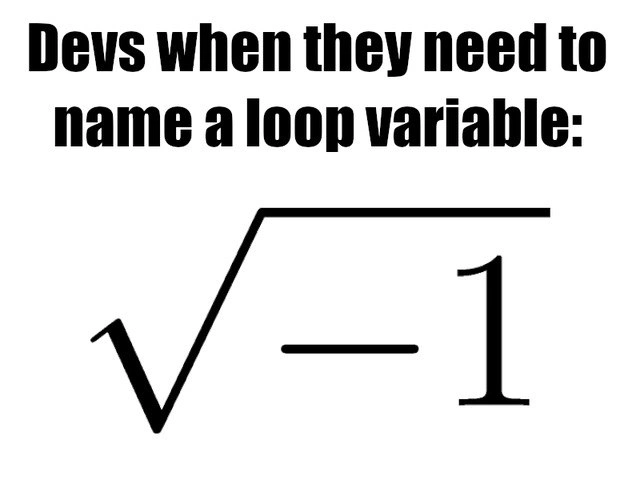
Imaginary Loop Variables
Description
A simple meme with black text on a white background. The top text reads, "Devs when they need to name a loop variable:". Below this, there is a large mathematical symbol for the square root of negative one (√-1). This is a clever mathematical pun. The square root of -1 is an imaginary number, represented by the symbol 'i'. In many programming languages, 'i' is the conventional and most common variable name used for the index or counter in a loop (e.g., `for (int i = 0; i < n; i++)`). The meme humorously equates this standard programming practice to a fundamental concept in mathematics
More like this
More like this in CS Fundamentals →
Use J and K for navigation
Comments
7Comment deleted
Why do programmers prefer 'i' for loops? Because 'j' is just 'i' after it's been through a gnarly code review and had to be completely refactored
Euler unintentionally became our style-guide author - 200 years later every for-loop still ships with his single-letter API surface
Twenty years in, still using 'i' for loops while enforcing strict naming conventions in code reviews that would make Uncle Bob weep with joy
The real reason we use 'i' for loop variables isn't laziness - it's because after debugging nested loops with i, j, k, l, m, n, we've all entered an imaginary dimension where variable names lose all meaning. At least mathematicians had the decency to stop at 'i'; we keep going until we're using Greek letters and contemplating our life choices at 2 AM
Architects mandate 'loopIndex' for readability, but every prod codebase secretly increments the imaginary 'i'
Twenty years of style guides and code reviews, and the only global standard we actually follow is that loop counters start at the imaginary unit - then increment straight into off-by-one hell
Name it i because readability is imaginary - then j and k show up and Big O starts standing for ‘oh no’