Democratised Intelligence, Except for the Intelligent Part
Level 1: Free Samples, Private Feast
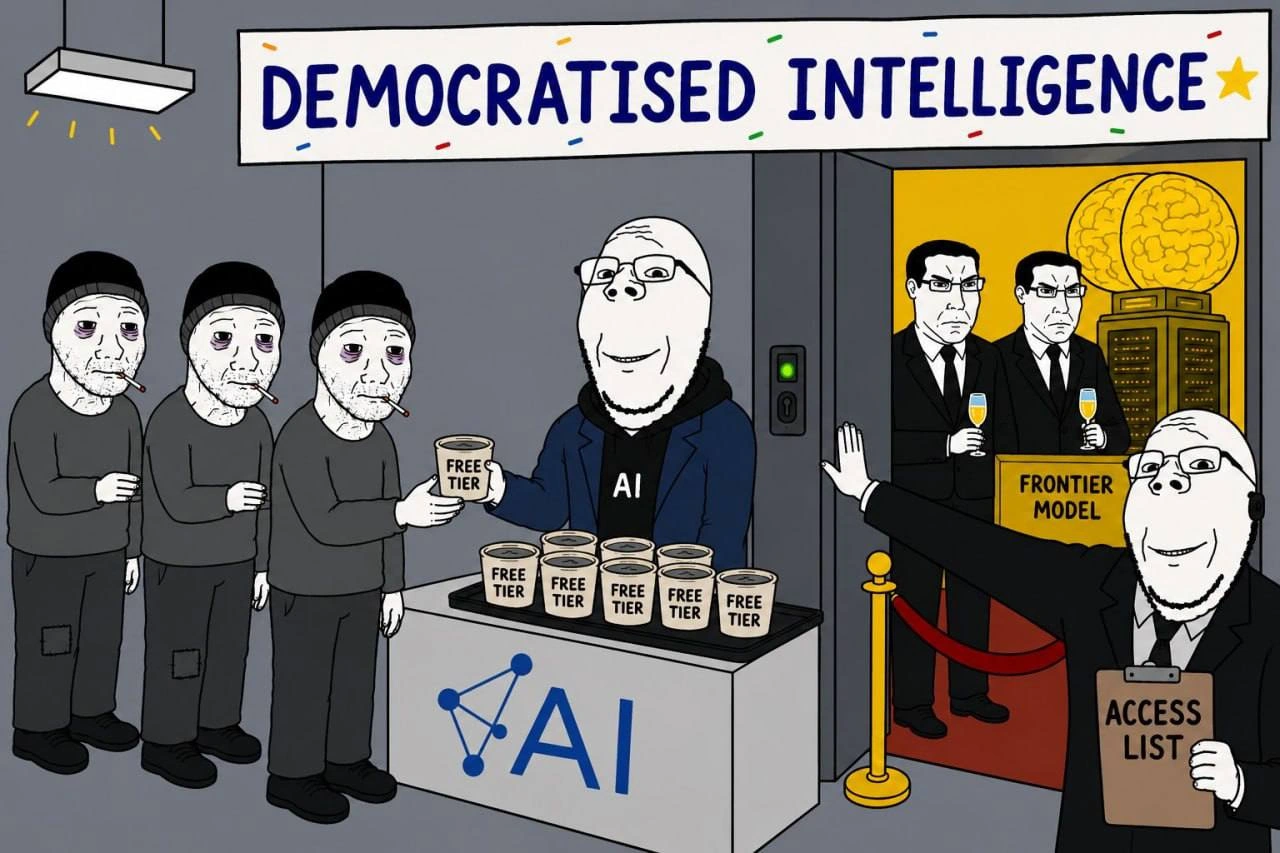
It is like a restaurant hanging a sign that says “Great Food for Everyone,” handing people outside tiny free sample cups, and keeping the best meal behind a velvet rope for names on a private list. The samples may be genuinely useful and tasty, but calling the whole arrangement equal is funny because everyone can plainly see the guarded dining room.
Level 2: Free Does Not Mean Equal
A free tier is a limited version of an online service offered without payment. For an AI product, limits may include how many messages a person can send, which model answers, how long the input can be, which tools are available, and how quickly requests are processed. Companies use free tiers to let people try a product, serve lower-cost use cases, collect feedback, and encourage upgrades.
A frontier model is a model near the leading edge of current capability. It may perform better on difficult reasoning, coding, science, or tool-using tasks, but it can also cost more to run and present greater misuse concerns. A provider may release such a model gradually to evaluators, trusted partners, enterprise customers, or verified specialists before offering it more broadly.
An access list is an access-control mechanism: only identities approved under specified rules can enter. In software this may be enforced through account permissions, organization IDs, API keys, regional checks, plan entitlements, or manual approval. The guard and rope turn those invisible checks into a physical nightclub entrance.
The meme asks who benefits from those rules. A free user holding a cup technically has AI access, but an admitted company may have a more capable model, higher limits, integration support, and permission to build products on top of it. That difference can affect education, research, business competition, and who learns the technology first.
Security creates a real trade-off. Releasing powerful tools to everyone can enable useful innovation and defensive work, but it can also lower barriers for abuse. Restricting them may reduce some risks while concentrating power and hiding decisions from public scrutiny. Fair access therefore requires more than declaring one side good: providers need clear criteria, appeals, independent evaluation, transparency about model differences, and pathways for qualified people outside major institutions.
The exhausted figures make the emotional point. They are not shown receiving nothing; they are shown receiving the same small standardized portion while being told the entire arrangement is democratic. The joke lives in that gap between having some access and having meaningful power.
Level 3: Equality at the Turnstile
The banner promises DEMOCRATISED INTELLIGENCE, but the room underneath is split into two products. On the left, three exhausted, interchangeable customers queue for paper cups marked FREE TIER. On the right, a velvet rope, a smiling guard, and an ACCESS LIST protect a gold-lit counter labeled FRONTIER MODEL, complete with suited attendants, server racks, drinks, and an oversized brain. The same friendly face appears to distribute the cups and police the door. Access has been democratized in the precise sense that everyone may approach the company.
The satire separates availability from parity. A free chatbot can provide real value: translation, explanations, drafts, brainstorming, and basic coding help that once required specialized software or paid labor. But “anyone can use AI” does not mean everyone receives the same model, limits, tools, latency, context window, privacy terms, or ability to automate it through an API. The public line gets a metered serving; selected institutions get the room where the serving decisions are made.
The timing makes the image unusually specific. It was posted on June 29, 2026, three days after OpenAI began a limited preview of the GPT-5.6 family. At that moment, the preview was restricted to a small group of selected partner organizations coordinated with the U.S. government; ordinary consumers were not eligible, and there was no public application, waitlist, or announced general-availability date. The cartoon contains no OpenAI name or model number, so treating it as a direct reference would be an inference. Still, its literal ACCESS LIST outside a FRONTIER MODEL room closely mirrors the access debate unfolding that week, alongside similar industry moves toward approved-partner and trusted-access programs.
That context matters because the meme is not merely complaining that paid users get more than free users. Subscription tiers are familiar. The sharper concern is that the highest-capability systems may become a different class of infrastructure: initially available to governments, major enterprises, established research partners, or organizations with account representatives, while everyone else receives a safer, cheaper, older, or more heavily throttled substitute. “Free tier” then functions as both a useful public service and a demonstration counter for power concentrated elsewhere.
There are legitimate reasons to stage frontier access:
- Compute scarcity: large models require costly accelerators, memory, power, and serving capacity.
- Safety evaluation: advanced cyber, biological, or autonomous capabilities can create dual-use risk.
- Operational learning: a limited preview exposes failures before millions of users depend on it.
- Abuse prevention: verified organizations are easier to monitor and hold accountable than anonymous accounts.
- Legal constraints: export controls, privacy rules, and sector regulations can restrict who may use what.
The problem is not that every gate is irrational. It is that “trusted” can quietly become a synonym for “already powerful.” A startup without a sales relationship, an independent security researcher, a university outside favored jurisdictions, or a public-interest group may be excluded even when its proposed use is beneficial. The organizations admitted early gain productivity, expertise, integration time, and influence over the product. Those advantages help them qualify for the next access list, creating a feedback loop in which institutional trust compounds like capital.
This is the digital divide at model scale. Earlier divides concerned owning a computer or having broadband. The newer divide has several layers:
| Layer of access | What “democratized” could mean | What may remain gated |
|---|---|---|
| Interface | Anyone can open a chat | Usage caps and weaker defaults |
| Capability | Comparable answer quality | Frontier reasoning and tools |
| Development | Ability to build with an API | Higher quotas and privileged endpoints |
| Control | Ability to run or modify a model | Closed weights and expensive compute |
| Governance | A voice in acceptable-use rules | Decisions made by labs and states |
Marketing often collapses all five into the first. The presence of a public chat box is presented as universal access to “intelligence,” while model ownership, training infrastructure, deployment policy, and the strongest capabilities remain centralized. The cups are free; the kitchen, recipe, supply chain, and guest list are not.
Open-weight models can narrow parts of this gap because people can inspect, adapt, and host released parameters without a vendor approving each request. They do not erase it. Running a large model still requires hardware, engineering skill, electricity, and often substantial money; training at the frontier requires much more. Openness changes who controls the software artifact, but it does not automatically distribute the physical capacity needed to operate it.
The image’s most cynical detail is the cheerful ceremony. Confetti and a yellow star turn rationing into a product launch, while the tired queue accepts identical cups beneath industrial gray lighting. The velvet-rope room does not even pretend to be public. Corporate language resolves the contradiction by defining democracy as broad exposure rather than equal agency. Everyone is free to receive the tier selected for them.
Description
A satirical cartoon places a festive banner reading "DEMOCRATISED INTELLIGENCE" above an AI giveaway counter, decorated with colored confetti strokes and a yellow star. On the left, three exhausted, identically dressed men—two smoking cigarettes—queue while a smiling vendor in an "AI" hoodie hands out cups labeled "FREE TIER"; more "FREE TIER" cups sit on a tray above a blue AI-and-network logo. On the right, a red velvet rope and a smiling suited guard holding an "ACCESS LIST" clipboard block the entrance to a gold-lit room where two stern attendants hold drinks beside server racks, an oversized brain, and a sign reading "FRONTIER MODEL". The contrast mocks claims that AI access has been democratized when ordinary users receive a constrained commodity tier while the most capable systems remain behind institutional allowlists and trusted-partner gates.
Comments
1Comment deleted
Democratised intelligence: HTTP 403 is available to everyone.