
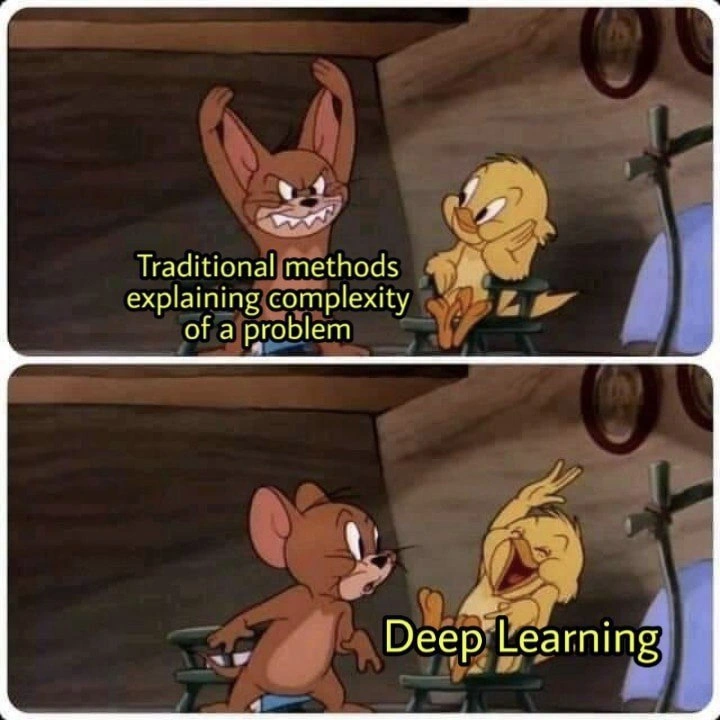
Deep Learning's Laughter at Traditional Complexity
Description
A two-panel meme using scenes from the cartoon 'Tom and Jerry'. In the top panel, Tom the cat looks angry and animated, with his hands up in frustration. A small yellow duckling sits on a stool, looking bored and unimpressed. Yellow text overlay reads: 'Traditional methods explaining complexity of a problem'. The bottom panel shows Jerry the mouse entering the scene with a surprised look, as the duckling is now falling off its stool, laughing hysterically. The yellow text overlay simply says: 'Deep Learning'. The meme humorously contrasts the rigorous, often convoluted, process of explaining and solving problems with traditional, explicit algorithms against the often opaque but powerful nature of deep learning. For senior engineers, the joke lies in the shared experience of wrestling with complex, explainable systems, only to see modern deep learning models achieve superior results as a 'black box,' making the old struggles seem absurd and laughable

Comments
15Comment deleted
Explaining a problem with traditional methods is a 30-page design doc. Explaining it with deep learning is just saying '...and then the matrix multiplication happens,' and hoping nobody asks for details
Turns out O(credit-limit) is the only Big-O that matters - six months shaving a log factor can’t compete with six minutes spinning up a billion-parameter model on the company card
After 15 years of explaining O(n log n) to stakeholders, I've discovered the ultimate complexity class: O(¯\_(ツ)_/¯) - where your model achieves 99.8% accuracy but the only explanation you can give the compliance team is 'the matrices liked each other.'
This perfectly captures the moment when your carefully crafted O(n log n) solution with detailed proof of correctness gets outperformed by someone who just threw the problem at a transformer with 175 billion parameters and called it a day. Sure, you can explain exactly why your algorithm works and its theoretical guarantees, but can you explain why adding more layers and attention heads somehow solved the halting problem? Didn't think so. Welcome to the era where 'just add more GPUs' is a valid architectural decision
Traditional CS: prove it’s NP-hard; Deep Learning: prove it’s H100-complete
We used to argue O(n log n); now it’s O($/hr of A100s) - interpretability=false, budget is the stopping criterion
Deep learning explains complexity like Jerry: emergent magic from backprop hell, zero LIME/SHAP required
Did not get Comment deleted
Please call Poyasnitilnuyu brigadu Comment deleted
you mean the explanation squad? Comment deleted
Yes, you are right :) Comment deleted
this is English-only chat, so please add a translation of your text (even in stickers and other media) to English (English-only should mean that talking other languages is prohibited, but it isn't - just add a translation) Translation: (line 1) Explanation Squad (line 2) won't come Comment deleted
So, an Explanation squad has not came :( Sadness Comment deleted
I might guess that in deep learning world you don't worry about mathematical complexity, you just "add more layers" and it works. Comment deleted
Also you kinda look like a giant from Twin Peaks? Comment deleted