
How to design a CPU in two deceptively simple steps
Description
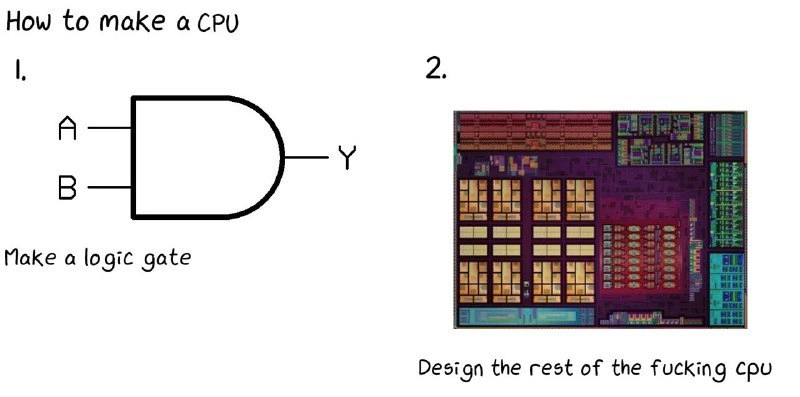
A two-panel meme humorously oversimplifying the process of creating a CPU, formatted like a 'how-to' guide. The title reads, 'How to make a CPU'. The first panel, labeled '1.', shows a simple black-and-white diagram of an AND logic gate with inputs A and B and output Y, captioned 'Make a logic gate'. The second panel, labeled '2.', abruptly escalates in complexity, displaying a detailed, colorful die shot of a modern microprocessor with its intricate internal structures. The caption for this panel is 'Design the rest of the fucking cpu'. This meme is a classic example of the 'how to draw an owl' trope, which satirizes tutorials that gloss over the most difficult parts of a complex process. It's particularly funny to anyone in tech who understands that while a CPU is fundamentally built from logic gates, the leap from a single gate to a complete processor involves immense architectural and engineering complexity

Comments
11Comment deleted
This is the project manager's timeline. Step 1 is a one-point story. Step 2 is 'epic - to be refined'
Hardware 101: draw an AND gate, then keep adding “just one more thing” until timing closure, cache coherence, and the power grid all agree - or until TSMC sends the invoice, whichever comes first
Ah yes, the classic computer architecture course progression: Week 1 - 'Look, AND gates make computers!' Week 10 - 'Now implement a superscalar out-of-order execution pipeline with speculative branch prediction, multi-level cache coherency protocols, and don't forget to handle Meltdown/Spectre mitigations.' The only thing missing is the professor saying it's 'just a matter of combining these simple building blocks.'
This perfectly captures the journey from 'I understand NAND gates are universal' to 'Why does my branch predictor have a 19-stage pipeline and how do I prevent speculative execution side-channels?' - a gap typically filled with 4 years of computer architecture courses, a PhD, and the slow realization that Dennard scaling ended and you're now fighting physics itself
Every “build a CPU” tutorial: Step 1 - draw an AND gate; Step 2 - “just” add an OoO pipeline, branch predictor, coherent caches, TLBs, interrupts, timing closure, formal verification, and a memory model that makes both the C++ and JVM committees cry
NAND's universal, but scaling to billions without DRC violations? Universally fucked
CS101: build an AND gate; tape-out: make the OoO core with TLB, coherence, and a two-level predictor meet timing and power across PVT - simple, right?
Finally an attempt to make a hardware joke. Comment deleted
output should be inverted Comment deleted
nice meme Comment deleted
how to draw an owl in two steps Comment deleted