
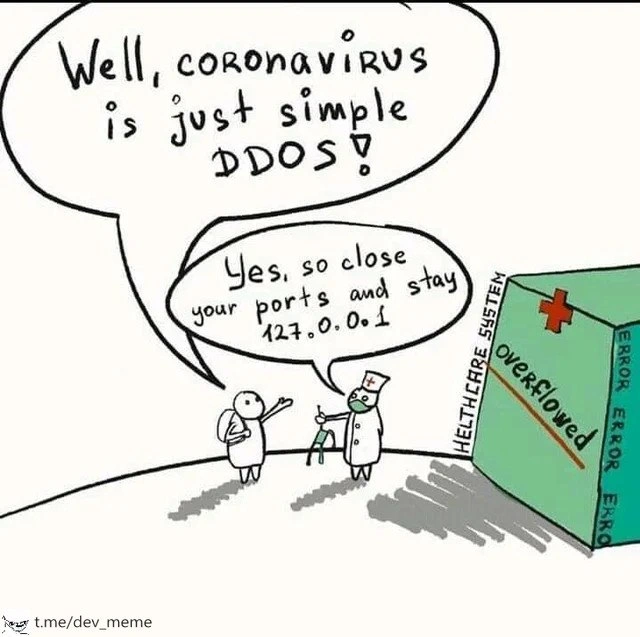
Coronavirus as a DDoS on the Healthcare System
Description
A single-panel, hand-drawn cartoon that uses a tech analogy to explain the COVID-19 pandemic. A simple stick figure character says to a doctor in a mask, 'Well, coronavirus is just simple DDOS!'. The doctor replies, 'Yes, so close your ports and stay 127.0.0.1'. To their right is a large green cube, representing the 'HEALTHCARE SYSTEM', which is visibly cracking under pressure, with the word 'overflowed' written across it and 'ERROR' repeated on its side. A watermark for 't.me/dev_meme' is in the bottom left. The meme explains the pandemic through the lens of a Distributed Denial of Service (DDoS) attack, where the healthcare system is the server being overwhelmed by too many requests (patients). The doctor's advice translates technical jargon into public health guidance: 'close your ports' means to isolate and avoid contact, and 'stay 127.0.0.1' is the IP address for localhost, a clever technical way of saying 'stay at home'





Comments
7Comment deleted
The human body's firewall has a zero-day, and the only effective patch is the 'air-gap' protocol. Unfortunately, management is still debating the cost of implementation
Funny how “stay at 127.0.0.1” is just a hotfix because we shipped healthcare as a single-node, stateful service with zero autoscaling - classic ops move: patch every client instead of fixing the architecture
Finally, a distributed system where "eventual consistency" means we all get sick at different times and the healthcare load balancer crashes anyway
When your incident response plan for a global pandemic reads like a network security playbook: 'Just implement rate limiting on human interactions and force everyone to bind to 127.0.0.1.' Meanwhile, the healthcare system is experiencing the kind of traffic spike that makes your Black Friday load tests look like a health check ping. At least with a real DDoS, you can spin up more instances in the cloud - turns out ICU beds don't autoscale quite as elegantly
Healthcare monoliths under viral DDoS: no autoscaling, just straight buffer overflow on admission endpoints
COVID was the world’s biggest unthrottled DDoS - healthcare had no circuit breakers, so the hotfix was basically “bind to 127.0.0.1 and close your ports.” Funny how infection rates autoscaled faster than budgets
Flatten-the-curve was just global rate limiting with a circuit breaker; bind to 127.0.0.1 and drop inbound or the healthcare cluster returns 503s