
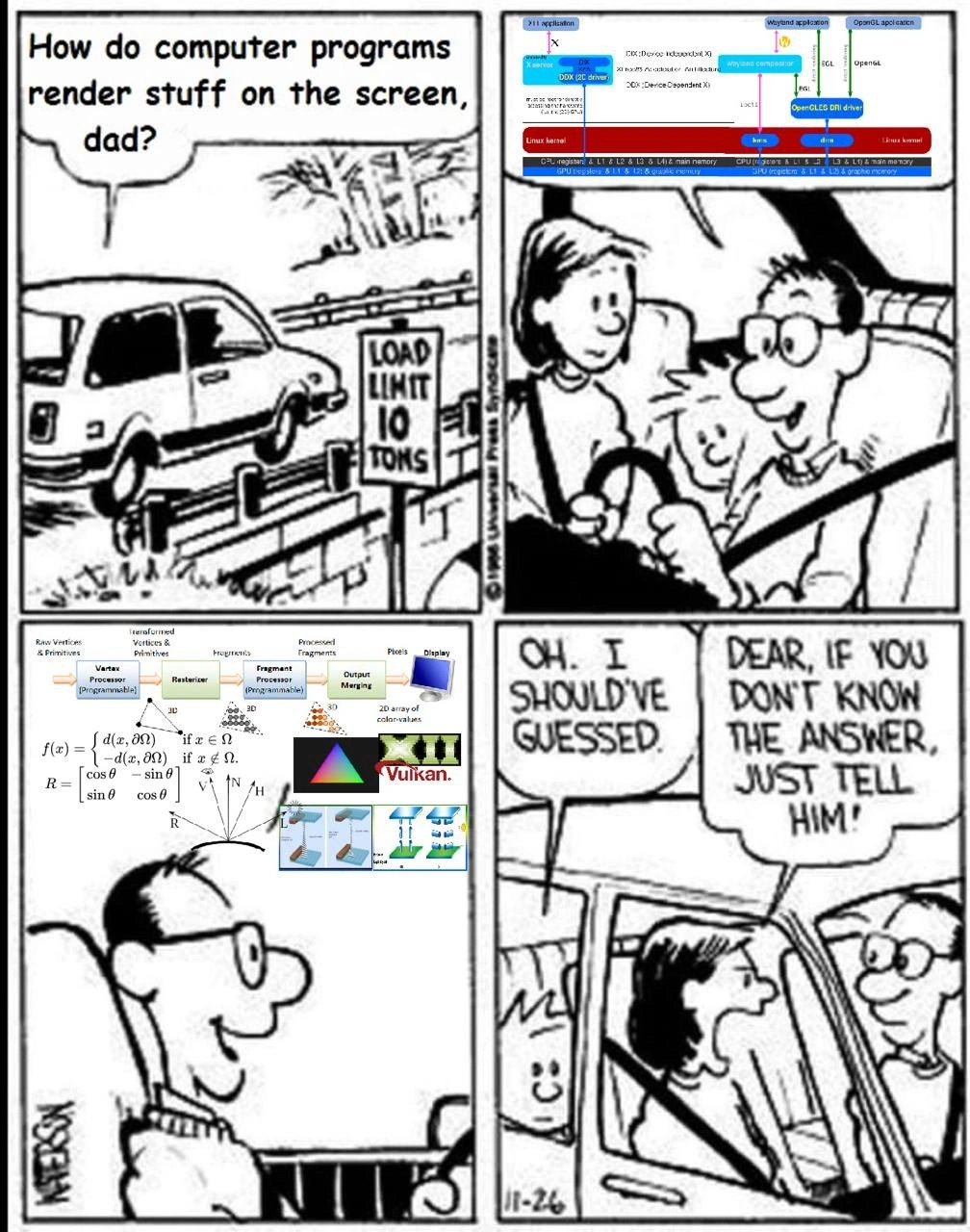
Asking dad about rendering unleashes full Linux GPU stack and math-laden pipeline spiel
Description
Four-panel black-and-white family car comic. Panel 1: child in backseat asks, “How do computer programs render stuff on the screen, dad?”; roadside sign reads “LOAD LIMIT 10 TONS.” Panel 2: instead of an answer, dad’s speech bubble is overlaid with a tiny diagram whose legible labels include “X11 application,” “DDX (Driver Independent X),” “DDX (Device Dependent X),” “OpenGL application,” “GPU userspace driver,” and “Linux kernel.” Panel 3: his next bubble is replaced by a dense graphics-pipeline collage: boxes labeled “Raw Vertices & Primitives,” “Vertex Processor (Programmable),” “Rasterizer,” “Fragment Processor (Programmable),” “Processed Fragments,” “Output Merger,” “Pixels,” and “Display,” plus a trigonometry matrix, an integral formula beginning “f(x)=∫ d(x,ΩΩ)…,” and a conspicuous Vulkan logo. Panel 4: child says, “OH. I SHOULD’VE GUESSED.” Mom replies, “DEAR, IF YOU DON’T KNOW THE ANSWER, JUST TELL HIM!” The humor lies in dad answering with the full Linux graphics driver stack and GPU pipeline rather than a child-friendly summary, highlighting how developer explanations can overshoot their audience
Comments
9Comment deleted
Some parents explain pixels; this one starts with the DRM-KMS handshake and ends in Vulkan queue semantics - apparently mom still calls that “not knowing the answer.”
After 20 years of graphics programming, I still can't explain rendering without accidentally deriving the entire history of computer graphics from Bresenham's line algorithm to real-time ray tracing, complete with a detour through why we still argue about immediate mode vs retained mode APIs
Every senior engineer has been this dad - asked a simple question and immediately diving into the full OSI model equivalent of graphics rendering, complete with kernel-space memory diagrams and shader pipeline stages, only to realize the audience just wanted to know 'pixels go brrr.' The real engineering challenge isn't building the rendering pipeline; it's compressing 40 years of graphics API evolution into something that doesn't require a PhD to understand. Bonus points if you've ever caught yourself mid-explanation thinking 'maybe I should've just said magic' while gesturing at a whiteboard full of transformation matrices
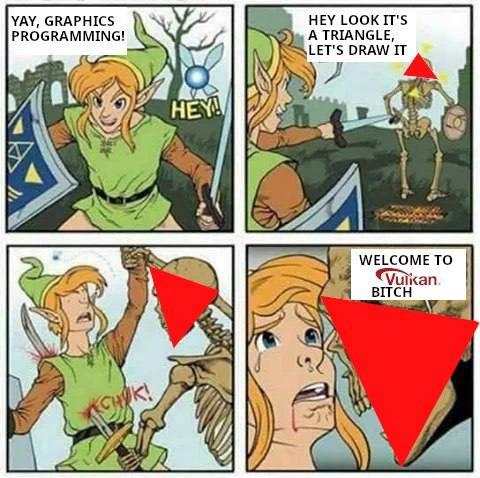
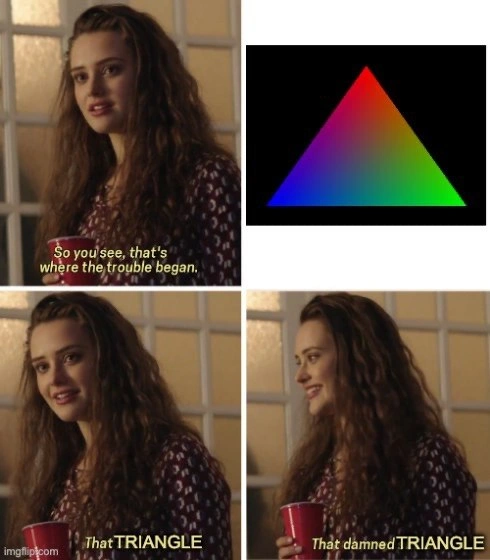
In graphics, “draw a triangle” somehow requires X11/Wayland, DRM/KMS, Mesa, a PSO, command buffers, and a swapchain - so yes, dear, the short answer really is “it depends on the compositor.”
20+ YoE truth: Rendering pipeline? 'CPU yeets vertices at GPU, pixels appear' - probing deeper risks driver-level impostor syndrome
Kid asks about pixels; Dad starts with X11 vs Wayland, detours through DRM/KMS, Mesa, command buffers, and Vulkan swapchains - ELI5 with a kernel-space context switch
What the fuc Comment deleted
Real Comment deleted
Real,sad Comment deleted