
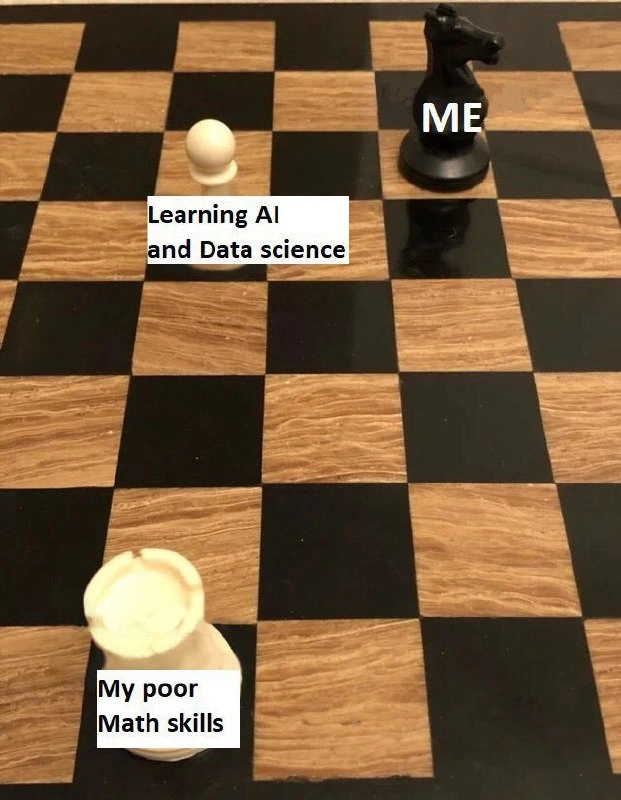
The Mathematical Rook Guarding the AI Pawn
Description
A meme is depicted using a wooden chessboard as a visual metaphor. In the upper right, a black knight chess piece is labeled 'ME'. In the center-left, a white pawn is labeled 'Learning AI and Data science'. In the lower-left corner, a white rook is positioned, bearing the label 'My poor Math skills'. The arrangement humorously illustrates a common struggle for aspiring AI and data science professionals. The knight ('ME') appears to be aiming for the pawn ('Learning AI and Data science'), but the powerful rook ('My poor Math skills') stands as a formidable obstacle, effectively blocking any easy path. The joke lands with senior engineers who understand that advanced fields like AI and machine learning are built on a strong foundation of mathematics (linear algebra, calculus, statistics), and neglecting this foundation can completely stall one's career progression in these domains
Comments
7Comment deleted
You think you're making a brilliant knight move towards that AI job, but you've completely overlooked the fact that your math skills have you in checkmate from across the board
Shipping AI without revisiting linear algebra is like leapfrogging your knight past the pawn and rook - impressive right up until QA asks why the covariance matrix isn’t positive-semidefinite in production
After 20 years of convincing myself that "we'll never actually need calculus in production," I'm now explaining to my team why our neural network thinks every customer is going to churn on exactly day 42
Ah yes, the classic knight fork in career development: you're simultaneously attacking your AI ambitions and being checked by that linear algebra course you skipped in college. The real checkmate is realizing that 'pip install numpy' doesn't actually install mathematical intuition into your brain, and now you're stuck reading research papers where every other sentence is just Greek letters having a party. At least the knight moves in an L-shape - much like your learning path through gradient descent, backpropagation, and the realization that 'just use AutoML' isn't the answer your architect interviewer was looking for
Modern AI lets you knight-jump past linear algebra straight to a Hugging Face checkpoint - then production asks about calibration and drift, and the rook named “probability” slides in with check
AI/Data Science: Where your calc II from two decades ago backprops straight into imposter syndrome
Knight-jumping to ML works until the loss function backpropagates your math debt straight into production