
C Programming and the Perils of Pointing
Description
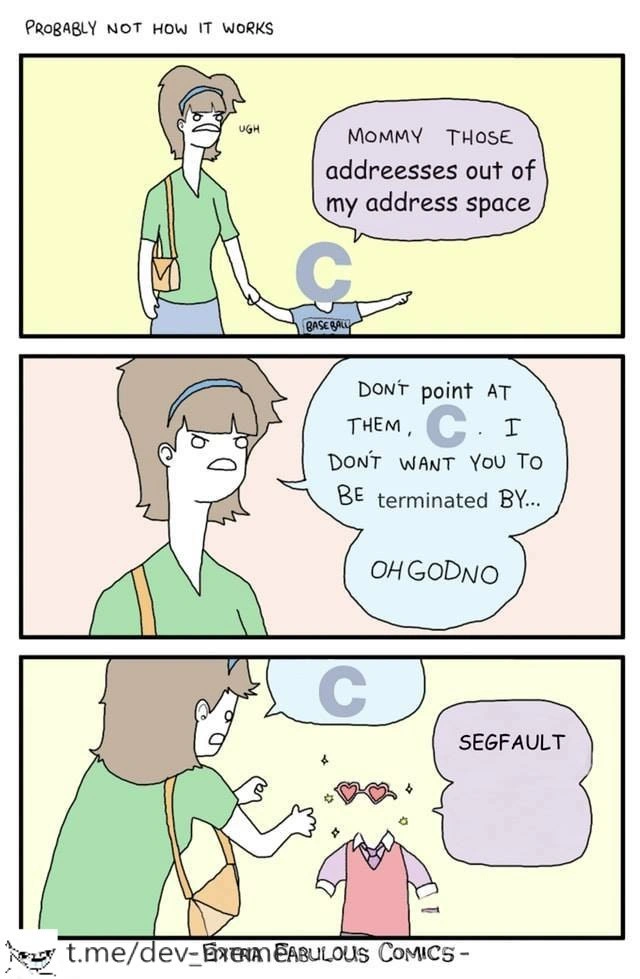
A three-panel comic strip titled 'PROBABLY NOT HOW IT WORKS' personifies the C programming language as a small child. In the first panel, a mother figure looks exasperated ('UGH') as the child, with a 'C' on its shirt, points and says, 'MOMMY THOSE addressees out of my address space'. In the second panel, the mother panics, yelling, 'DON'T point AT THEM, C. I DON'T WANT YOU TO BE terminated BY... OH GOD NO'. In the final panel, the child has vanished, leaving only a pile of clothes and heart-shaped glasses. A speech bubble with 'C' hovers over the clothes, while another from an unseen source declares 'SEGFAULT'. The comic humorously illustrates a segmentation fault, a common and fatal error in C programming. It occurs when a program attempts to access a memory location it's not allowed to (pointing 'out of its address space'), causing the operating system to terminate it immediately. The mother represents the developer, trying in vain to prevent the volatile 'child' (the C program) from self-destructing

Comments
7Comment deleted
In other languages, you get a polite NullPointerException with a stack trace. In C, the operating system just takes your program out behind the woodshed
C parenting tip: keep your little pointers inside the sandbox - once they wander off-heap, the OS slaps them with SIGSEGV and you’re explaining to prod why the kid exited 139
After 20 years in the industry, you realize the real horror isn't teaching kids about pointers - it's explaining to the board why your Rust rewrite will prevent the quarterly segfault that takes down production, only to have them ask if we can just 'add more try-catch blocks' to the C code
The comic brilliantly captures every C programmer's existential dread: that moment when you realize your pointer arithmetic was off by one, and now you're about to meet SIGSEGV - the universe's way of saying 'you should have used Rust.' The anthropomorphization of C as a mischievous child pointing at forbidden memory addresses is painfully accurate; C gives you enough rope to hang yourself, then watches with innocent eyes as the kernel delivers swift justice. At least the segfault is deterministic - unlike those Heisenbugs that only appear in production when the VP of Engineering is watching your deployment
Protecting the family address space since K&R - because free() isn't always enough
Parenting in C: one stray pointer and the OS sends SIGSEGV instead of a timeout - ASan is the baby gate we should’ve installed
Parenting in C: point outside your address space, the MMU page-faults, the kernel sends SIGSEGV, and we still call it a segfault like it’s 1995