
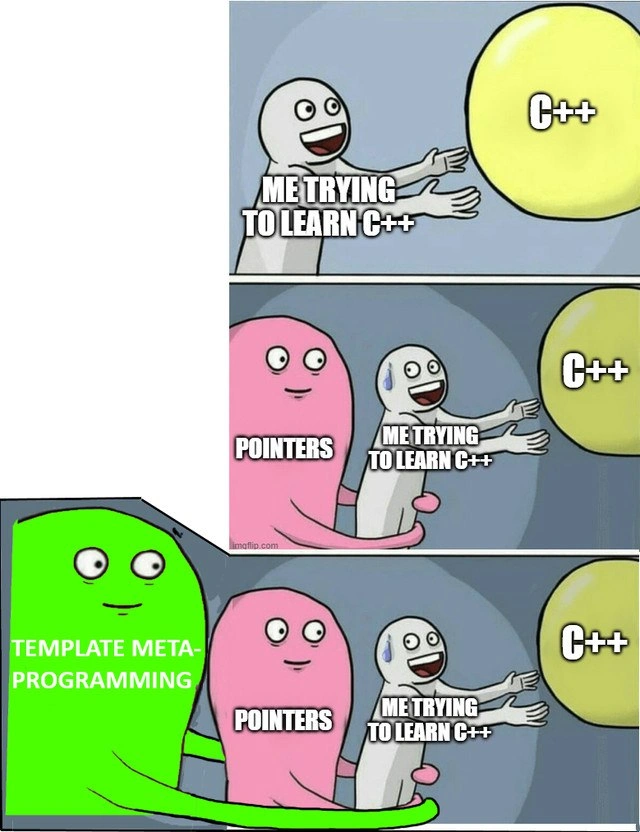
Pointers gatekeep, templates body-slam: the uphill battle of learning C++
Description
Three-panel cartoon meme: Panel 1 shows a happy stick-figure labeled “ME TRYING TO LEARN C++” reaching toward a large yellow sphere labeled “C++”. Panel 2: a pink blobby creature labeled “POINTERS” wraps an arm around the same sweating stick-figure (still captioned “ME TRYING TO LEARN C++”), blocking the path to the yellow “C++” sphere. Panel 3 adds an even larger green creature bursting in from the left, labeled “TEMPLATE META-PROGRAMMING”, which engulfs both the pink “POINTERS” blob and the struggling learner, while the distant “C++” sphere remains out of reach; the smaller captions “POINTERS” and “ME TRYING TO LEARN C++” are repeated. Visually, the escalating monsters humorously depict how basic pointer semantics already intimidate newcomers, but C++ template metaprogramming arrives as an even bigger, mind-bending obstacle. The joke resonates with developers who know that C++’s low-level pointer management and its Turing-complete compile-time templates often derail otherwise straightforward language learning journeys

Comments
11Comment deleted
Pointers teach you segfaults; template metaprogramming teaches you humility with a 4-page SFINAE stack trace that, somehow, still ends in iostream
The real horror isn't template metaprogramming - it's explaining to your team why the compiler takes 45 minutes to build after you discovered SFINAE and decided to implement a compile-time JSON parser using recursive variadic templates
Pointers are just the tutorial boss; template metaprogramming is when C++ reveals it's been Turing-complete at compile time the whole game
C++ learning progression: First you chase the language itself, then pointers chase you through your dreams with segfaults, and finally template metaprogramming shows up - a Turing-complete compile-time beast that makes you question whether you're writing code or performing dark rituals. By the time you understand SFINAE, you've aged out of 'junior developer' purely through existential suffering, not experience
C++ onboarding plan: master pointers, then smart pointers, then accidentally build a compile-time interpreter with SFINAE just to pick an overload
Pointers teach you to fear the stack; templates make you question why anyone compiles on purpose
Learning C++: you escape raw pointers with unique_ptr, then template metaprogramming uses SFINAE to remove you from overload resolution
Pointers and templates may be PITA, but they are still much better than marshaling and generics. Comment deleted
bigger one : type conflicts Comment deleted
not really Comment deleted
Pointers are not really that bad. You just need some mental adjustments. Memory management is worse. Comment deleted