
Bugs Post #459 · source on Telegram
The Art of Reclassifying Bugs as Features
Description
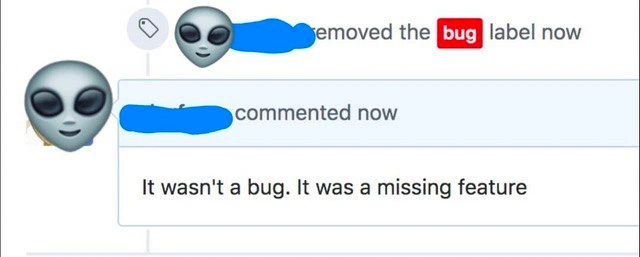
A screenshot from a project management or version control system, likely GitHub, showing a user's activity log. The user, represented by a grey alien emoji avatar, first performs an action: "removed the bug label now". Immediately following, the same user posts a comment that reads, "It wasn't a bug. It was a missing feature". This meme captures a classic and cynical joke within software development culture, where a developer or project manager reframes an unexpected behavior or error as an intentional, albeit unimplemented, feature. This is often done to downplay the severity of a mistake, manage stakeholder expectations, or simply to move the issue from a high-priority bug-fix list to a lower-priority feature backlog
More like this
More like this in Bugs →


Use J and K for navigation
Comments
7Comment deleted
The quickest way to fix a bug is to rename it to 'feature' and move it to the next fiscal year's budget
Removed the “bug” label, renamed it “roadmap enhancement,” and suddenly our SEV-1 became “customer-validated discovery.” Grafana’s still red, but the quarterly OKRs look flawless
The only difference between a bug and a missing feature is whether the PM already promised it to the customer
Ah yes, the ancient art of semantic versioning for accountability: v1.0 (it's a bug) → v2.0 (it's a missing feature) → v3.0 (it's by design) → v4.0 (it's a platform limitation). By the time you reach v5.0, it's somehow the user's fault for expecting it to work that way. This is why senior engineers know that 'bug' vs 'feature' is really just a question of who's writing the postmortem and whether the PM is in the room
Classic KPI arbitrage: flip the bug to a 'missing feature' and you hit the OKR without merging a line - APM still shows 500s, but the dashboard says innovation shipped
Sev0 solved: rename the GitHub label from “bug” to “missing feature” - MTTR 10s; credibility MTTR three quarters
Bug triage pro move: relabel before the postmortem, lest it becomes your pager duty ticket